
How Ideas2IT Built the Private LLM Infrastructure and Agentic AI Architecture That Lets Memorial Healthcare System Own Its Clinical AI
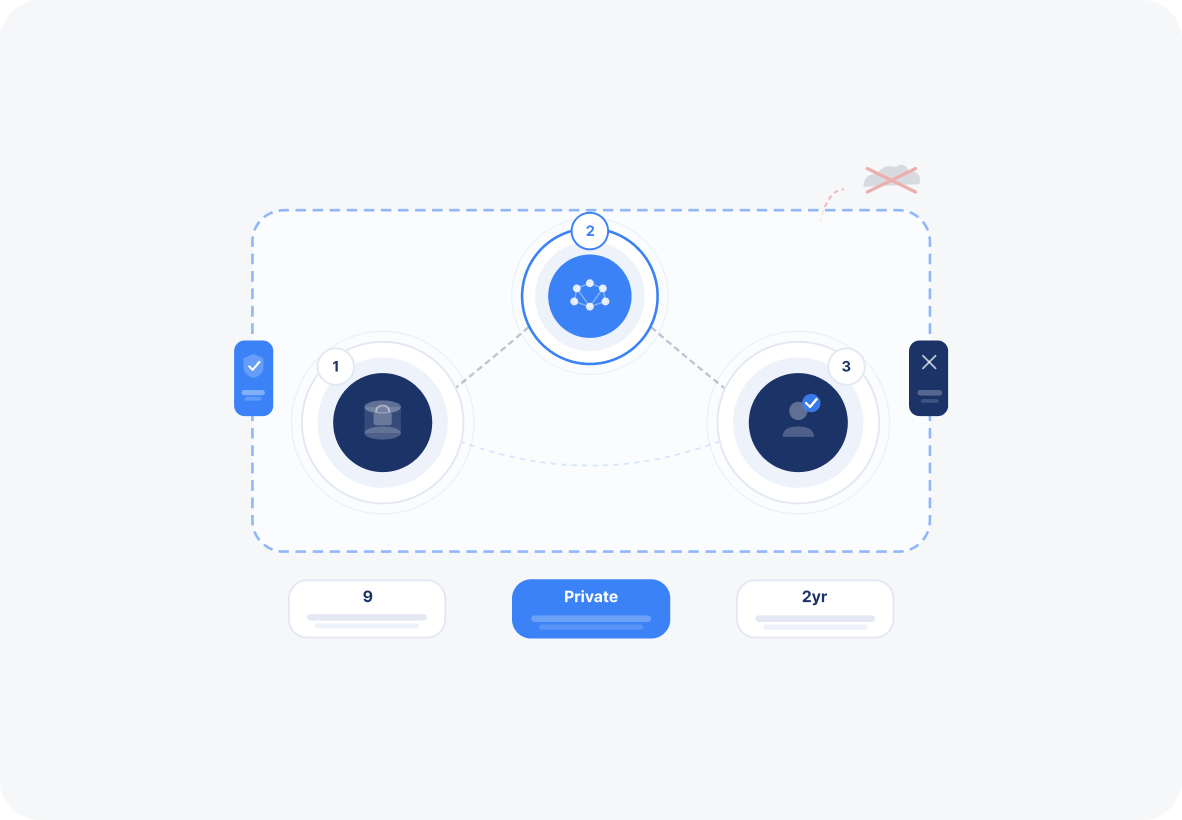
A major South Florida public healthcare system needed clinical AI it could actually control. Sending patient data to public LLM APIs was not a compliant option. Ideas2IT built the private LLM infrastructure and agentic AI system architecture that made enterprise GenAI possible at MHS.

Client
Memorial Healthcare System

Industry
Healthcare

Service
Agentic AI

Engagement
Ongoing 2 years

Geography
South Florida, US
01 Challenge
MHS ran clinical workflows across disconnected systems with no unified AI layer. Staff were using consumer AI tools informally. Public LLM APIs were a HIPAA dead end, which meant there was no path to production clinical agents without first building a compliant private infrastructure.
02 Solution
Ideas2IT ran two parallel tracks: use case discovery across clinical and operational teams, and an architecture engagement to build MHS's private LLM and Agent infrastructure. The platform hosts, trains, and fine-tunes proprietary models on MHS data, with governed agentic workflows that operate entirely within the organisation's compliance boundary.
03 Outcome
MHS gained ownership of its AI infrastructure, the ability to fine-tune proprietary models on institutional data, and a governed agentic platform for deploying HIPAA-compliant clinical AI agents.
Phase 01
Mapping clinical AI opportunity before committing to architecture
Use case discovery and prioritisation: identifying the right first agent before any infrastructure was built
The first decision was to run use case discovery before touching infrastructure. Clinical AI projects fail at pilot when the use case is chosen for convenience rather than impact and compliance feasibility.
- Ideas2IT ran stakeholder workshops across clinical operations, IT, billing, and patient services to map nine use case candidates across the full patient journey.
- Each was evaluated against HIPAA data requirements, integration complexity, available data quality, and business impact.
- A single low-to-medium complexity use case was selected for the PoC, with success criteria defined before a line of code was written. That sequence, requirements before architecture, shaped every downstream decision.
Deliverables
- Use Case Discovery Report covering business needs, pain points, and data dependencies
- Use Case Prioritisation matrix across 9 clinical and operational candidates
- Finalised PoC use case with documented rationale and HIPAA feasibility assessment
- Defined PoC Success Criteria including PHI/PII data requirements Stakeholder workshop outputs across clinical, billing, IT, and patient services teams
Phase 02
Designing the architecture that makes clinical AI agents possible
Enterprise LLM and Agent Blueprint: private infrastructure that HIPAA compliance required
The architecture constraint was absolute: no patient data could leave the organisation's environment. That ruled out public LLM API integration and required a fully private, self-hosted LLM and Agent system.
Ideas2IT assessed MHS's existing cloud, AI, and data infrastructure, then defined the full component architecture: LLM and SLM layers, agent orchestration, vector storage, retrieval pipelines, and a governance layer that made outputs auditable and overridable.
On-premises, secure cloud-native, and hybrid deployment configurations were evaluated against MHS's compliance posture. The output was a complete enterprise blueprint with technology recommendations, implementation roadmap, and a staffing plan ready for execution.
Deliverables:
- Enterprise Gen AI and Agent-Based LLM Infrastructure Blueprint (cloud-native)
- LLM and SLM component architecture with agent orchestration layer
- Vector storage and retrieval pipeline architecture Governance and auditability framework for agentic AI outputs
- Technology and Tooling Recommendations by component
- Deployment strategy evaluation: on-premises, secure cloud, and hybrid Enterprise LLM/Agent Blueprint Implementation Plan Staffing and Resourcing Plan
Phase 03
Proving the architecture works on a real clinical workflow
AI Agent PoC: building and deploying the first governed clinical agent on MHS's own infrastructure
With the blueprint confirmed and infrastructure in place, Ideas2IT built and deployed the selected AI Agent use case entirely on MHS's private LLM platform.
Human-in-the-loop governance was embedded from the start: agent outputs in clinical workflows trigger a review checkpoint before any action is taken, keeping every output auditable and overridable.
The agent ran against MHS's institutional data, producing context-specific responses that no external API could replicate without exposing PHI.
Outputs were validated against the defined success criteria. The engagement closed with documented scaling recommendations for expanding the agent architecture across additional clinical and operational use cases.
Deliverables:
- Deployed AI Agent PoC on MHS private LLM/SLM platform
- Human-in-the-loop governance layer with auditable output checkpoints
- Agent validation report against defined PoC success criteria
- PHI-safe retrieval pipeline connecting agent to MHS institutional data
- Scaling recommendations for additional clinical and operational use cases
The Outcome
Private infrastructure, governed agents, and clinical AI that MHS owns and controls.
The results came from an architectural discipline that most GenAI engagements in healthcare skip: building the compliant private infrastructure before attempting any agent deployment. No PHI leaves the organisation's environment. Every agent output is auditable. Every model runs on MHS's own data. That combination, private LLM ownership, governed orchestration, and HIPAA-embedded pipelines, is what separates a production clinical AI platform from a well-performing demo.