
Building the NLP Data Access Platform That Lets a Fortune 500 Pharmaceutical Company's Business Teams Query Their Own Data
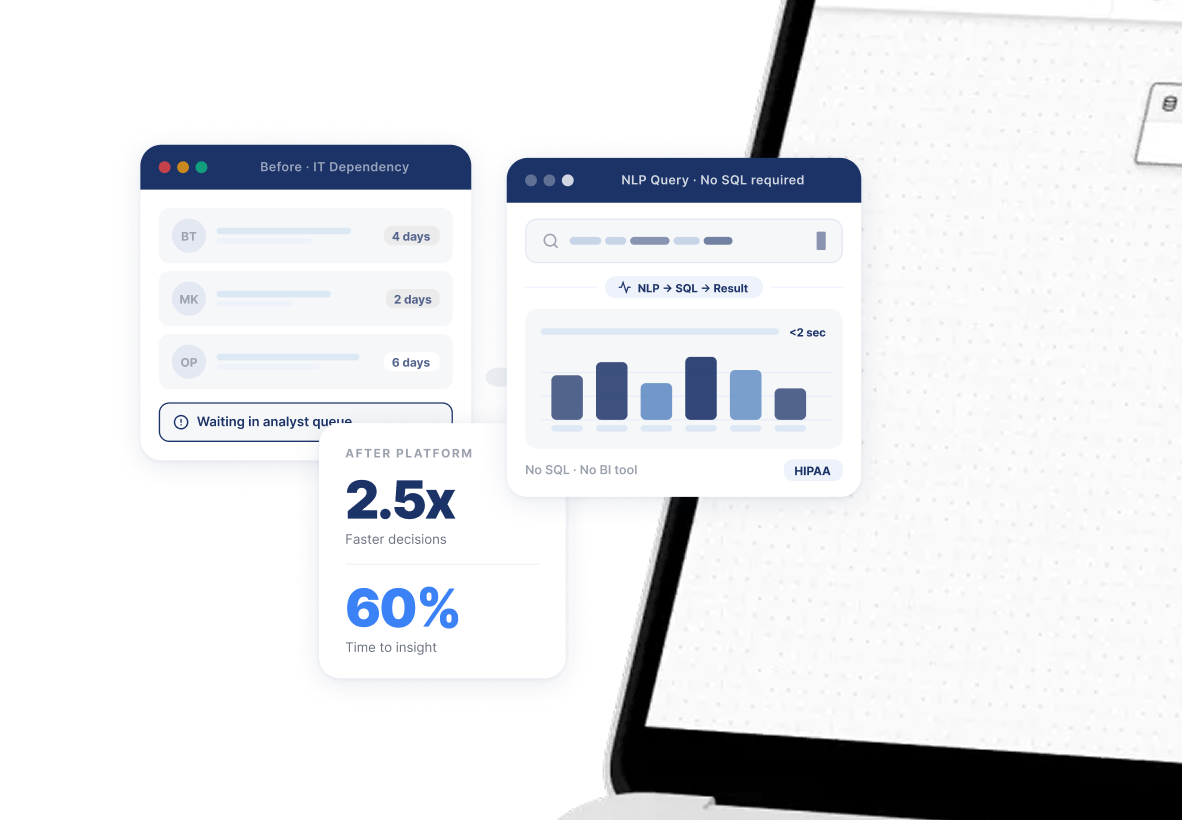
Business users at a Fortune 500 pharmaceutical company were routing every data question through IT. Ideas2IT built the NLP layer that let them query their own data estate in plain English, with results in seconds.

Client
Fortune 500 Pharmaceutical Company

Industry
Pharma & Life Sciences

Service
Artificial Intelligence
Data Engineering

Outcome
2.5x faster decisions · 60% faster time to insight

Geography
USA
01 Challenge
Business teams had the data but not the access. Every query required an analyst, every report took days, and BI dashboards were too rigid for the questions frontline users actually needed to answer. The cost was compounding: slow data meant slow decisions, and slow decisions meant missed market windows.
02 Solution
Ideas2IT built a zero-code query platform on top of the existing database estate. Custom NLP models translated plain English into parameterised SQL, a dynamic table generator rendered results instantly, and an auto-visualisation engine produced charts on demand, with no BI tool or technical skill required.
03 Outcome
Time to insight dropped 60%. Decision-making speed increased 2.5x across business units. Business teams can now move from question to answer without touching IT or opening a BI tool.
Phase 01
From locked enterprise data to a queryable, governed layer
Data Access Architecture: building the foundation that made self-service possible
The first decision was what the NLP layer had to sit on. Without a unified, governed connection to the existing database estate, query results would be unreliable and access controls impossible to enforce.
Ideas2IT built the integration layer first: connecting to the client's PostgreSQL and Redshift databases via a containerised, API-first architecture deployed on AWS ECS, with role-based access controls and audit logging configured before any NLP model was introduced.
The data governance layer determined which users could query which datasets, and that boundary was enforced at the API level, not by the interface.
THIS PHASE PRODUCED
- Containerised API-first data access layer
- Database integration connectors (PostgreSQL, Redshift)
- Role-based access control framework
- Data governance and query routing layer
- Audit logging
Phase 02
Making clinical and operational data queryable without SQL
NLP-to-SQL Engine: translating plain English queries into governed database results
With the data layer in place, Ideas2IT built the translation engine on top of it. Custom NLP models trained with spaCy were fine-tuned on the client's domain vocabulary: drug nomenclature, clinical identifiers, and study metadata that generic models would mishandle.
Queries were parsed into intent and entity components, validated against the schema, and converted to parameterised SQL before execution. A query clarification layer intercepted ambiguous phrasing before it reached the database, prompting the user for specificity rather than returning a result that looked correct but wasn't.
Results were returned via a FastAPI REST interface with response times under two seconds.
THIS PHASE PRODUCED
- Custom NLP-to-SQL translation engine
- Domain vocabulary fine-tuning
- Ambiguous query clarification layer
- Parameterised SQL generation and validation
- FastAPI REST query interface
Phase 03
Turning structured query results into charts without a BI tool
Auto-Visualisation and Self-Service Interface: from query result to decision-ready output
The final layer was output. Tables returned from SQL queries were useful, but charts generated instantly from those results, without a BI tool, changed how business users related to the data.
Ideas2IT built the dynamic table generator and a D3.js-powered auto-visualisation engine as the user-facing layer, with bar, line, and pie chart rendering triggered from query context with no manual configuration.
The React interface required no training to operate. Users typed a question, received a structured table, and switched to a visualisation in one click.
THIS PHASE PRODUCED
- Dynamic table generator
- D3.js auto-visualisation engine (bar, line, pie)
- Zero-code React self-service interface
- Export and sharing layer
The Outcome
From IT queues to instant answers: what the platform changed
The 60% reduction in time to insight and the 2.5x improvement in decision-making speed were direct consequences of one architectural decision: access control enforced at the data layer, NLP trained on domain vocabulary, and output rendered without a BI intermediary. Business teams stopped waiting in analyst queues because the platform removed the technical barrier that had put them there. That is what a well-scoped NLP data access layer produces when the integration layer, the translation engine, and the output layer are built in the right sequence.