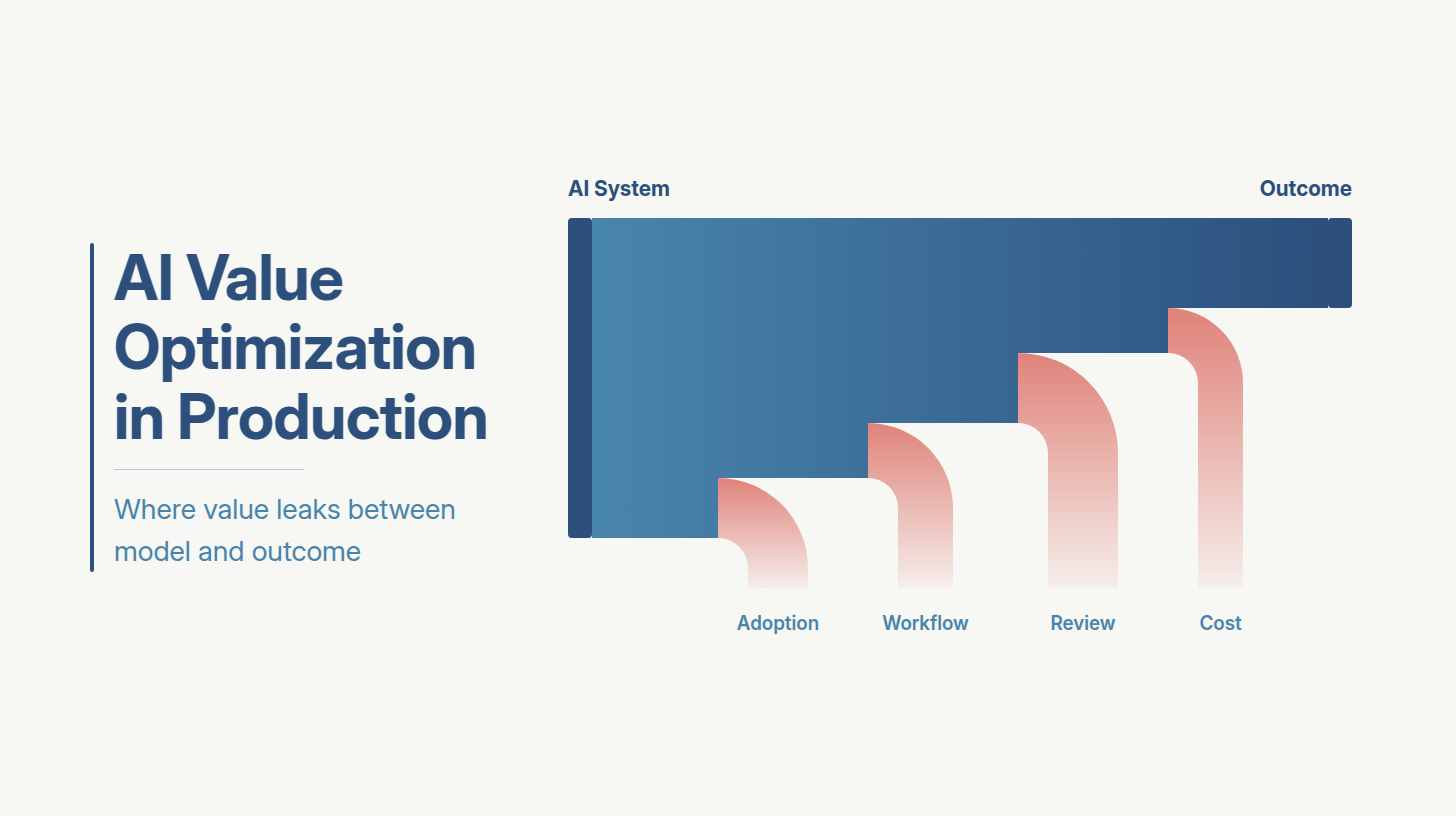

- Most acquisitions carry undisclosed technical debt that does not appear in the CIM, management deck, or financial audit
- Legacy code, fragile data pipelines, and engineering practices held together by tribal knowledge are invisible to standard diligence frameworks
- Standard diligence is built to evaluate commercial and financial viability, not engineering execution capacity that gap means the technology carrying your value creation plan goes unexamined before capital is committed
- A single undisclosed technical issue can cost anywhere from $2 million in cybersecurity remediation to $30 million in ERP rebuild costs, based on documented post-close cases
- Engineering-led diligence translates technical findings into deal implications: repricing estimates, integration timelines, AI feasibility, and modernization effort in months and dollar ranges
- The last reversible moment is before the IC memo after that, the remediation budget comes out of the hold period
Who this is for:PE deal teams and operating partners underwriting scale, integrations, margin expansion, and AI-led upside in software-heavy assets.
What this helps you decide:
Whether you can trust the platform as-is, what must be priced in, and when you need technical truth before signing.
What to do next:
Run a short, engineering-led technology evaluation before your IC memo becomes a promise you cannot execute.
No founder tells a PE firm how much of their product is held together by five engineers, three cron jobs, and a decade of shortcuts.
Technical debt is the one part of an acquisition that’s never disclosed, never highlighted, and rarely understood. It doesn’t show up in the CIM. It isn’t reflected in EBITDA. And yet it quietly dictates how fast or how painfully slow value creation will be once the deal closes.
If you’ve ever been blindsided after an acquisition, this is the debt you inherited.
Most diligence processes are not designed to interrogate: the condition of the technology that has to carry your plan for the next 3 to 5 years.
Technical debt is execution risk with a compounding interest rate. It shows up as:
- initiatives that slip from weeks to quarters
- integrations that become custom builds
- AI programs that die in the data layer
- compliance surprises that freeze delivery
- EBITDA expansion that gets eaten by remediation work
If you do not underwrite technical truth pre-close, you are underwriting assumptions.
Reality Check:
- In a 2025 survey of M&A failures, 83% of practitioners involved in failed deals cited poor integration as a primary cause and not market downturns or misvaluation.
- Many deals gloss over or underestimate technical debt like legacy systems, brittle architecture, undocumented code, decentralised data stores because these don’t show up in financial audits or management decks.
What Standard PE Diligence Consistently Misses Before Close
Standard diligence is built to evaluate commercial and financial viability, not engineering execution capacity. That gap is not an oversight. It is a design constraint. Financial audits confirm that revenue exists. Technology evaluations confirm whether the platform that generates it can actually carry the plan you are underwriting.
Most PE deal frameworks prioritize financials, customer base, legal and IP compliance, and commercial fit. These are essential. But they do not surface what sits beneath the product layer.
Here is where the blind spots compound. The exposure layer is the gap between what the story says and what the system can actually sustain:
- Legacy cores disguised by a modern UI
- Codebases only one or two people truly understand
- Integrations held together by scripts and manual fixes
- Data pipelines that fail silently and cannot be reconciled
- Security and compliance debt that has never been quantified
- Engineering maturity gaps that cap throughput no matter how many people you hire
This is why post-close value creation collapses in a repeatable pattern. Integration is where M&A outcomes are won or lost, but most deal motion still treats technical integration and platform integrity as a later problem.
Technical debt is the only part of the business the seller is never incentivized to quantify. It stays invisible until the first push on growth, integration, AI, or compliance.
For buy-and-build strategies, the exposure compounds differently. In a platform-plus-add-on structure, technical debt discovered in one acquisition does not stay isolated. It becomes an integration barrier for every subsequent add-on. If the first acquisition has an ERP that cannot absorb integrations and the deal closes without surfacing that, acquisitions two and three will hit the same wall. A $2 million remediation in acquisition one becomes a $6 million assumption across three deals. What looked like a single diligence gap becomes a structural constraint across the entire portfolio strategy.
7 Hidden Problems That Blow Up Your Deal After Close
When you peel back the layers of a “successful-looking” target, here’s what you commonly find and why each is dangerous for a PE buyer:
One documented case: a PE client discovered post-close that the target's custom ERP could not support integration. The remediation cost was $30 million. Standard diligence missed it entirely. The table above is not a list of theoretical categories. These are documented financial consequences with timelines and dollar amounts that should appear in your IC memo before you commit capital.
If you treat technology as a checkbox rather than a core axis in your diligence, you’re risking post-close value. Overlooking tech debt, data pipelines, architecture maturity, and real integration cost is often the root cause of why many well-valued deals fail to deliver.
How Undisclosed Technical Debt Destroys Pre-Close Assumptions
Now let's visualize this: A private equity firm avoided a $950M mistake by not doing the deal. The asset looked strong, but a technical evaluation showed the platform would cap growth, delay integrations, and stall AI plans once real pressure hit. Rather than inherit that debt and fix it on their own dime, the firm chose to build internally and move faster.
The Situation
The firm was executing a buy-and-build strategy. Two acquisitions were already complete. A third target was lined up to close a capability gap.
On paper, the deal made sense. The product demoed well. The team was credible. The numbers worked.
Before signing, the firm asked one question most deals skip: Are we buying leverage or buying complexity?
What the Evaluation Revealed
A detailed, engineering-led review surfaced what the decks didn’t show:
- A tightly coupled core that would be hard to extend
- Data foundations that would stall analytics and AI plans
- Integration paths that were slower and riskier than assumed
- Modernization work that was unavoidable post-close
Buying the company would slow down the platform roadmap instead of speeding it up.
The Decision
The firm walked away from the acquisition. They chose to build the platform internally, with full control over architecture, data, and sequencing. What would have taken years to untangle after close was avoided entirely.
The More Common Pattern
For every deal where a firm had the clarity to walk away, there are dozens where the same information arrived 18 months post-close as a remediation budget that was never modeled.
Roadmap items estimated at four weeks take four months. Integrations described as straightforward require custom builds. AI programs stall in the data layer. Compliance requirements freeze delivery. According to a 2023 survey of M&A professionals, over 60 percent reported that technology issues missed during diligence materially impacted deal outcomes after close.
Why This Matters
This is what good technical diligence is supposed to enable. A right technology due diligence should not validate or make you comfortable but help you with better decisions.
Most firms only see these constraints after the deal is done. At that point, the choice is gone. The firms that consistently protect value see the system clearly enough to decide before they commit.
Why This Outcome Was Impossible Before
Before this reset, the same asset told a very different story.
Execution friction kept appearing in places that were never flagged as risks:
- “Small” roadmap items caused regressions
- Integrations failed under real volume
- Analytics stalled because pipelines had no lineage or consistent definitions
- Engineering estimates kept slipping because the system itself resisted change
None of these were visible during other diligence checks. None of them were maliciously hidden. They simply lived below the surface.
The PE firm bought a business whose technical limits were never underwritten.
What PE Firms That Protect Deal Value Do Differently
Across PE portfolios, the firms that consistently preserve value do not just execute well. They underwrite technical truth early enough to change the decision itself.
The firms that struggle are not the ones without ambition. They are the ones who try to execute before they understand what the system can actually carry.
Underwriting technical truth early sometimes leads to repricing a deal, re-sequencing integration, delaying AI initiatives, or, as in this case, walking away entirely. That is not risk aversion. That is disciplined capital allocation.
The deals that succeed, where PE firms actually unlock value, are those that treat technology diligence, remediation planning, and integration readiness as integral to the investment thesis.
What Engineering-Led Diligence Answers Before Capital Is Committed
Good technical diligence is not meant to make a deal feel safe. It is meant to make execution predictable.
Most diligence processes confirm that a product exists, customers are paying, and systems are “working.” None of that tells you whether the platform can carry the value-creation plan you are underwriting.
A PE-grade technical review should answer a small set of uncomfortable questions before capital is committed:
- What breaks first when scale, integrations, or new features are applied?
- What remediation work is unavoidable before growth can resume safely?
- Which initiatives can proceed now and which will fail unless sequenced later?
- What is the real cost, in time and effort, to modernize or integrate the platform?
- How much execution risk is embedded in the current architecture and data foundations?
If these answers are unclear, valuation is an estimate.
Timelines are optimistic and post-close surprises are not accidents instead they are design outcomes.
This is the gap where most deals leak value. Not because diligence was absent, but because it was never designed to surface execution constraints.
What Technical Diligence Reveals About AI Upside Before You Buy
AI-led value creation now appears in the investment thesis of nearly every software-heavy PE acquisition. Bain's diligence practice has a dedicated framework for evaluating AI risk and opportunity in acquisition targets built around five questions on business model disruption, pricing, competitive moat, product upside, and cost savings." Hyperlink "Bain's diligence practice. CohnReznick treats AI and ML capabilities as a standalone diligence pillar as a standalone, fourth pillar of its software due diligence framework. Yet AI feasibility is the dimension most frequently left unexamined before close.
AI feasibility is not visible in a product demo. It is determined by what sits beneath the product layer: data infrastructure quality, pipeline stability, metric consistency, and observability. A platform with a compelling AI roadmap but fragmented data stores and no governance cannot execute any of it, regardless of model quality or team ambition.
Before committing capital to a thesis that includes AI upside, a pre-close evaluation should answer four specific questions:
1. Can the current data pipelines support the AI use cases in the value creation plan without significant remediation first?
If the data team's answer involves manual cleaning or "we are working on it," the AI upside in your thesis is not yet executable. The timeline and cost to get there should appear in your IC memo as a line item, not a footnote.
2. Is there a single authoritative source for the metrics the AI initiative depends on?
If revenue or margin is defined differently across business units or acquired entities, any AI model built on those metrics will produce outputs no one trusts. Metric fragmentation is one of the most common reasons AI programs stall after the first proof of concept.
3. Does the platform have observability and data lineage infrastructure sufficient to trust AI outputs at scale?
Without lineage, you cannot trace why the model produced a specific output. Without trust in outputs, business users stop using the tool within months. Observability is not optional infrastructure. It is what separates a functioning AI system from an expensive experiment.
4. What is the realistic timeline and cost to reach AI readiness given current data architecture?
This converts the AI upside from a narrative in the investment memo into a line item with a timeline. It is also the question that tells you whether the AI story in the management deck reflects actual infrastructure capacity or anticipated infrastructure that has not been built.
For a detailed view of why AI initiatives stall in PE portfolio companies after acquisition, the patterns repeat more predictably than most deal teams expect.
See how Ideas2IT evaluates AI feasibility for PE acquisitions →
How Ideas2IT Evaluates Technical Truth for PE Deal Teams
Most diligence stops at surface artifacts: diagrams, SOC reports, product docs, roadmap decks. But technology due diligence is approached differently at Ideas2IT.
We underwrite what actually determines whether the value-creation plan is executable:
- We read the system: architecture, code patterns, pipelines, infra topology, release signals
- Architecture reality: coupling, modularity, scalability ceilings, deployment patterns
- Code reality: test coverage, defect risk, maintainability, release safety
- Data reality: lineage, pipeline stability, schema discipline, observability, governance
- Integration reality: API quality, dependency mapping, failure modes, operational load
- Security reality: controls that survive enterprise scrutiny, not just checkbox compliance
- Team reality: bus factor, process maturity, ownership, ability to absorb change
- Architecture reality: coupling, modularity, scalability ceilings, deployment patterns
- We quantify constraints: what breaks first under scale, what blocks integrations, what makes delivery slow
- We translate findings into deal implications: timeline risk, hidden Opex, modernization effort, AI feasibility
- We make it board-usable: clear risk categories, severity, and remediation estimates in months and effort bands
Our PE Technology Evaluation is built to answer one question that determines everything else:
Can this system execute the value-creation plan you’re underwriting without collapsing under scale, integration, or change?
Here’s what our client wanted to share about our engagement with us.
“We needed to know what would break first, what it would cost, and whether the platform could actually carry the plan. The output of the technology due diligence changed how we priced integration and sequenced Year-1 priorities.”
Conclusion
Every PE firm believes they will fix technology issues after close. Most discover too late that execution risk compounds faster than value.
Technology diligence is not about being conservative. It is about preserving the ability to decide while the decision is still reversible.
If technical truth is missing, the deal may still close. But the value-creation plan is already compromised.
The last reversible moment in a deal is just before you underwrite. After that, you're firefighting surprises.
Request for a PE Technology Due Diligence Evaluation and see what execution risk actually looks like before it shows up in your portfolio.
References
- "New Diligence Challenge: Uncovering AI Risks and Opportunities." Bain & Company. https://www.bain.com/insights/new-diligence-challenge-uncovering-ai-risks-and-opportunities/
- "The Strategic Imperative of Software Due Diligence in Technology Investments." CohnReznick. https://www.cohnreznick.com/insights/the-strategic-imperative-of-software-due-diligence-in-tech-investments
- "M&A Success Rate Rises to 70%, But Firms Must Navigate 7 Potential Missteps." https://www.forbes.com/sites/vibhasratanjee/2025/04/01/ma-success-rate-rises-to-70-but-firms-must-navigate-7-essential-missteps/
- Simon-Kucher. "Transaction Services & Private Equity Consulting." Simon-Kucher. https://www.simon-kucher.com/en/consulting/transaction-services-private-equity