
A Custom Agentic EVBV Platform for Automating Eligibility and Benefits Verification for a Behavioral Health Operator
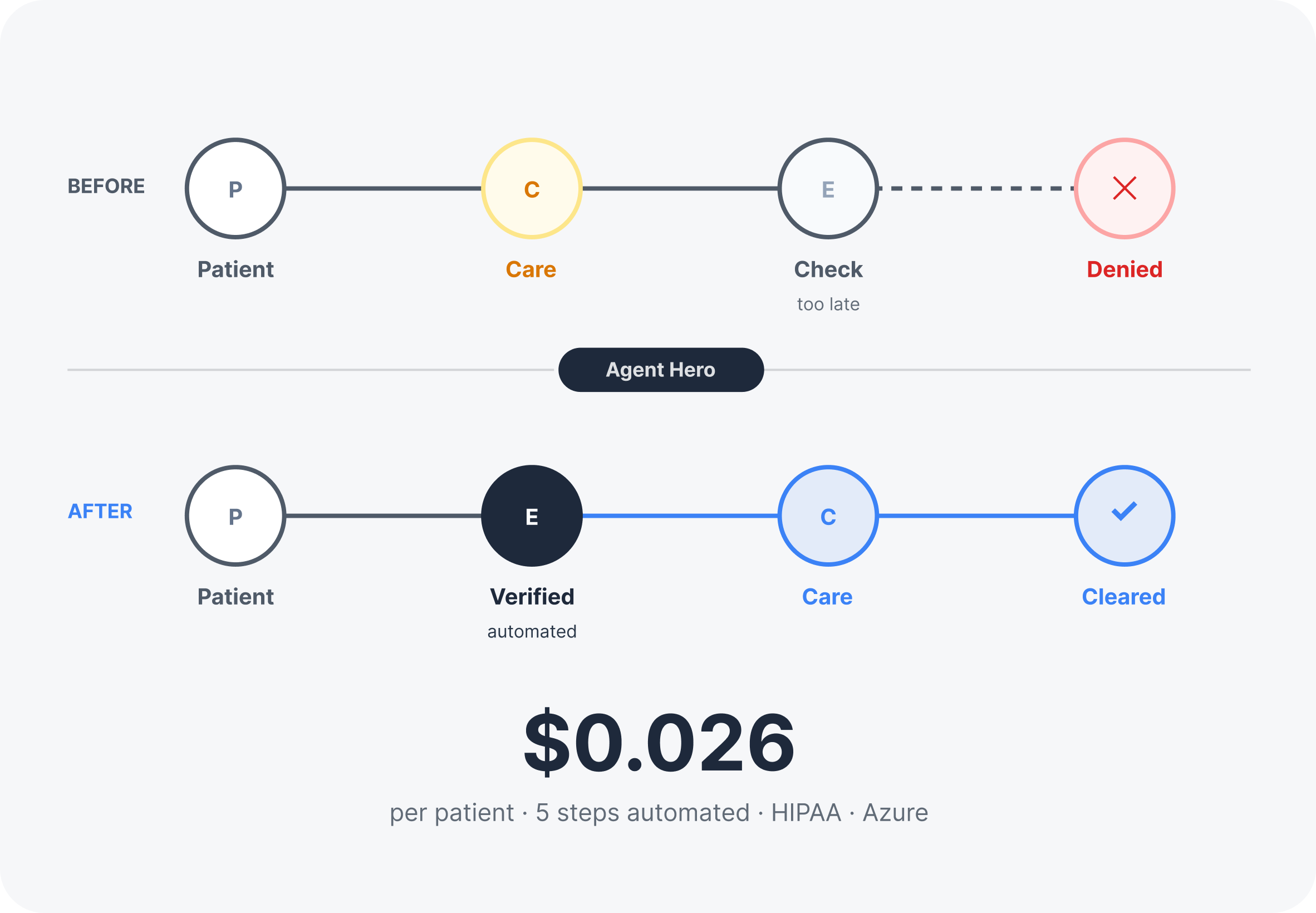
A behavioral health portfolio company was running eligibility and benefits verification manually across Kipu EHR, commercial payers, and Arizona Medicaid, with coverage gaps and prior-auth flags arrived after care delivery surfacing after care delivery. Ideas2IT automated the full verification flow on Agent Hero, with Kipu write-back and staff review before any downstream action.

Client
PE-backed Behavioral Health

Industry
Healthcare

Service
Artificial Intelligence
App Development

Compliance
HIPAA

Platform
Agent Hero (Ideas2IT proprietary)
01 Challenge
A behavioral health portfolio company ran eligibility verification manually across Kipu EHR, commercial payers, and Arizona Medicaid. Coverage gaps, cost-share details, and prior-authorization requirements surfaced after care was delivered, not before, turning front-end process failures into downstream denials, rework, and write-offs.
02 Solution
Ideas2IT configured a five-step agentic EVBV workflow on Agent Hero: patient and insurance data extracted from Kipu via REST API, 270 eligibility requests built and submitted to pVerify for commercial coverage and AHCCCS for Medicaid, 271 responses parsed for coverage details, deductibles, copay, and prior-auth indicators, and structured results written back to Kipu before staff take downstream action.
03 Outcome
The full Kipu-to-pVerify-to-AHCCCS verification flow runs as an automated five-step agent at $0.026 per patient across all LLM steps. Coverage gaps, cost-share, and prior-auth flags reach staff before care delivery. Every eligibility run produces an auditable write-back to Kipu.
Phase 01
Connecting the source system before building the automation
Kipu integration and EVBV agent configuration: establishing the data extraction and write-back layer
The first constraint was source system access: without a reliable Kipu integration, no eligibility automation could run. Ideas2IT established REST API connectivity with Kipu EHR to extract patient demographics, insurance details, member IDs, and payer codes, then mapped those fields to the data model required for 270 eligibility request construction.
The initial EVBV agent was configured on Agent Hero with the orchestration scaffold: multi-step workflow routing, retry logic, exception handling, and the write-back channel back to Kipu's eligibility status store. PII and PHI masking, prompt-injection prevention, and audit logging were applied at the orchestration layer.
The agent was validated against patient and insurance field extraction before eligibility service integration began.
THIS PHASE PRODUCED
- Kipu REST API connectivity
- Patient and insurance field mapping
- Patient data extraction flow
- Initial EVBV agent configuration on Agent Hero
- Kipu write-back channel
- PII/PHI masking and audit logging
Phase 02
Building the eligibility intelligence layer across commercial and Medicaid payers
Eligibility service integration and 270/271 workflow automation: pVerify, AHCCCS, and end-to-end orchestration
With the Kipu integration stable, Ideas2IT built the eligibility intelligence layer across two payer paths. For commercial coverage, pVerify integration handles real-time 270 request submission and 271 response parsing, extracting active coverage status, coverage dates, deductibles, copay amounts, and prior-authorization indicators.
For Medicaid, AHCCCS integration follows the same 270/271 pattern, with Skyvern browser automation configured as a fallback for any AHCCCS API access restrictions requiring registration.
The 271 parser runs at the most token-intensive step in the workflow, 520 input tokens and 560 output tokens per patient, because extracting structured benefit details from payer responses requires full response parsing across variable formats.
THIS PHASE PRODUCED
- 270 request builder
- pVerify eligibility API integration
- AHCCCS eligibility integration
- 271 parser and benefit extraction engine
- LLM Pluggability Layer
- End-to-end testing and UAT sign-off
Phase 03
Stabilizing the workflow and establishing the deployment pattern
Observability, hypercare, and portfolio-level deployment architecture: from POC to compounding portfolio asset
The four-week hypercare phase covered live workflow monitoring, issue triage, token usage tracking, and minor tuning based on staff feedback. Every agent action produces an immutable audit log meeting HIPAA review standards.
The deployment model was designed for portability from the start: Agent Hero runs as a self-contained runtime in each PortCo's own cloud environment, Azure in this case, so no patient data leaves the PortCo's infrastructure.
The EVBV workflow architecture is designed to extend to additional payer portals and EHR systems in subsequent phases without rebuilding the orchestration layer. Each new PortCo onboarding starts from the same Agent Hero runtime, with the eligibility workflow as the first agent and the Healthcare Skills Library expanding with each deployment.
THIS PHASE PRODUCED
- Live workflow monitoring and stabilization
- Token usage and cost tracking dashboard
- Minor tuning based on UAT feedback
- Self-contained Azure deployment
- Audit trail and observability framework
- Payer extensibility architecture
The Outcome
A five-step automated EVBV workflow. $0.026 per patient. Full Kipu write-back.
The $0.026 per-patient cost follows from how the workflow was decomposed. Each of the five agent steps runs with its own model-tier configuration, tuned for the accuracy-versus-cost tradeoff at that specific step. The audit trail, PHI masking, and Kipu write-back were built into the Agent Hero infrastructure layer from the start. The open-source deployment model means no portfolio company carries a platform licence or vendor dependency at exit.