
How a US-Based Commercial Contractor Locked 40 Years of Proprietary Estimation Logic Inside a Governed Web Platform
A US-based commercial glazing contractor ran every project bid through a 40-year-old Excel workbook with no formula protection. Ideas2IT translated the full estimation logic into a secure platform with a black-box computation engine, modular glazing system modules, and automated proposal generation.

Client
US-based commercial glazing contractor

Industry
Manufacturing

Service
Artificial Intelligence
Data Engineering

Deployment
On-premises

Stack
React / Node.js / PostgreSQL
01 Challenge
A US-based commercial glazing contractor had run its entire estimating operation on the same Excel workbook for 40 years. Every project bid, every labor model, every proposal traced back to formulas that anyone with access to the file could copy, modify, or export. Just five estimators, five independent copies with zero governance ran the show.
02 Solution
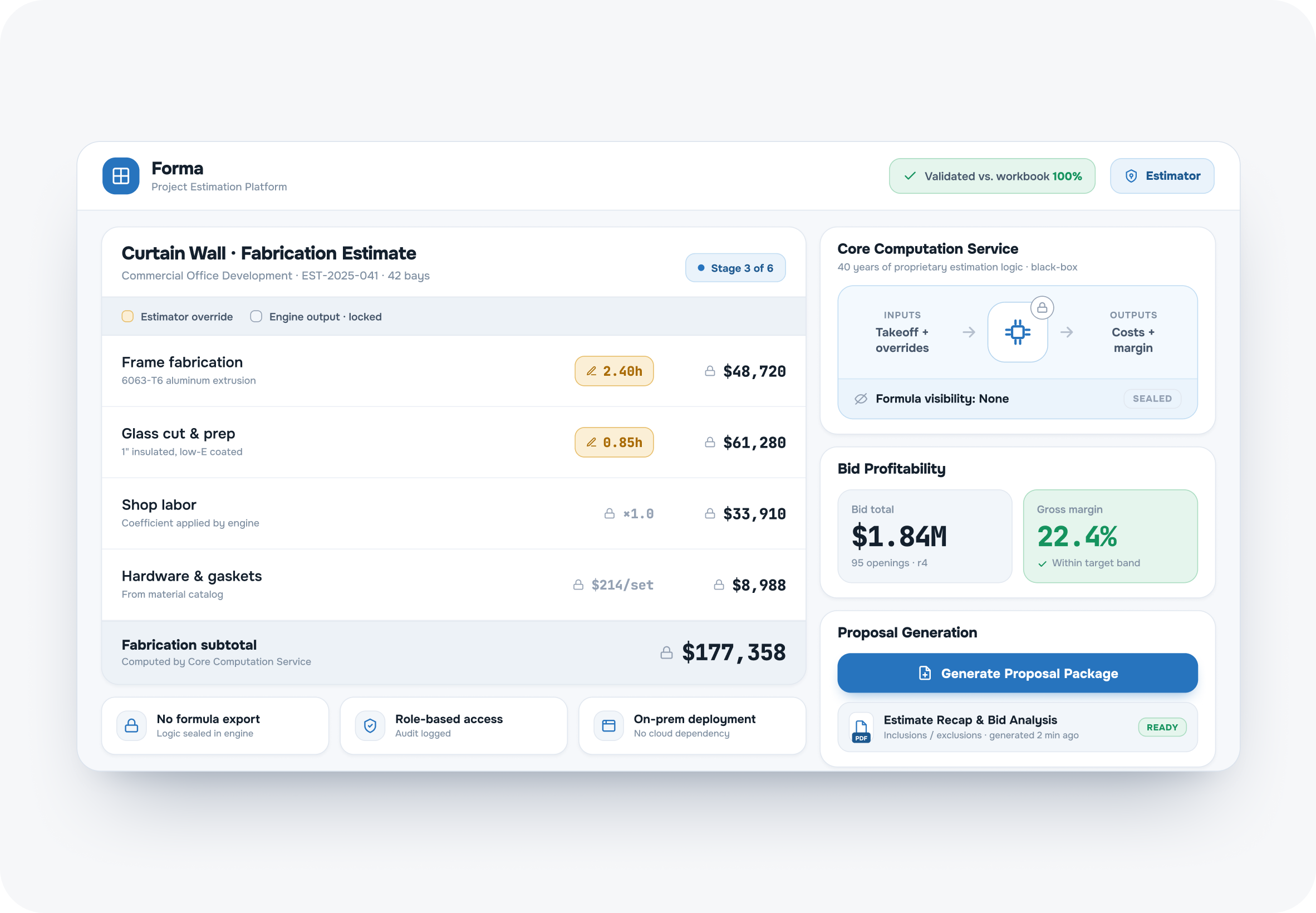
The first architectural decision was containment: the estimation logic had to move into a backend computation service where users see inputs and outputs. Ideas2IT decomposed the full workbook, mapped every cross-sheet dependency, translated the proprietary calculation chain into a black-box Node.js engine, and built a React frontend with role-based access and automated proposal generation.
03 Outcome
Forty years of proprietary estimation logic is now protected behind a governed web platform with no formula visibility, no export path, and a single methodology enforced across every estimator.
Phase 01
Mapping the full cross-sheet logic chain before the first line of code
Workbook Decomposition and Dependency Mapping
The first engineering constraint was epistemic: nobody fully understood the workbook. Fifty sheets, 40 years of accumulated formula logic, and cross-sheet dependencies that were invisible until something downstream stopped calculating correctly. Ideas2IT began with a full structural analysis of the active estimation sheets, tracing every formula dependency across the takeoff, fabrication, installation, and profitability layers.
The output was a dependency map that identified which calculation chains were sequential, which were parallel, which required manual override zones, and which parameters varied per project. That map became the construction contract for every decision that followed.
THIS PHASE PRODUCED
- Full workbook dependency map
- Workflow structure definition
- Override zone identification
- Calculation validation baseline
- Estimation module scoping
Phase 02
Making estimation knowledge opaque to users
Calculation Engine and Modular Estimation Framework
The core risk in translating the workbook was exposure. The goal was a system where estimators input project parameters and receive outputs, with no access to the coefficients, multipliers, or formula logic producing them. Ideas2IT built the Core Computation Service in Node.js, implementing the full calculation chain from takeoff inputs through fabrication modeling, installation labor, materials costing, and profitability outputs.
Modular estimation components were built for each glazing system type, with controlled override zones permitting estimator judgment on labor coefficients and fabrication times without exposing the underlying model. Application outputs were validated against the original Excel workbook across representative project scenarios.
THIS PHASE PRODUCED
- Core Computation Service
- Estimation modules
- Controlled override layer
- Estimate Management Service
- Calculation validation report
- Material Catalog and Master Data Manager
Phase 03
From manual document assembly across 50 sheets to governed, automated proposal generation
Proposal Automation, UI, and On-Prem Deployment
Proposal generation had been the final manual bottleneck: outputs from across the workbook had to be consolidated by hand before a bid document could go to a client. The Template Renderer and Document Storage Service replaced that process, generating estimate recaps, bid analysis sheets, inclusion and exclusion documentation, and PDF-ready proposals directly from structured estimation data.
The React frontend replicated the multi-stage estimation workflow as a governed interface, with role-based access separating estimator, reviewer, and administrator permissions. The platform deployed to the client's existing on-prem infrastructure, with no cloud dependency and no external data exposure path.
THIS PHASE PRODUCED
- Template Renderer Service
- Document Storage Service
- Role-based access control
- Automated proposal package
The Outcome
Forty years of proprietary estimation logic, protected, governed, and standardized across every bid.
The platform now holds something that a spreadsheet could never protect: four decades of accumulated estimation knowledge made inaccessible to anyone who does not have an account. The calculation logic does not travel. The methodology does not drift across estimators. A governed interface with role-based access, automated proposal generation, and a black-box computation engine at its core produced those results. The architecture enforced them.