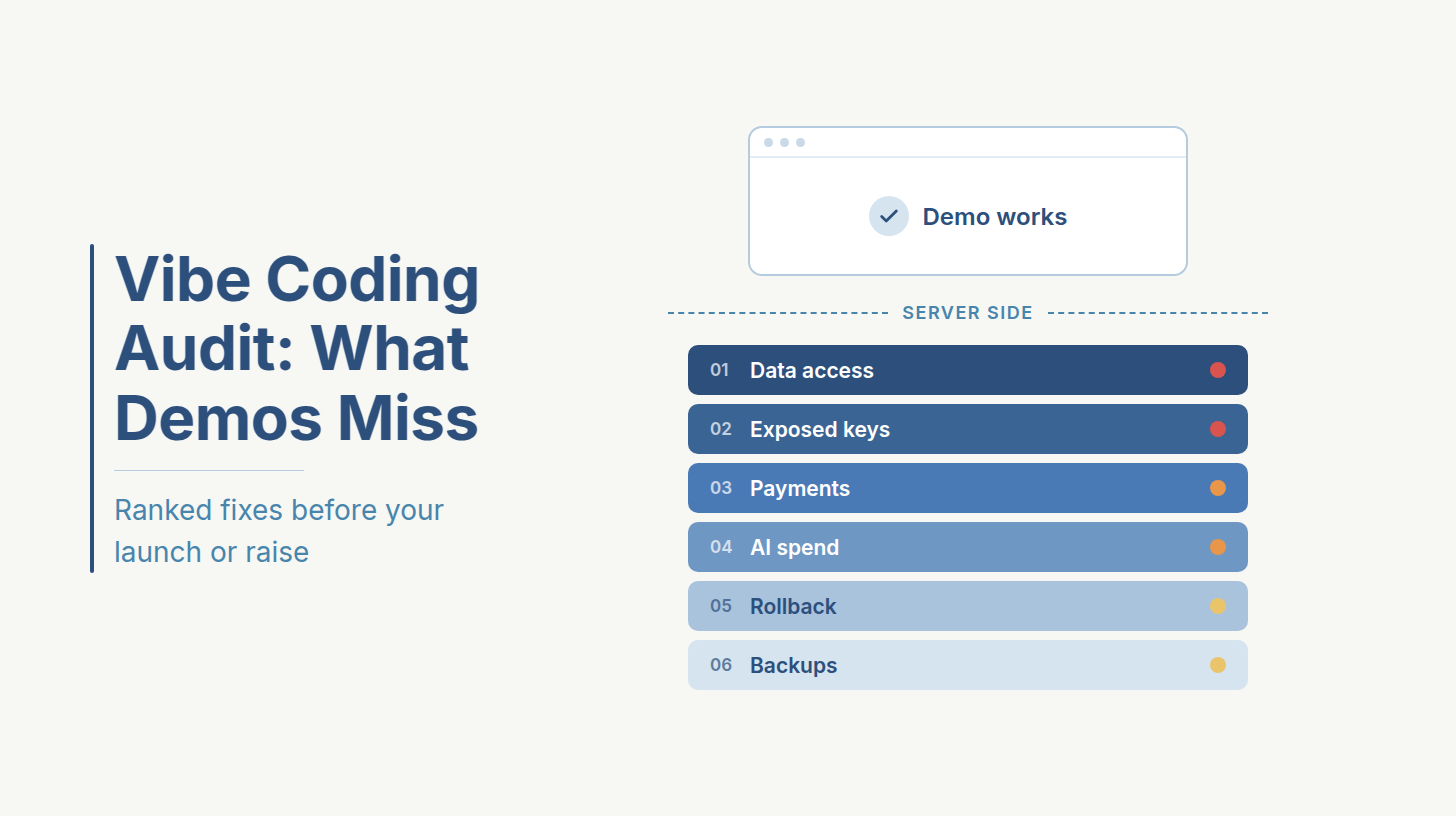

- A working AI-built app is not the same as a production-ready application. Security, scalability, monitoring, and ownership are where most teams discover the real gaps.
- Before deciding whether to ship, refactor, or rebuild, evaluate your app across five areas: Security, Architecture, Quality, Operations, and Ownership.
- Most AI-built apps fail production reviews because they were optimized for demos, not real users, compliance requirements, or long-term maintenance.
- Your scorecard results should determine the next step: refactor isolated gaps, rescue foundational issues, or bring in outside expertise when specialized work is required.
- This guide provides a practical production-readiness framework to help founders and engineering leaders confidently move AI-built applications from prototype to production.
Six months ago, vibe coding was a side project. You or someone on your team opened Cursor, or Claude Code, or Lovable, described what the app needed to do, and had a working version by the end of the week. It handled the demo and follow up flawlessly. Leadership and a pilot customer got excited. Because of which, someone put it on the roadmap for Q3.
That is the story behind most of the AI-built software sitting in production queues right now, and none of it is the problem. Across every model and every task Veracode tested in its most recent security benchmark, only 55% of AI code generation tasks produced code free of a known security flaw, which means the tool that built your app was never optimizing for the question you're about to be asked. It was optimizing for "does this work when I run it," not "does this survive contact with real users, real load, and real scrutiny."
That gap shows up the week someone asks you to sign off on shipping this to customers, and you realize you don't actually know what you'd be signing off on.
Why Vibe Coding Is the Right Starting Point
Vibe coding earned its place for a real reason: it collapsed the cost and time of finding out whether an idea is worth building at all. The part that gets skipped is what changes once the answer is yes.
The tools did their job but the gap is that "did their job" and "ready for production" were never the same bar, and most teams don't find out they were operating on the first one until someone asks about the second.
Why AI-Built Apps Break Before Launch
The pattern is consistent enough that it has a shape. A team builds something with an AI coding tool, then it gets tested by the two or three people who built it, clicking through the same three flows they always click through, because those are the flows they know to check. It gets shown to leadership, who click through the same flows and see the same success. Everyone in the room has now confirmed the app works, using the exact same test.
Production is a hundred people hitting the same endpoint at once, one of them submitting a form with a value nobody anticipated, an API rate limit that trips during your best week of usage instead of your worst, and a support ticket six weeks later asking why one customer can see another customer's data. None of those scenarios showed up in the demo because nobody built the demo to surface them.
This is a description of how the tool works, the app was validated against the scenarios someone thought to test, and production runs on the scenarios nobody thought to test.
How to Evaluate an AI-Built Application
You cannot answer "is this ready" with a feeling. Score your app against five categories that have nothing to do with whether the features work, and everything to do with whether the app survives contact with reality.
What Each Category Actually Means
Security is where AI-generated code fails most often and most invisibly. Veracode's most recent testing found that 45% of the time, across every model and task evaluated, the model introduced a known security flaw into the generated code, and that number has not meaningfully improved across testing cycles despite vendor claims otherwise. Georgia Tech's Vibe Security Radar project tracked 35 new CVE entries in March 2026 alone directly attributable to AI-generated code, up from six in January. This isn't a stable, known risk. It's accelerating.
Architecture gaps show up as a monolith that works at ten users and starts failing in ways that are hard to trace at a thousand, because nothing in the structure was designed to isolate a failure to one part of the system. AI coding tools default to the fastest path to a working feature, which is usually the most tightly coupled path.
Quality gaps compound quietly. This is the same structural pattern driving the broader shift toward agentic QA models across AI-built software: test coverage never extends past what the builder happened to click through, and nobody notices until an edge case reaches a real user.
Operations gaps are invisible until they aren't. No monitoring means the first person to know something is broken is the customer reporting it. No rollback plan means a bad deploy is a scramble instead of a button.
Ownership is the category most vibe-coded apps fail without anyone realizing it's a category at all. If the person who prompted the app is the only one who understands it, and there's no documentation, the app itself is a single point of failure independent of whether the code even works.
How to Read Your Score
Score it honestly. Two or more categories with unresolved red flags means you're still looking at a prototype, regardless of how finished it looks. One clean category and the rest with gaps means an MVP with real exposure workable for a limited pilot but not a broad rollout. All five addressed means something that can actually be called production ready. Most AI-built apps, checked honestly, land in the first two.
Should You Refactor, Rewrite, or Rescue an AI-Built Application?
A scorecard result isn't useful sitting on its own. It resolves three decisions that stay vague without a number behind them.
The mistake most teams make on the second decision is treating it as one binary choice, rewrite everything or ship as-is when the scorecard almost always points to something more specific and less expensive than either extreme.
What It Actually Costs When Nobody Owns the Code
This, in a real conversation with a founder building a two-sided marketplace platform, an earlier proof of concept had been built informally through a freelance connection, using the kind of AI coding tools that make a working prototype possible in days, it worked. Electricians were registering and the flow proved out.
Then the freelancer stopped paying the hosting bill and suddenly the site went dark. Nobody, including the person who built it, had a copy of the code. Months of proof-of-concept validation existed only as a memory of what the app used to do.
Nothing about that failure was a coding mistake. The prototype logic was reportedly sound enough to work. The failure was a category the team never scored: Ownership. No backup, no documentation, no one but a single external person holding the only copy of the asset. The fix that followed wasn't a rewrite. It was rebuilding with the same speed, but on infrastructure that couldn't disappear if one person's card got declined, paired with documentation from day one so the founder wasn't dependent on any single builder again.
That pattern repeats constantly, just with the failure mode disguised as something else: a stalled enterprise deal at the security questionnaire stage, a compliance requirement surfacing mid-pilot that should have been designed in from the start, an outage in front of the exact users leadership was hoping to impress. Every week spent debating whether to act on the scorecard is a week one of these moments gets closer.
What most teams need at this point isn't more analysis. It's someone to run the diagnostic on the actual codebase, map exactly which categories are exposed, and give an honest answer on whether this is a two-week fix or a structural rebuild.
How to Choose the Right Production Partner for Your Vibe Coded App
Once you've decided you need outside help, the risk shifts from whether this app can be fixed to whether the partner you hire will actually fix it instead of rebuilding it because that's the only motion they know.
A fix that leaves your team dependent on the partner to understand its own codebase has reproduced the original Ownership problem with a different person's name on it.
How Ideas2IT Approaches Production Readiness
The pattern above only resolves well with a specific kind of delivery model: one built around diagnosing before rebuilding, and embedding inside what already exists instead of replacing it wholesale.
Ideas2IT does this through Forward Deployed Engineers who join your existing environment from day one: your repository, your stack, your standups, your actual sprint goals. There is no separate delivery track producing a handover document weeks later. The FDEs assigned to a production-readiness engagement are the same engineers running the diagnostic, closing the gaps, and answering directly to what your team needs, without a project management layer sitting between you and the people doing the work.
Anticlock is the platform that makes the fix itself consistent instead of another round of ad hoc AI-assisted patching. Where the original build likely had one person prompting one way, Anticlock standardizes how the remediation work gets built. The same tooling, the same security guardrails, and the same deployment standards apply across every fix, so the app you end up with doesn't just pass today's audit. It stays maintainable as your team keeps building on top of it.
Qadence closes the testing gap that showed up in nearly every category of the scorecard. Instead of your team writing a test suite from scratch on top of code they didn't originally write, Qadence auto-generates a substantial share of the test cases needed to cover functional flows, integration points, and the edge cases a manual pass tends to miss, without locking you into a proprietary testing platform or language.
Ideas2IT holds AWS GenAI Specialist Partner status and SOC 2 Type II certification, and its healthcare engagements follow HIPAA-compliant delivery practices covering encryption, access control, and audit logging from the development environment through to production. If your app touches health data specifically, that point is worth reading in more depth in Ideas2IT's guide to HIPAA-compliant software development.
The entry point for this specific problem is a Production Readiness Assessment:
A working session where Ideas2IT's engineers run the scorecard against your actual codebase and hand you a specific map of what's exposed, what it would take to close each gap, and a clear recommendation on refactor versus rescue versus rebuild before you commit a team or a budget to either path.
Book a Production Readiness Assessment →
References
- Veracode. "Spring 2026 GenAI Code Security Update: Despite Claims, AI Models Are Still Failing Security." Veracode Blog. March 2026.
- Infosecurity Magazine. "Researchers Sound the Alarm on Vulnerabilities in AI-Generated Code." March 2026.
- CFO Dive. "AI Rush Is Fueling Tech Debt 'Tsunami': Forrester." January 2026.