
- Most enterprise AI projects in manufacturing, healthcare, and industrial businesses fail because the use case was chosen based on perceived value.
- The readiness illusion is believing you're ready because you understand AI is the most expensive state to stay in. It burns time and competitive positioning along with budget.
- 92% of manufacturers say smart manufacturing drives competitiveness. Only 20% feel fully prepared to deploy at scale.
- Before any AI build, evaluate four things: business value of the problem, data availability, integration complexity, and organizational change capacity.
- The GenAI Workshop produces five build-ready deliverables in two weeks. For companies that meet the criteria, it's available at no cost. [Book a $0 Assessment→]
Somewhere in the last twelve months, the question changed. It used to be "should we be looking at AI?" Now it's "why aren't we further along?"
If you run a $1B–$5B manufacturing operation, a healthcare practice group, an industrial services business, or a PE-backed company across any of these verticals, you've felt this shift. The board has asked the question. The investor has asked the question. You've asked it yourself. The real enterprise AI strategy problem is knowing which bet to make first and almost none of the companies at your scale have a structured answer to that question.
Understanding AI and knowing which initiative to bet your next six months on are completely different problems. Most companies at your scale have the first one handled. Almost none have a structured answer to the second.
The Gap Between AI Awareness and AI Action
The biggest cost of AI is the months spent in ambiguity while competitors move.
There is a gap that sits between knowing AI matters and deploying something that generates real operational or financial impact. Call it the readiness illusion: the belief that because you've read the case studies, watched the demos, and had the internal conversations, you're ready to move when in fact you haven't yet done the foundational work of validating which AI use case fits your operational reality right now.
The readiness illusion is expensive in a way that doesn't show up immediately. It burns time, internal credibility, and competitive positioning. Those are harder to get back.
Deloitte's 2025 Smart Manufacturing Survey found that 92% of manufacturers believe smart manufacturing will be the main driver of competitiveness over the next three years.
Yet only 20% say they feel fully prepared to deploy AI at scale, according to Redwood Software's 2026 manufacturing survey. Those two numbers describe the readiness illusion exactly. The intent is universal. The structured path to execution is nearly absent.
Why This Is Harder for Manufacturing, Healthcare, and Industrial Businesses
A $2B manufacturing company doesn't have a data science team. A healthcare practice group has clinical data locked in systems that weren't designed to be queried. An industrial machinery business has operational data distributed across ERP, MES, CMMS, and QMS systems that rarely talk to each other. A PE-backed portfolio company has board pressure, a lean IT team, and a 90-day value creation expectation that leaves no room for a year-long AI exploration program.
In these environments, the readiness illusion is particularly dangerous. The cost of picking the wrong use case burning $300K–$500K in engineering effort, based on what we've seen across our engagements, before realizing the data doesn't support the model or the workflow integration is too complex is not just financial. It's organizational cynicism. Once AI fails publicly inside a company, the next person who proposes an AI initiative is fighting institutional memory as much as they're fighting the technical problem.
What Going Wrong With AI Actually Looks Like
The failure mode in industrial and operational businesses is different from the failure mode in tech-adjacent companies. It's not about generic AI features. It's about the collision between operational complexity and AI that hasn't been grounded in operational reality.
We've seen manufacturers deploy AI systems for production scheduling where the model is technically sound, but the data feeding it comes from an ERP that hasn't been properly maintained, with incomplete routings and inaccurate lead times. The AI's recommendations are ignored by plant managers within three weeks. The model didn't fail. The inputs were wrong from Day 1.
We've seen healthcare practice groups invest in AI tools for clinical documentation reduction where the tool works in the demo environment. Integrating it with the practice's specific EHR takes four months and a full scope rewrite. By the time it's live, clinical staff have found workarounds. Adoption lands at 12%.
We've seen PE-backed industrial services roll-ups deploy AI across three portfolio companies simultaneously because the operating partner wants to show value at the portfolio level. Each company has different systems, different data maturity, and different workforce readiness. The initiative produces pilots at all three. It produces P&L impact at none.
Three different industries. Three different AI tools. The same outcome: deployed AI with no business impact.
What These Failures Have in Common
AI projects in operationally complex businesses fail for one reason: the use case was selected based on what seemed valuable, not what was feasible given the actual data, systems, and organizational capacity at the time of deployment.
The market rewards the first mover who gets AI working inside a real workflow at production quality. It does not reward the organization that ran the most thorough strategy process before building nothing.
If these patterns are familiar, the GenAI Workshop is built for exactly this situation. Two weeks. Five deliverables. A locked use case your team can start building on Day 1.
Book a conversation about the GenAI Workshop →
The One Question Worth Answering Before Spending Anything
The question that separates companies generating AI returns from those accumulating pilots is this: which use case has the highest combination of business value and deployment feasibility given exactly what we have today?
Not what we wish we had. Not what the vendor said was possible. Not what the competitor is reportedly doing. What we have today in terms of data quality, system integration depth, governance readiness, and team capacity to absorb change.
Before building anything, any AI use case evaluation should examine four things: the dollar value of the operational problem being solved, whether the data required actually exists and is clean enough to use, how complex the integration with existing systems will be, and whether the organization has the change capacity to absorb a new workflow right now. Companies that answer these four questions before committing to a build rarely end up in the failure scenarios above.
Doing this well requires a combination most mid-market companies don't have in one room: people who understand your operations, people who understand AI architecture, and people who can translate between the two in a way that produces a decision the CEO, CFO, and engineering team can all act on. That combination tends to live in consulting firms that charge for strategy decks, or in technology companies that want to sell you a platform. Neither is designed to produce a locked, build-ready answer in a compressed timeframe.
What the First Two Weeks Should Produce
This is the problem Ideas2IT's GenAI Workshop was built to solve. In two weeks, it produces five outputs: a scored map of where AI can actually work in your business right now, a ranked shortlist of use cases with P0/P1/P2 classification and rationale, a week-by-week 90-day pilot roadmap for the top use case, a frank data and systems readiness report, and an architecture direction document the engineering team acts on directly.
The process draws on frameworks from 50+ enterprise AI engagements, covering data maturity, systems integration, process readiness, governance, and organizational change capacity.
The output is not a slide deck. It's a blueprint delivered 48 hours after the final session, one document the executive team reads for strategic direction and the engineering team reads as a build spec.
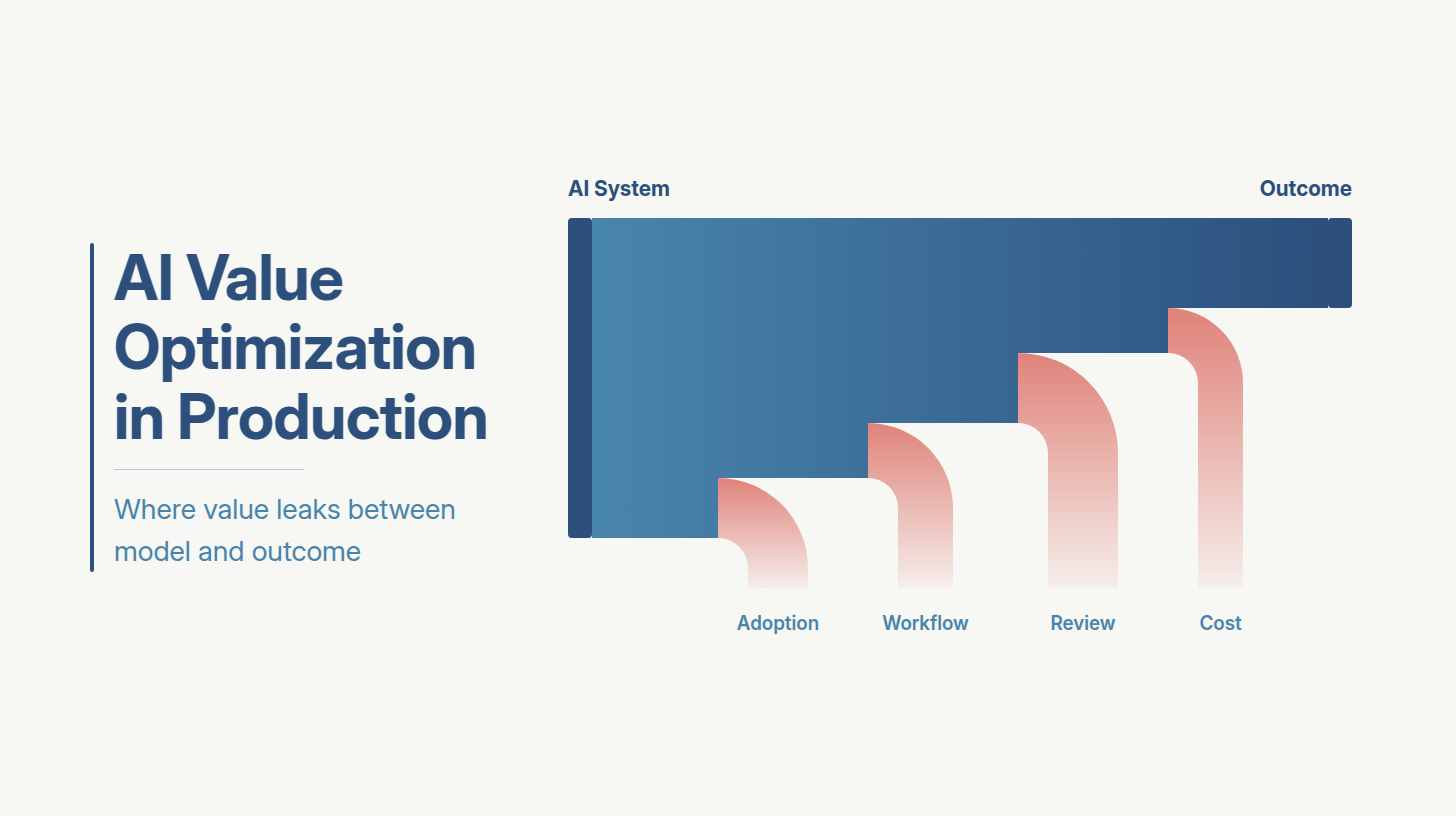
For companies that have already invested in AI but aren't seeing measurable returns, we run a separate assessment that audits what's deployed, identifies the gap between deployment and business outcomes, and builds the measurement framework that connects AI usage to metrics a CFO or PE board can track.
The Companies Moving Now Are Pulling Ahead
The companies pulling ahead aren't spending the most on AI. They're the ones that found one use case, executed it completely, and used the proof to fund the next one. Deloitte's smart manufacturing research shows the leaders generating production output gains of 10–20%, employee productivity improvements in the double digits, and capacity unlocked without adding equipment.
The gap between companies that have embedded AI in one core workflow and those still in the assessment stage widens every quarter. The organizations moving now are accumulating operational data, workflow integration depth, and organizational AI literacy that compounds over time. That advantage is hard to close once it's established.
The structured path from ambiguity to a validated first use case takes two weeks. The organizations that have been through it describe the same outcome: clarity that had been missing for months, locked decisions that ended debates running for quarters, and an engineering team that could start building on Day 1.
For companies that meet the criteria, this engagement is available at no cost. We're selective because the process only works for organizations genuinely ready to move from AI ambiguity to AI action.
Book a conversation about the GenAI Workshop
Already invested in AI but not seeing results? Ask about the AI ROI Assessment
Ideas2IT is a platform-led AI and software engineering company and AWS GenAI Specialist Partner. We've built AI systems for companies including Medtronic, Meta, Bloomberg, and Mayo Clinic. Our GenAI Workshop and AI ROI Activation Program are designed for mid-market companies in operationally complex industries where AI talent is not internally available and where the cost of the wrong first bet is too high to get wrong.