
Building the Unified Care Coordination, Referral, and Telehealth Platform for a Post-Acute Care Services Company Scaling Home-Based Care
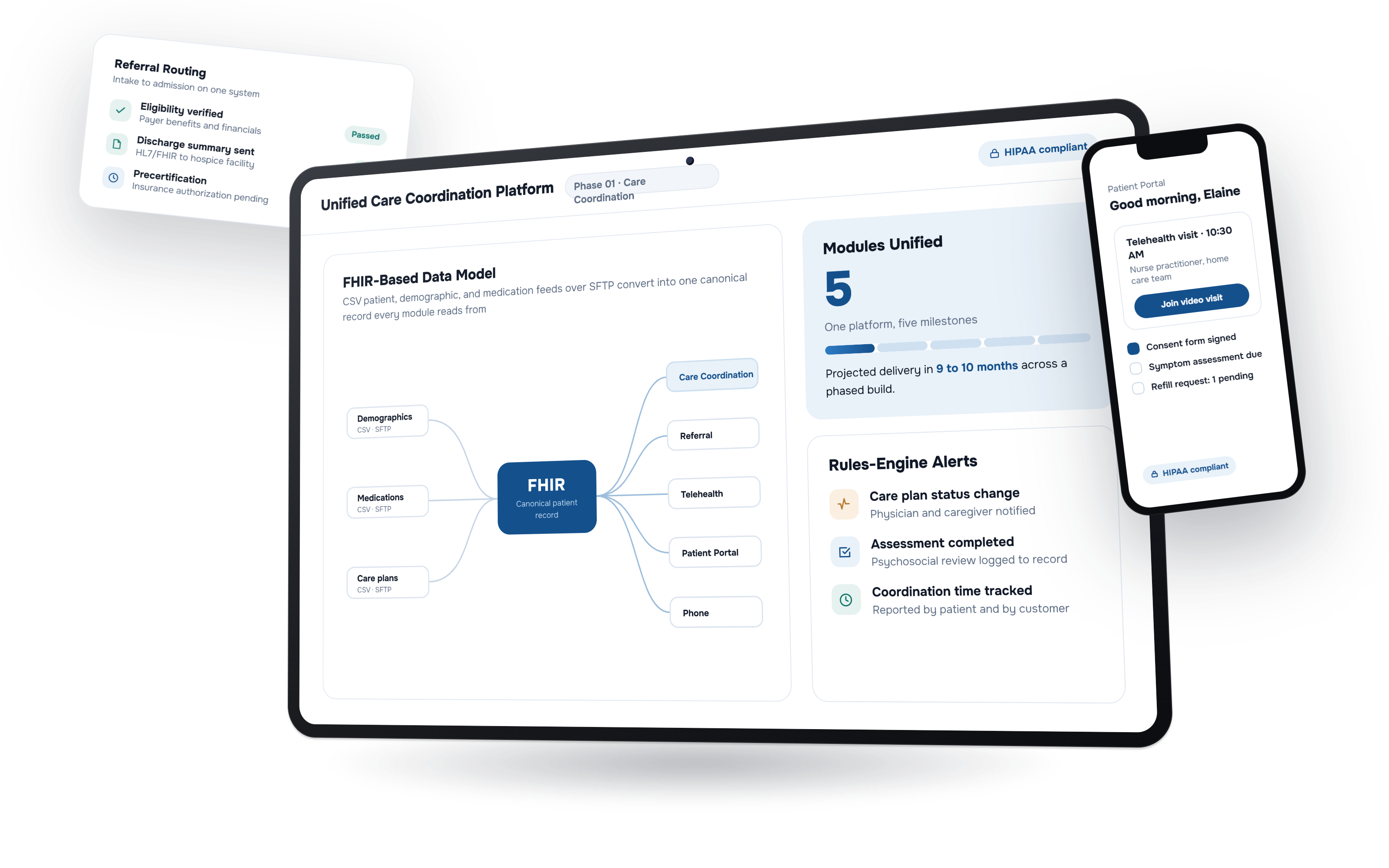
The company needed one platform connecting care coordination, referral management, telehealth, and patient engagement instead of five disconnected workflows built on CSV file drops. Ideas2IT is architecting that platform on a FHIR-based data model with Care Coordination as the foundation phase.

Client
A post acute care

Industry
Healthcare

Service
App Development
App Modernization

Engagement
Active · Ongoing

Team Size
10
01 Challenge
A post-acute care services company built its model on payer and provider partnerships for at-home serious illness and hospice care, but ran care coordination, referrals, telehealth, and patient engagement as five disconnected workflows fed by CSV files dropped over SFTP.
02 Solution
Ideas2IT is building a FHIR-based unified data model as the platform's foundation, converting CSV patient, demographic, and medication feeds into one canonical record. Care coordination ships first, with referral, telehealth, portal, and phone integration built as connected modules on Azure rather than five separate systems.
03 Outcome
The Architecture Is Set: One FHIR-Based Platform Replacing Five Disconnected Systems. What's decided is the architecture: care coordination ships first as the FHIR-based foundation, with referral, telehealth, portal, and phone built as connected modules rather than five separate systems.
Phase 01
Building the data foundation every other module depends on
Care Coordination: converting CSV patient feeds into one FHIR-based system of record
The first decision was structural: patient data arrived as CSV files, demographics, medication, care plans, dropped over SFTP, and every downstream module needed one canonical record to work from.
Ideas2IT is building the ingestion layer that converts those CSV feeds into a FHIR-based data model, then layering assessment forms, Integrated Care Plan management, and monitoring and follow-up workflows on top of it.
Rules-engine-triggered alerts notify patients, caregivers, and physicians of status changes, and dashboards report care coordination activity by patient and by customer, the two views the intake team is designing for first.
This Phase Produced
- FHIR-based patient data model from CSV/SFTP ingestion
- Integrated Care Plan builder (goals, objectives, interventions)
- Patient assessment engine (physical, psychological, social, environmental factors)
- Rules-engine stakeholder alerting · Care coordination time-tracking module
- Consolidated PDF care coordination reports
- Internal staff messaging
- Care coordination dashboards
Phase 02
Turning virtual visits into a scheduled, notified, connected workflow
Telehealth: one-to-one video visits with document sharing and scheduling built in
Telehealth is scoped as a connected module, not a standalone video tool. Providers and patients schedule one-on-one or group sessions through an appointment dashboard filterable by date and patient name, with rescheduling and cancellation built into the same flow.
Video visits carry in-meeting chat and file sharing, and every scheduling change triggers automated email and SMS notifications to participants. The dashboard gives providers a calendar view of their telehealth caseload alongside the care coordination and referral data already in the platform.
This Phase Produced
- One-to-one and group video visit scheduling
- In-meeting chat and file sharing
- Appointment dashboard with date/patient filtering
- Automated email and SMS meeting notifications
- Reschedule and cancellation workflows
- Provider calendar view integrated with care coordination data
Phase 03
Replacing manual handoffs with tracked, eligible, auditable routing
Referral Management: routing hospice referrals from intake to admission on one system
Referrals arrive from the Care Coordination module and get enriched against recent falls, chronic conditions, and HCC/HEDIS gaps before an intake coordinator runs an eligibility check against financials and payer benefits.
Possible-match logic rejects duplicate referrals up front. Accepted referrals transmit clinical discharge summaries and preadmission information to hospice facilities over HL7/FHIR, and authorization requests route to insurance for precertification, including special-needs approvals like dialysis or personal care. Every status change updates automatically, and dashboards report referral trends, conversion rate, and top denial reasons by referring source.
This Phase Produced
- Referral intake and enrichment engine (falls, chronic conditions, HCC/HEDIS gaps)
- Duplicate referral detection (possible-match logic) · Eligibility and payer benefits verification
- HL7/FHIR preadmission and discharge summary transmission
- Insurance authorization and precertification routing
- Referral status automation
- Referral trend and conversion analytics dashboards
Phase 04
Giving patients and caregivers a front door into their own care
Patient Portal: self-service access to records, refills, and care team chat
The portal gives patients direct access to what previously required a call to staff: viewing lab results, allergies, problems, and medications, requesting a prescription refill, and completing assigned assessments or declining with a reason.
E-signature covers consent forms and notary signatures, and a caregiver view lets one login switch between a caregiver's own profile and the patients they support. Chat connects patients directly to their assigned RN, social worker, or care coordinator, and a dashboard surfaces upcoming appointments alongside pending to-dos: assessments, documents awaiting signature, and outstanding actions.
This Phase Produced
- Patient dashboard (appointments, pending actions, to-dos)
- Medical records view (labs, allergies, problems, medications)
- Medication refill request workflow
- Assessment completion and decline-with-reason flow
- E-signature for consent and notary documents
- Caregiver view with patient-switching
- Chat with assigned care team member
The Outcome
Five Fragmented Workflows, One Proposed Platform, a 9-to-10-Month Build
The case for this platform rests on a sequencing decision: one FHIR-based record underneath care coordination, referral routing, telehealth, and patient engagement, rather than four systems that each solve one problem and none of them talk to each other.