
Building a HIPAA-Compliant Genealogy Platform for Genetic Risk Prediction
Family health history lived in memory and paper records, disconnected from the medical system that needed it. Ideas2IT built a HIPAA-compliant genealogy platform that turned family trees into a risk-prediction tool physicians and patients could use directly.

Client
TapGenes

Industry
Healthcare

Service
Artificial Intelligence
App Development

Compliance
HIPAA

Delivery Model
T&M
01 Challenge
Families tracked health history on paper or not at all, disconnected from the physicians who needed it for diagnosis. Genealogy tools existed, but none tied relationships to medical records, applied HIPAA-grade protection, or turned family history into a risk prediction a patient could act on.
02 Solution
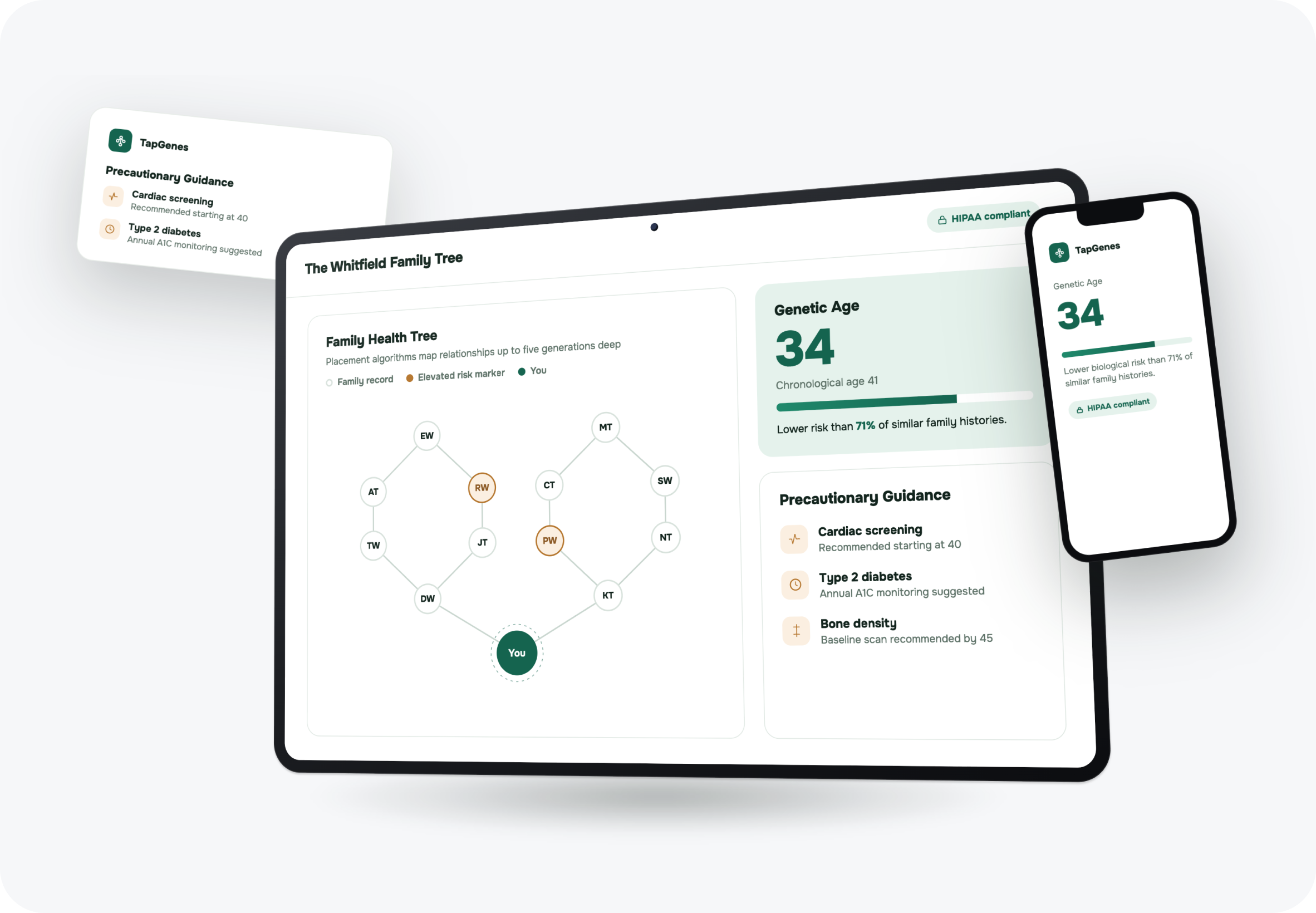
Ideas2IT built the genealogy engine first: complex placement algorithms mapping family relationships five generations deep, delivered in a shortened build timeframe. Truevault became the HIPAA-compliant store for medical records underneath it, reached only through a secure API, with a risk-prediction algorithm layered on top to translate family history into precautionary guidance.
03 Outcome
TapGenes became an award-winning genealogy application for family health management, protecting patient data at the same encryption standard used in financial institutions while giving patients a Genetic Age view of their own risk profile.
Phase 01
Turning scattered family relationships into a structured, generational tree
Genealogy Tree Architecture: Complex Placement Algorithms Across Five Generations
The first decision was structural: a family health tree only works if it can represent real genealogical complexity, not a simplified org chart.
Ideas2IT built placement algorithms that construct a comprehensive relationship map running up to five generations, handling parents, grandparents, siblings, and extended family without forcing manual reconciliation.
The algorithms were built for a shortened delivery timeframe, since a genealogy structure this complex is normally the slowest part of a family health platform to get right.
THIS PHASE PRODUCED
- Multi-generational genealogy tree (up to 5 levels)
- Complex relationship placement algorithms
- Accelerated build timeline for tree construction
Phase 02
Storing family medical records without owning HIPAA risk directly
HIPAA-Compliant Data Layer: Truevault as the System of Record for Medical Information
The genealogy tree could not hold medical data directly without pulling the entire platform into HIPAA scope. Ideas2IT integrated Truevault as a dedicated HIPAA-compliant data service, storing family medical records outside the application layer and exposing them only through a secure API.
Patient data reaching the platform was protected at 128-bit encryption, the same standard used in financial institutions, keeping medical records auditable and access-controlled without slowing down how families interacted with their own tree.
THIS PHASE PRODUCED
- Truevault HIPAA-compliant data store
- Secure API layer for medical record retrieval
- 128-bit encryption for patient data
Phase 03
Making family history actionable for patients and physicians
Health Risk Prediction and Portal: Turning Family History into Preventive Guidance
The final layer turned stored history into a decision aid. Ideas2IT built a health risk prediction algorithm that reads a patient's family health history and surfaces precautionary measures based on inherited risk, expressed to patients as a Genetic Age relative to others with similar risk profiles.
A WordPress portal sat alongside it, giving users general health information on immunizations, allergies, diseases, and symptoms, while Facebook import and social sharing let a family's health tree grow the same way the family itself does.
THIS PHASE PRODUCED
- Health risk prediction algorithm
- Genetic Age risk-profile comparison
- WordPress health information portal
- Facebook import and social sharing for family tree growth
The Outcome
An Award-Winning Genealogy Platform Built on a HIPAA-Compliant Foundation
TapGenes works because the architecture kept concerns separated: genealogy structure, HIPAA-regulated medical data, and risk prediction each lived in their own layer instead of one shared database. That separation is what let Truevault carry the compliance burden, the placement algorithms carry the relationship complexity, and the prediction engine turn family history into something a patient could act on before it became a diagnosis instead of after.