
Ideas2IT Stabilized a Medicare Advantage SNP Care Coordination Platform Through a Vendor Takeover and Rebuilt
The platform needed continuity through a vendor takeover and a path off a legacy Django UI with no single sign-on. Ideas2IT stabilized every critical module, then rebuilt the release pipeline into a compliance-embedded, weekly deployment system.

Client
Medicare Advantage SNP care coordination platform

Industry
Healthcare

Service
App Modernization
App Development

Engagement
Vendor Takeover

Compliance
HIPAA,SOC2,HEDIS,MOC
01 Challenge
A Medicare Advantage SNP care coordination platform was mid-transition from its incumbent vendor, running on an unmodernized Django UI with no single sign-on and open production bugs across HRA, Care Plan, and Reporting modules, while still bound to HEDIS and Model of Care mandates.
02 Solution
Ideas2IT co-onboarded with the incumbent vendor and took ownership of every critical module before touching architecture. It then rebuilt the release pipeline: migrated the UI from Django to React, added SAML 2.0 SSO, and moved deployment to Argo CD with Cypress test automation, so HEDIS and SNP compliance proof ships with every change.
03 Outcome
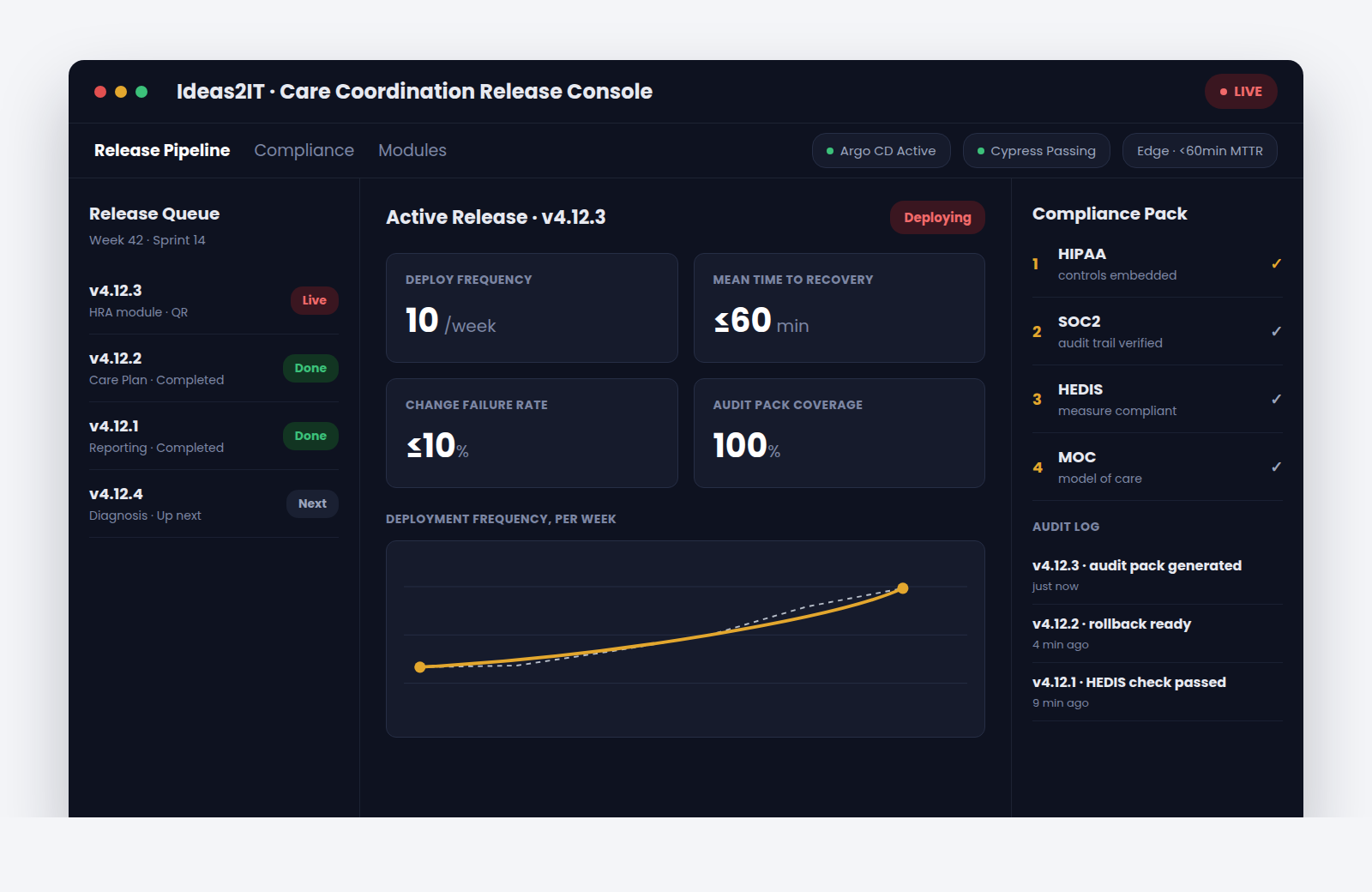
Deployment frequency rose from 4 releases a week to 10. Recovery time dropped from 180 minutes to under 60. Change failure rate fell from 18% to under 10%, with 100% of releases audit-ready.
Phase 01
Keeping clinical workflows live through a vendor exit
Vendor takeover without disruption: continuity secured before a single module changed
Every account transition risked breaking live clinical workflows mid-transfer, so Ideas2IT co-onboarded with the incumbent vendor before touching architecture, running knowledge-transfer sessions and building foundational documentation in Confluence to capture what the incumbent's team knew and Ideas2IT did not.
From there, Ideas2IT took ownership of active development on the platform's critical modules, HRA, ICT, and Diagnosis among them, resolving open production bugs in HRA, Care Plan, and Reporting while holding SNP mandate compliance steady. No module went unowned during the handoff, and no clinical workflow went dark.
This Phase Produced
- Confluence knowledge-transfer documentation
- Ownership of HRA, ICT, and Diagnosis modules
- Zero-disruption vendor cutover
- Production bug resolution across HRA, Care Plan, and Reporting
- Verified SNP mandate compliance through the transition
- Consolidated module ownership map
Phase 02
Rebuilding the interface clinicians touch every day
Modernizing the interface: Django to React and SAML SSO without disrupting daily clinical use
Modernizing a live clinical UI meant clinicians could not feel the migration happening under them, so Ideas2IT rebuilt the frontend in React while the platform stayed in daily use, then layered SAML 2.0 SSO onto the backend with secure integration built in, not added later.
Alongside the rebuild, Ideas2IT introduced structured Agile ceremonies, standups, retros, and sprint planning, with Ideas2IT engineers serving as Scrum Masters, and set structured PR feedback metrics so code review became a discipline.
Argo CD and Cypress replaced manual deployment and manual QA, giving the team automated testing and reversible releases before the modernization was finished.
This Phase Produced
- React frontend rebuild
- SAML 2.0 SSO with secure backend integration
- Structured Agile ceremonies and Scrum Master coverage
- Structured PR feedback metrics
- Argo CD deployment automation
- Cypress automated test suite
Phase 03
Making reliability and compliance visible every week
Weekly, reversible releases: compliance proof built into the pipeline, not audited after the fact
Every clinical change had to prove HEDIS and SNP compliance before it shipped, so Ideas2IT built that proof into the release pipeline itself rather than assembling audit evidence after the fact.
Git became the source of truth, Argo CD handled deployment with feature flags so clinicians were never surprised by a rollout, and rollback was instant if a release looked wrong.
FHIR kept data sharing clean and HIPAA and SOC2 controls stayed embedded in the pipeline rather than layered on top. Deployment frequency rose from 4 releases a week to 10, recovery time from 180 minutes to under 60, and change failure rate from 18% to under 10%, with every release shipping an audit pack.
This Phase Produced
- Compliance proof embedded in the release pipeline
- Feature-flagged rollouts
- Git-based instant rollback via Argo CD
- FHIR-based data sharing layer
- HIPAA and SOC2 controls embedded in CI/CD
- Weekly reliability and compliance dashboard
The Outcome
Four releases a week to ten, with every one audit-ready from day one.
| Category | Metric | Description |
|---|---|---|
| Release velocity | 4/week → 10/week | Weekly release cadence increased after Argo CD and Cypress automated testing replaced manual QA gating. |
| Reliability | 180 → ≤60 min MTTR | Git-based rollback through Argo CD replaced manual recovery procedures. |
| Quality | 18% → ≤10% failure rate | Structured PR feedback metrics and Cypress test coverage caught defects before production. |
| Compliance | 100% audit-ready | HEDIS and SNP compliance evidence is automatically generated with every release. |
| Compliance | HIPAA,SOC 2,HEDIS | Compliance remained embedded across the platform through the vendor transition and every release thereafter. |
| Scope | Next-gen platform | Delivery performance during the takeover led the client to expand Ideas2IT's role to the next-generation platform. |
The reliability gains came from moving compliance into the pipeline itself. Git-based rollback through Argo CD, feature-flagged rollouts, and Cypress test automation turned a manual, audit-after-the-fact process into one where HEDIS and SNP proof shipped with every change. That discipline, held through a live vendor transition, is why the client has since expanded Ideas2IT's role to its next-generation care coordination platform.