

How Ideas2IT Transformed a 32-Year-Old Healthcare Platform Into an AI-First Clinical Product
A PE-backed healthcare software company had spent 32 years building the ultrasound reporting platform that over 35% of US healthcare enterprises run on. When the PE firm invested, the technology was the blocker: millions of lines of legacy code, 290 single-tenant deployments, and no AI capabilities despite sitting on 32 years of gold-standard radiology data. Ideas2IT modernized the entire platform in 7 months, then built the AI strategy and data foundation to turn a reporting tool into an AI-first clinical product.

Client
Confidential

Industry
Healthcare

Service
App Modernization
Agentic AI

Geography
USA

Engagement
Active
01 Challenge
The client was the market leader in ultrasound reporting for maternal and fetal care with 200+ customers, but the technology couldn't keep pace. Every customer ran a dedicated on-prem or Azure VM instance, onboarding took 3 weeks per tenant, and the VB6 and .NET 4.7.2 monolith had no API layer. Beyond the modernization problem, the product had zero AI capabilities. Alerts used static thresholds that missed fetal growth trends. Billing codes were manually assigned, causing claim rejections. Sonographers spent hours on repetitive data entry. 32 years of clinical data was sitting unused.
02 Solution
Ideas2IT executed in two stages. First, we deployed Legacyleap to rewrite VB6 services as .NET 8 microservices, scaffold REST APIs from the monolith, and migrate 290 environments to multi-tenant AWS with zero downtime, all in 7 months. Then we ran a structured AI discovery: stakeholder workshops, workflow deep-dives across clinical and operational functions, and feasibility analysis across 15+ candidate use cases. We designed a medallion-architecture data platform to unlock decades of clinical data for AI and shortlisted four use cases now entering development.
03 Outcome
The client went from a technically stalled monolith to a cloud-native SaaS platform in 7 months, with tenant onboarding dropping from 3 weeks to under a day and infrastructure costs falling 65%. The AI discovery produced a prioritized roadmap of 15+ use cases, a production-grade data platform architecture, and four high-impact features now in active development.
Phase 01
Using AI to compress years of modernization work into months
Legacyleap Codebase Analysis and Migration Strategy
Before a single line was rewritten, Legacyleap analyzed the full codebase, mapped every dependency, and generated the refactoring blueprints that made 7-month delivery possible.
- Legacyleap automated discovery across the VB6 and .NET 4.7.2 monolith, generating dependency maps and refactoring blueprints in days rather than months
- Zero-downtime migration strategy designed with parallel running of legacy and new services throughout cutover
- Multi-tenant AWS architecture blueprint replacing 290 single-tenant deployments with schema-per-tenant data isolation and RBAC enforcement
This phase produced
- Legacyleap codebase analysis
- Dependency mapping
- Zero-downtime migration strategy
- Multi-tenant AWS architecture blueprint
Phase 02
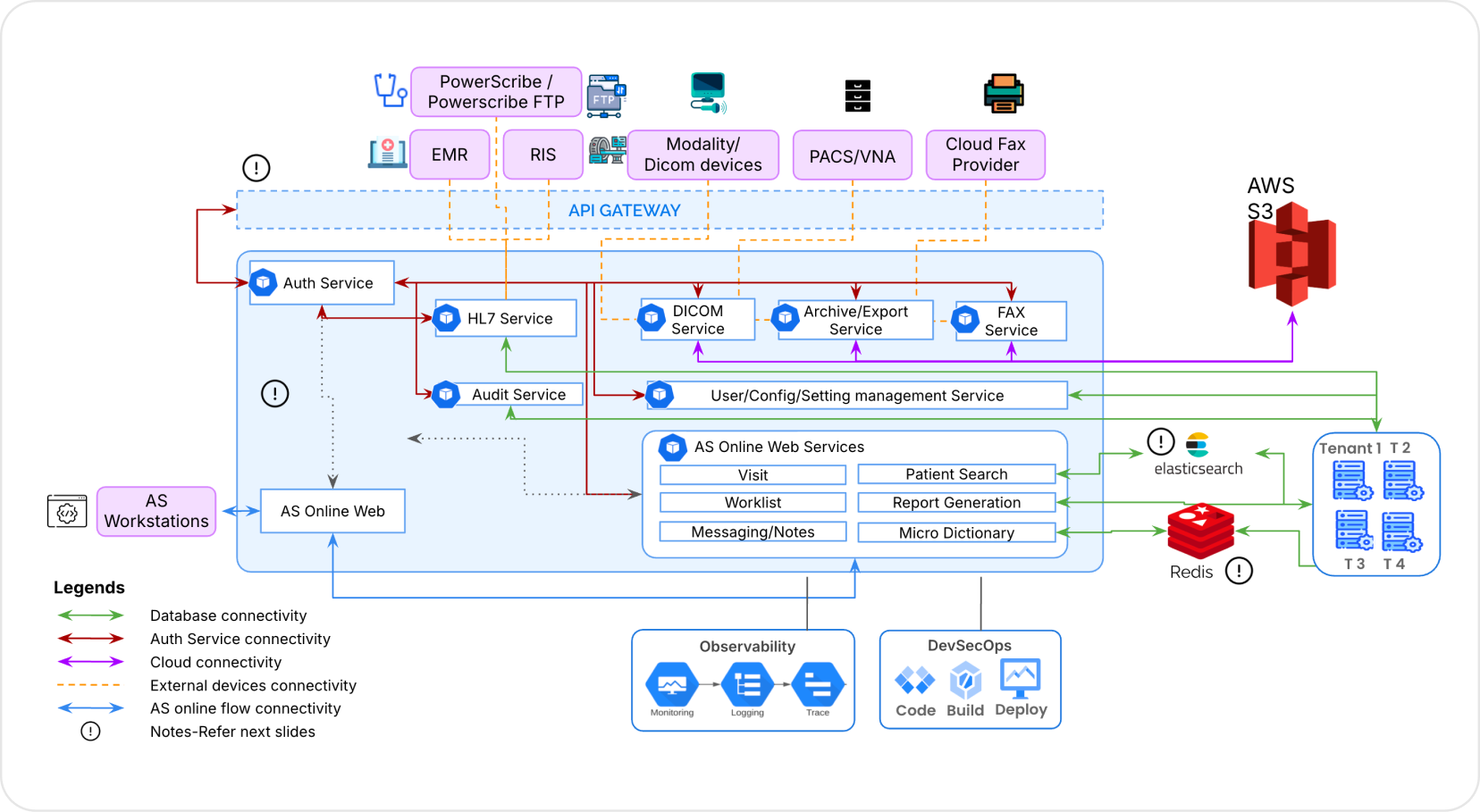
From VB6 monolith to .NET 8 microservices, 290 environments to one platform
Microservices Rewrite and SaaS Migration
Legacyleap scaffolded the REST API layer while the team rebuilt every VB6 service as a containerized microservice and migrated all 290 environments to AWS without a single production outage.
- All VB6-based HL7, Fax, and DICOM services rewritten as containerized .NET 8 microservices with API-first design
- Legacyleap scaffolded modular REST APIs from the .NET monolith, reducing development effort by 40%
- 290 customer environments migrated to AWS with automated CI/CD, ECS orchestration, and zero-downtime cutover
Deliverables:
- .NET 8 microservices
- Legacyleap REST API scaffolding
- Schema-per-tenant multi-tenant SaaS
- AWS migration of 290 environments
- Automated CI/CD and ECS
- Zero-downtime cutover
Phase 03
Rebuilding the interface that 8,000 clinicians use daily
Frontend Rebuild and Clinical UX
Ideas2IT rebuilt the full frontend in React, delivering 2x faster navigation and cutting onboarding time by 40% across the platform.
- React rebuild with React Hook Form and Redux Query delivering 2x faster navigation and deep linking across clinical workflows
- Modular component architecture enabling rapid feature deployment without destabilizing existing workflows
- Onboarding and training time cut 40% through improved usability and accessibility
Deliverables:
- React frontend
- React Hook Form and Redux Query
- Deep linking
- Modular component architecture
- 40% reduction in onboarding time
Phase 04
Unlocking 32 years of clinical data and building the first wave of AI features
AI Discovery, Data Platform & Phase 1 Use Cases
After modernization, Ideas2IT proactively identified AI opportunities in the client's data, designed the platform to power them, and began building the first four features.
- Multi-round discovery sessions with sonographers, clinicians, billing staff, and product leadership to map workflows and identify automation opportunities
- 15+ candidate use cases generated across clinical documentation, operational optimization, and revenue management, each scored on business impact and technical feasibility
- Medallion-architecture data platform designed with vector database layer for embedding-based similarity search across 32 years of historical cases
- New revenue opportunity identified: licensing de-identified radiology data to AI startups building clinical tools
Four high-impact use cases now in active development:
1. Intelligent Alerts: AI-driven trend monitoring that tracks fetal growth and fluid levels across visits to detect clinically significant deviations, replacing static threshold alerts that miss growth pattern changes. (6-8 weeks)
2. Similar Findings Identification: AI-powered retrieval of past studies with comparable abnormalities, giving clinicians instant access to prior cases for faster diagnosis of rare or complex findings. (12-14 weeks)
3. Intelligent Dynamic Billing: AI-assisted validation that cross-checks report content against CPT and ICD-10 codes to flag missing or mismatched entries. POC underway. (6-8 weeks)
4. Ambient Listening: Integration capturing spoken observations during scans to auto-populate report fields. POC underway to evaluate clinical accuracy. (6-8 weeks)
This phase produced / in development:
- 15+ AI use cases identified and prioritized
- Data platform architecture (Bronze/Silver/Gold)
- Vector database for similarity search
- AI product roadmap across three phases
- Intelligent Alerts (in development)
- Similar Findings search (in development)
- Dynamic Billing validation (POC)
- Ambient Listening (POC)
The Outcome
The Ideas2IT compressed a two-year modernization roadmap into 7 months using Legacyleap, then looked at the data underneath and built an AI strategy that turns decades of clinical expertise into intelligent product features. From alerts that catch what static thresholds miss to ambient listening that eliminates manual data entry, the client's product roadmap now positions them as an AI-first leader in their category.