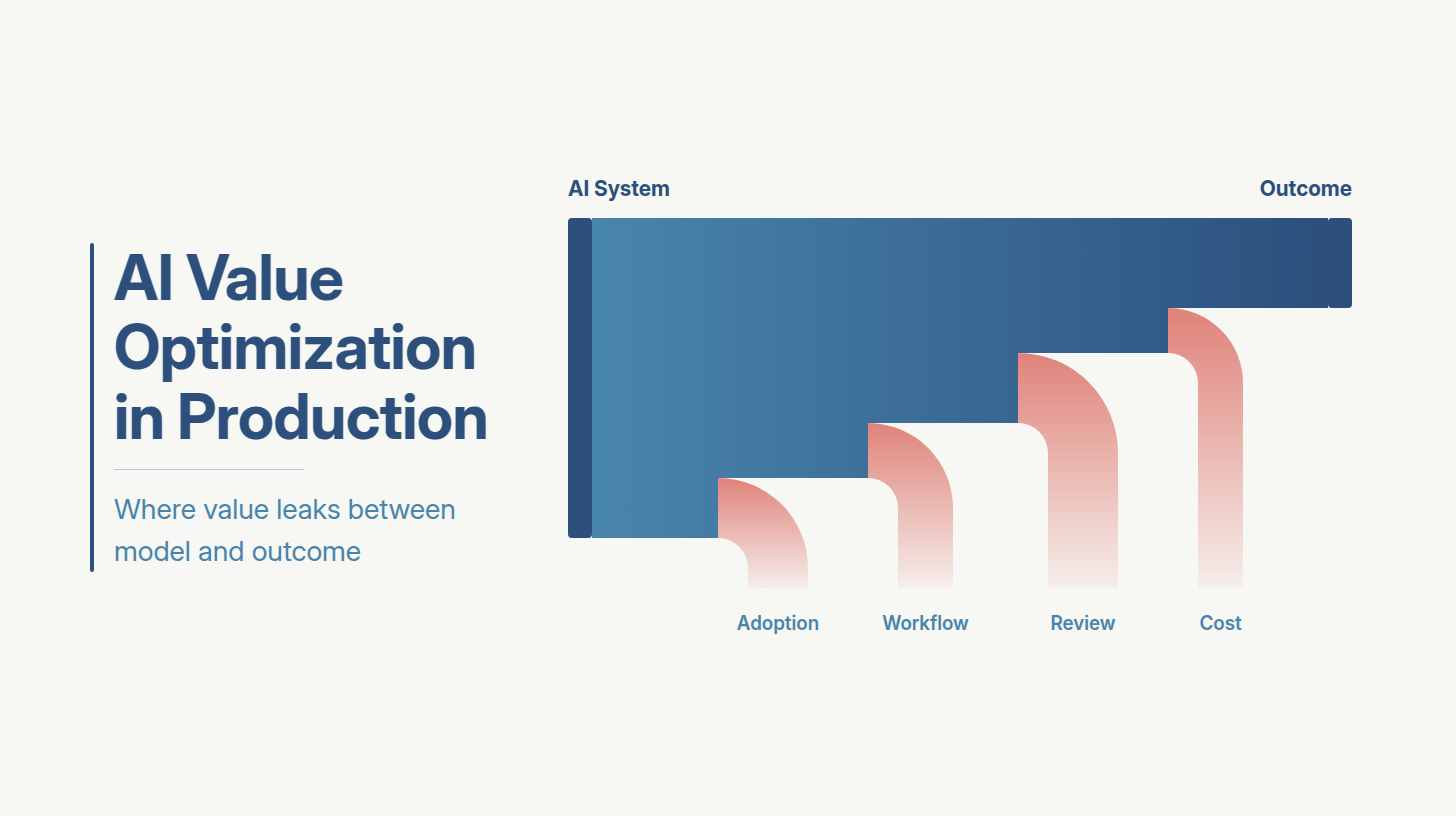

- Most AI initiatives in PE-backed portfolio companies stall quietly after a promising pilot and stop influencing operations without ever being formally cancelled.
- According to McKinsey, 60 percent of portfolio companies are experimenting with AI but only around 5 percent have scaled to production.
- Accenture's analysis of hundreds of use cases across nearly 40 portfolio companies found that nearly 90 percent of AI initiatives never move beyond pilot stage.
- The root cause is the post-acquisition data environment that the pilot phase never exposed, combined with a misalignment between operating partners, portfolio company CEOs, and IT teams on what the initiative should deliver and who owns it.
- This article explains the structural mechanism behind it, which AI use cases can survive fragmented post-acquisition data conditions, and the four questions PE operating partners should answer before funding any AI initiative after close.
Artificial intelligence has become a stated priority across private equity portfolios. In post-acquisition plans, AI is frequently positioned as a lever for operational efficiency, revenue growth, or differentiation.
Despite that intent, most AI initiatives in PE-backed portfolio companies stall after proof of concept. This is an execution problem rooted in post-M&A operating realities that are often underestimated.
According to BCG, 74 percent of companies still struggle to scale AI initiatives into real business impact. This article explains the structural mechanism behind these failures in the specific context of PE portfolio companies and gives operating partners a framework for identifying which AI initiatives can realistically scale given post-acquisition data conditions.
For background on the integration conditions that create these data challenges, see our analysis of post-merger integration challenges that slow PE performance.
Why AI Gets Prioritized Right After Acquisition and Why the Timing Creates Risk
When PE operating partners and portfolio CEOs champion AI initiatives post-acquisition, they're hiring AI to accomplish three critical jobs:
Proving Value Creation Velocity to Limited Partners and Exit Partners: You need to demonstrate that the acquisition is already generating operational improvements ideally within 12-18 months. AI represents a tangible, board-ready narrative of modernization and efficiency gains.
Unlocking Operational Efficiencies Without Headcount Expansion : Portfolio companies are under pressure to improve EBITDA margins while managing integration costs. AI promises to automate processes, optimize pricing, and reduce manual work without expanding the cost base.
De-Risking Future Valuation Through AI Readiness: Buyers increasingly discount portfolios that lack modern data infrastructure and AI capabilities. You're investing in AI not just for operational gains, but to avoid valuation haircuts at exit.
The problem here is that the operating conditions in the first 12 to 18 months after close are almost perfectly hostile to the kind of AI that actually moves EBITDA. The pressure to show AI momentum arrives before the infrastructure to support it exists.
The Real Pain Point: You're accountable for results, but you're executing in an environment where data systems are fragmented, teams are stretched across integration priorities, and every AI initiative competes with urgent operational firefighting.
There is also a three-way misalignment that makes early AI funding particularly risky.
- Operating partners measure success by EBITDA impact within the hold period.
- Portfolio company CEOs measure success by operational stability during integration.
- IT teams measure success by system uptime and integration completion.
None of these three groups are working from the same definition of what an AI initiative should deliver before it is funded. When this alignment is missing, the initiative proceeds without agreed success criteria, and zombie mode becomes the default outcome rather than the exception.
The False Readiness Signal: Why AI Pilots Succeed and Scaling Fails
Here's the pattern we see repeatedly:
Month 1-3 Post-Close: AI gets added to the 100-day plan. It's positioned as a quick win—a way to show boards and LPs that digital transformation is underway.
Month 4-6: A pilot launches. Data scientists manually clean a small dataset. The model shows promise. Everyone's excited.
Month 7-12: The pilot attempts to scale. Teams discover that:
- Customer data definitions differ across three acquired CRMs
- Revenue recognition rules are inconsistent between entities
- No single person owns data quality across systems
- IT teams are underwater with integration work
Month 13+: The AI initiative enters "zombie mode"not formally killed, but no longer influencing actual operations. Business users stop trusting the outputs. The budget gets quietly reallocated.
Why the Pilot Always Works
Pilots use manually cleaned datasets, while data scientists spend weeks preparing a small representative slice of data and the model performs well on that clean data. What the pilot never reveals is whether the data infrastructure can produce clean data at scale without that manual intervention every time.
Pilots use narrow and tightly controlled scope: one use case, one business unit, one data source. The scale attempt introduces multiple acquired entities, multiple CRM systems, and inconsistent revenue definitions. The model encounters data it was never trained on.
Pilots generate confidence at exactly the moment when skepticism is most needed. The positive pilot result becomes a board narrative and budget gets approved. At that point, raising data infrastructure concerns is politically difficult. The initiative proceeds into a predictable failure.
Why the False Readiness Signal Is Worse With Generative AI
The False Readiness Signal is especially pronounced with generative AI. A large language model produces genuinely impressive outputs on clean curated data, which makes board presentations and demos compelling. But when the same model is deployed against inconsistent enterprise data across multiple acquired systems, output quality drops sharply and the trust collapse happens faster than it did with traditional machine learning models. The gap between what the board sees in a demo and what the initiative delivers at scale is wider with generative AI than with any previous enterprise technology. This is why generative AI pilots in PE portfolio companies are entering zombie mode faster than traditional AI initiatives did.
What the False Readiness Signal Looks Like in Practice
- The data science team asks for a few more weeks to clean the data before scaling.
- Business users describe outputs as directionally right but not actionable.
- No single person in the organization can name which version of a revenue or margin metric is the authoritative one.
- The model performs well on the use cases shown in the demo but breaks on edge cases that appear constantly in real operations.
Most PE operating partners discover the False Readiness Signal after the budget is already spent. Our AI readiness assessment identifies it before your pilot begins. We map your current data conditions, flag which use cases will hit a wall at scale, and tell you exactly what needs to be in place before you fund the next initiative. Talk to our AI for PE team to get a clear picture of where your portfolio stands.
Talk to Our AI for PE Team
Why AI Becomes a Priority Immediately After Acquisition
After an acquisition, PE-backed companies face pressure to demonstrate momentum.
AI initiatives are attractive because they appear to offer:
- Fast efficiency gains
- Differentiation in crowded markets
- A compelling narrative for boards and future buyers
As a result, AI often enters the roadmap early, sometimes before foundational issues are resolved.
The Real Operating Conditions AI Is Introduced Into
In most PE portfolio companies, AI initiatives begin in environments with conditions including fragmented data systems, inconsistent metric definitions, and manual reconciliation processes, are the standard operating environment in most PE-backed portfolio companies within the first 12 months after close. The data foundation challenges that create this environment are covered in depth in our guide to scaling data platforms in PE portfolio companies.
These conditions are common. They are also hostile to reliable AI execution.
The Silent Failure Pattern: How AI Initiatives Stop Working Without Being Stopped
AI initiatives in PE portfolios rarely fail in visible ways. Instead, they stall.
Common patterns include:
- Models that produce inconsistent outputs
- Teams that cannot agree on which data t o trust
- Pilots that never move into production
- Quiet loss of confidence from business users
When AI outputs are not trusted, adoption stops. The initiative no longer influences operations.
Also Read: How private equity firms evaluate technology partners
What Silent Failure Mode Means
Silent Failure Mode is the state an AI initiative enters when model outputs are still being generated but no business decision is being made using them. The initiative is not cancelled. Budget may still be allocated. But the outputs are no longer trusted, referenced, or acted upon by the people it was built to serve. This state is widely referred to across enterprise AI literature as pilot purgatory and it is especially damaging in PE environments because the hold period does not allow time for repeated cycles of failure and restart.
Five Signs an AI Initiative Has Entered Silent Failure Mode
- Business users have stopped referencing the AI tool in weekly operations
- The data science team is still running the model but no stakeholder is requesting the output
- The initiative appears on the portfolio roadmap but has not been discussed at a portfolio review in 60 days
- No one can name a single operational decision the AI output influenced in the last quarter
- The initiative has been moved from active to monitoring in the project tracker without a formal evaluation
The Ownership Gap Behind Silent Failure Mode
FTI Consulting found that 40 percent of PE firms are managing AI investments at the portfolio company level with a fully decentralized model. This means every portfolio company independently figures out AI, failure lessons never travel across the portfolio, and when one initiative enters Silent Failure Mode the experience does not inform how the next initiative is structured at a different portfolio company. The absence of a shared governance framework across the portfolio is one of the structural reasons Silent Failure Mode repeats. Operating partners who are approving AI budgets at individual portfolio company level without a cross-portfolio governance model are funding the same failure pattern repeatedly.
Once one AI initiative enters Silent Failure Mode in a portfolio company, the next AI proposal faces institutional skepticism. The cost is not only the wasted budget. It is the organizational cynicism that makes the next initiative harder to fund, harder to staff, and harder to sustain past pilot stage. Buyers conducting technology diligence increasingly assess whether AI capabilities are operational or merely piloted. Portfolio companies where AI has entered Silent Failure Mode face valuation questions they cannot answer with confidence at exit
The root cause behind both the False Readiness Signal and the Zombie Mode Pattern is the same. AI systems require data that is consistent, owned, and accessible across the full portfolio, not just a manually curated slice prepared for a pilot. Building that foundation is a prerequisite step, not a parallel workstream. See our guide to [scaling data platforms in PE portfolio companies] for the architecture and sequencing that works in practice.
The Impact on Portfolio Operating Cadence
Stalled AI initiatives have broader consequences than wasted investment.
They often lead to:
- Reduced confidence in technology initiatives
- Increased skepticism from business leaders
- Slower decision-making due to mistrust in analytics
Over time, this erodes momentum across the portfolio rather than accelerating it.
If AI initiatives are a priority in your portfolio, early assessment of data readiness and execution capacity can prevent wasted effort later
Discuss AI Execution Support for Your Portfolio
What Successful PE Portfolios Do Differently With AI
Portfolios that make consistent progress with AI treat data foundation and integration work as prerequisites, not parallel workstreams. The sequencing that works across PE-backed portfolio companies is covered in detail in our PE technology integration playbook.
Which AI Use Cases Can Survive Post-Acquisition Data Conditions and Which Cannot
Not all AI use cases have the same data requirements. Use cases that operate on self-contained data can function in fragmented post-acquisition environments. Use cases that require unified definitions of customers, revenue, or products across acquired entities cannot scale until data foundation work is complete. Accenture's analysis of portfolio company AI use cases confirms that real value clusters around specific functions rather than broad transformation, with back-office and document-intensive workflows delivering the most reliable returns in environments with fragmented data infrastructure. Understanding which use case category your proposed initiative falls into is the most practical decision a PE operating partner can make before approving AI budgets post-acquisition.
The pattern is consistent. Operating partners who map proposed AI use cases against current data maturity before funding avoid the False Readiness Signal. Those who do not will fund use cases that look promising in a pilot and collide with data fragmentation at scale. The use cases in the partial and no categories are not wrong choices for the long term. They are wrong choices for the first 12 to 18 months post-close before data foundations are stable.
Not sure which column your proposed AI initiative falls into? Unsure which AI use cases fit your current data maturity? Our free AI Use Case Sprint gives you 2 to 3 prioritized opportunities with return on investment estimates in two weeks.
Talk to Our AI for PE Team
How Ideas2IT Supports AI Execution in PE Portfolios
Ideas2IT works with private equity firms and PE-backed portfolio companies to align AI initiatives with post-M&A operating realities.
Our work typically includes:
- AI readiness assessments grounded in data and integration maturity
- Data foundation and integration programs designed for portfolio environments
- AI use case prioritization tied to measurable outcomes
- Execution support models that scale delivery capacity without permanent overhead
The focus is on enabling AI adoption that survives beyond pilot stages.
Four Questions PE Operating Partners Should Answer Before Funding AI
Before approving AI budgets, PE operating partners and portfolio leaders should ask:
Can someone name the single authoritative source for the top metrics this AI initiative will use?
If the answer involves a meeting, a spreadsheet reconciliation, or the phrase "it depends which system you pull from," the data infrastructure is not ready for AI at scale.
Is the AI initiative staffed as a dedicated workstream or absorbed into a team already running integration?
AI initiatives absorbed into integration teams get deprioritized every time an integration issue surfaces. In the first 12 months after close, that happens constantly.
Have operating partners, portfolio company leadership, and IT teams agreed in writing on what success looks like before the pilot begins?
This is the organizational alignment question that most AI funding decisions skip entirely. Without agreement across all three groups on what a successful outcome looks like and by when, there is no shared basis for deciding whether to scale or cancel. Zombie mode fills that governance vacuum.
Has this portfolio company experienced a previous AI initiative that entered Zombie Mode?
If yes, the next initiative requires a formal kill gate. A specific date and specific operational metrics against which the initiative will be evaluated and either scaled or cancelled. Without it, Zombie Mode is the default outcome again.
These questions area funding gate. If any answer is unclear, the AI initiative is not ready to be funded at scale. Clear answers to these questions reduce the risk of stalled initiatives.
How Ideas2IT Helps PE Portfolio Companies Move Beyond Pilot Stage
Ideas2IT works with PE operating partners specifically at the gap between pilot success and production-ready AI. The work focuses on three things: identifying which use cases can scale with current data conditions, identifying which require data foundation work first, and building the initiative governance that prevents Zombie Mode by making success and failure criteria explicit before a pilot begin.
Many private equity portfolios prioritize AI immediately after acquisition, but initiatives often stall when data foundations and governance structures are not yet in place.
Ideas2IT works with PE firms and portfolio companies to help translate AI ambition into operational outcomes.
If AI is on your value creation plan, tell us where your portfolio stands. We will come back with a clear view of what to fund now, what to sequence later, and what is putting your current initiatives at risk. We help portfolio companies identify AI initiatives that deliver measurable value.
Our approach focuses on:
- prioritizing AI opportunities tied to cost reduction or margin expansion
- defining ROI-backed use cases rather than experimentation
- establishing governance frameworks with clear execution gates
- aligning AI initiatives with portfolio operating timelines
Frequently Asked Questions
FAQ's