
This piece covers three things:
• Where AI creates the most leverage in each underwriting function and what the carriers and lenders who moved first have already built.
• What the three types of AI (Generative, Agentic, AI Agents) mean as deployment bets and which to make first given where you are.
• What the actual failure modes look like why STP plateaus at 60%, why model accuracy stagnates, and what regulators are finding in AI examinations.
The carriers and lenders that deployed AI underwriting in 2022 and 2023 are not incrementally ahead. They are operating on a structurally different information set. AIG processes 200,000 E&S submissions per year without adding underwriters. Upstart approves 101% more borrowers at the same default rate. These are operations stories about which tasks in the underwriting workflow were handed to which type of AI, in what sequence, built on what data infrastructure.
None of these results came from buying a platform and turning it on. They came from three specific architecture decisions: which AI layer to deploy at which stage, what data to feed it, and how to build the feedback loop that makes the model improve from production experience rather than stagnate after six months. This piece covers exactly those three decisions, by function, with the production evidence behind each one.
Most operations that have deployed AI underwriting have deployed pieces of it. A document extraction tool here, a scoring model there. The piece they are missing is the architecture view: which use cases live in which domain, which horizontal components they share, and how the whole system learns from production rather than stagnating after six months. The framework below provides that view at a glance.
The framework above is the architecture decision. The three domains Submission & Intake, Risk Assessment & Pricing, Decisioning & Portfolio map directly to how underwriters think about their workflow. The six horizontal components below them are the building blocks that separate an integrated AI underwriting architecture from a collection of disconnected pilots. Operations that build these six components once and deploy them across use cases get to their third and fourth use case significantly faster than those rebuilding an extraction pipeline, validation layer, and data integration from scratch for each one.
Why the type of AI matters more than the use case
Before examining each domain, there is a decision that determines whether an AI underwriting program compounds or stagnates. Most organizations treat all AI as one category. Generative AI, agentic AI, and AI agents are not variations on the same technology they are different deployment bets with different timelines, different failure modes, and different payoffs.
The Three AI Deployment Usecase Bets
Most coverage of AI in underwriting treats all AI as one thing. The three types represent different deployment bets with different timelines, different risk profiles, and different payoffs. Choosing which to make first is the most consequential decision in an AI underwriting program.
The Document Intelligence Bet: Generative AI
What it delivers: AI that reads any unstructured document, broker submissions, loss runs, financial statements, medical records, engineering reports and returns structured, validated data. Answers underwriter questions in natural language. Drafts adverse action notices, risk memos, coverage summaries.
Best first bet for: Any operation where underwriters spend significant time reading and organizing documents before the actual risk judgment begins.
Timeline to production value: The value timeline is the fastest. Document intelligence can be in production in 8–12 weeks on a defined document type. ROI is immediate and measurable in hours recovered.
The Straight-Through Processing Bet: Agentic AI
What it delivers: AI that orchestrates entire underwriting workflows end-to-end from submission receipt through pricing and binding without human handoffs on standard, in-appetite risks. Straight-through processing (STP) at 80–91% on eligible volume.
Best first bet for: Operations with high submission volume and a well-defined in-appetite risk profile. The clearer the appetite, the higher the STP rate achievable.
Timeline to production value: The value timeline is longer from 6 to 12 months to meaningful STP lift depending on data environment. Highest long-term payoff and the most common implementation failure point.
The Precision Workflow Bet: AI Agents
What it delivers: Specialized AI workers that own a specific task in the workflow a fraud detection agent, a compliance checking agent, a covenant monitoring agent, a pricing exception agent. Each runs independently and multiple agents coordinate in a pipeline.
Best first bet for: Complex workflows where different tasks require different data sources, systems, or rules. Where the bottleneck is a specific, repetitive, high-volume task.
Timeline to production value: The value timeline is moderate from 10–16 weeks per agent. Highest precision on specific tasks builds toward a coordinated system over time.
The sequencing question: most operations should start with Generative AI for document intelligence. It delivers the fastest ROI, requires the least systems integration, and builds the organizational confidence that makes the harder Agentic AI bet achievable. Operations that jump directly to Agentic AI without first solving their data pipeline and document quality problems almost always plateau at 40–50% STP and cannot diagnose why.
Where the Leverage is by Underwriting Function
These sections are not explanations of how underwriting works. They cover where AI changes the economics of each function and what the operations that got there first have already built.
Domain 1: Submission Triage & Intake
The submission arrives as an unstructured package. In commercial insurance, that is an ACORD form, loss runs, a schedule of values, inspection reports, and broker emails sometimes 200 pages for a single account. In mortgage, it is pay stubs, tax returns, bank statements, and appraisals. In life insurance, it is an application form eventually followed by an attending physician statement and prescription history. In consumer lending, it is an application and supporting documents that may or may not be genuine.
Every minute that package sits in a manual intake queue is a minute a competitor's model may already be pricing it. The intake domain is a risk selection problem. The carriers who price first choose the risks they want. Their competitors price what remains.
The bigger shift: AI triage filters out-of-appetite risks at intake, so underwriters only open files that are already within appetite parameters, enriched with external data, and organized for a decision.
Use Case 1.1: AI submission triage orchestrates the full intake workflow without human handoffs on standard risks. The system reads every document in the package, extracts structured data, checks the risk against appetite parameters, identifies hard declination triggers, enriches the package with external data (aerial imagery, credit bureau, loss history, security scan results), and routes the risk. The underwriter opens a file already organized, enriched, and triaged to just decide. Hiscox deployed this on London Market terrorism and sabotage business using Google Cloud Gemini, live August 2024, intake-to-quote time went from 72 hours to 3 minutes.[1] AIG processes 200,000 E&S submissions per year through the same architecture without adding underwriting headcount, with data accuracy improving from 75% to over 90%.[2]
Use Case 1.2: document intelligence is the Generative AI layer that reads any document and returns validated structured data. This understands context: "net income" on a Schedule E means something different from "net income" on a P&L. It cross-validates: stated income against source documents, appraisal values against comparable data, prescription history against MIB records. It flags discrepancies, the ones a time-pressured human reviewer misses. Rocket Mortgage's Rocket Logic platform processes 1.5 million documents per month, extracts 90% of data points without human input, and saves over 9,000 underwriter hours monthly.[6]
Use Case 1.3: fraud detection at intake is an AI Agent that runs on every submitted document before human review. AI-generated document fabrication increased 5X between April and December 2025. One in 16 submitted documents now shows signs of fabrication. The tools for generating convincing synthetic pay stubs and bank statements are accessible without technical expertise, and cost under $20. Manual review cannot detect this at volume or at this level of sophistication. The agent analyzes file metadata anomalies, formatting irregularities, pixel-level editing marks, and deviations from authenticated source templates. Consortium-trained models add a network layer: fraud schemes that touch 50 lenders simultaneously show up clearly in a 300-million-application dataset and are invisible to each of the 50 independently. Ocrolus Detect detects 10 times more fraud than manual review with a true positive rate above 90%.[9]
Deployment decision: Start with Generative AI for document extraction and appetite triage. Scope to your highest-volume submission type and measure STP rate and time-to-first-response. This is the entry point for the Agentic AI build that follows.
Domain 2: Risk Assessment & Pricing
The foundational shift in risk assessment is from proxies to measurements. Bureau scores proxy creditworthiness from prior payment history on existing accounts. Static rate tables proxy insurance risk from demographic segments and historical loss averages. These correlate with risk at the population level and cannot assess an individual. A model trained on 2,500 behavioral variables can. The carriers and lenders that made this shift earlier have data advantages that are now 3 to 4 years deep. That is a data vintage gap, and it grows every year.
Use Case 2.1: ML risk scoring evaluates hundreds to thousands of variables simultaneously, including non-linear interactions between variables that rules-based scoring cannot capture. The model assesses how a borrower or insured is likely to behave from the full pattern of their financial, behavioral, and health data rather than from how they have behaved on existing accounts. Upstart, deployed across 100-plus bank and credit union partners with 91 million monthly repayment events in its training dataset, approves 101% more borrowers at the same default rate compared to traditional models.[3]
Use Case 2.2: dynamic pricing replaces static rate tables with models that train continuously from production loss outcomes. Progressive Snapshot prices 27 million enrolled drivers from behavioral telematics data with a rate modification range of plus or minus 40%, up from plus or minus 10% at launch. The FY2025 combined ratio was 87.4%.[11]
Use Case 2.3: the accelerated underwriting engine assesses mortality and morbidity risk for individual life and health applications without requiring blood draws, attending physician statements, or lab work. The engine evaluates prescription database records via Milliman IntelliScript, MIB reports, electronic health records, motor vehicle records, and behavioral data from wearables. Gen Re's 2025 survey of 30 carriers representing $827 billion in volume found that 57–59% of individual life applications are now AU-eligible, with programs achieving 86% placement rates versus 63% for traditional fully-underwritten cases.[16]
Deployment decision: The first question to answer is about data. Identify which risk segments in your book are being assessed from proxies where measured signals are available. The AI is straightforward. Getting the data pipeline to feed it is the actual work and it is the work that determines whether the model improvement is real.
Domain 3: Decisioning & Portfolio Management
The decision domain is where regulatory stakes are highest and where the compounding advantage either appears or fails to appear. Every AI-driven decline in consumer lending requires a specific, attributable adverse action notice under ECOA. Every AI underwriting program in insurance is now subject to NAIC examination guidance in 24 states plus DC. The NAIC's 12-state AI Systems Evaluation Tool pilot launched in March 2026.[19] Documentation needs to exist before the model is deployed, not assembled in response to an examination request.
Use Case 3.1: straight-through processing is where the agentic system makes the binding decision and generates all documentation for in-appetite, standard risks that score within authority limits and pass all validation checks. The underwriter's time is reserved for genuinely complex, novel, or large risks. STP rate the percentage of decisions made without human review is the primary operational metric. Upstart automates 91% of personal loan decisions at zero human review.[3]
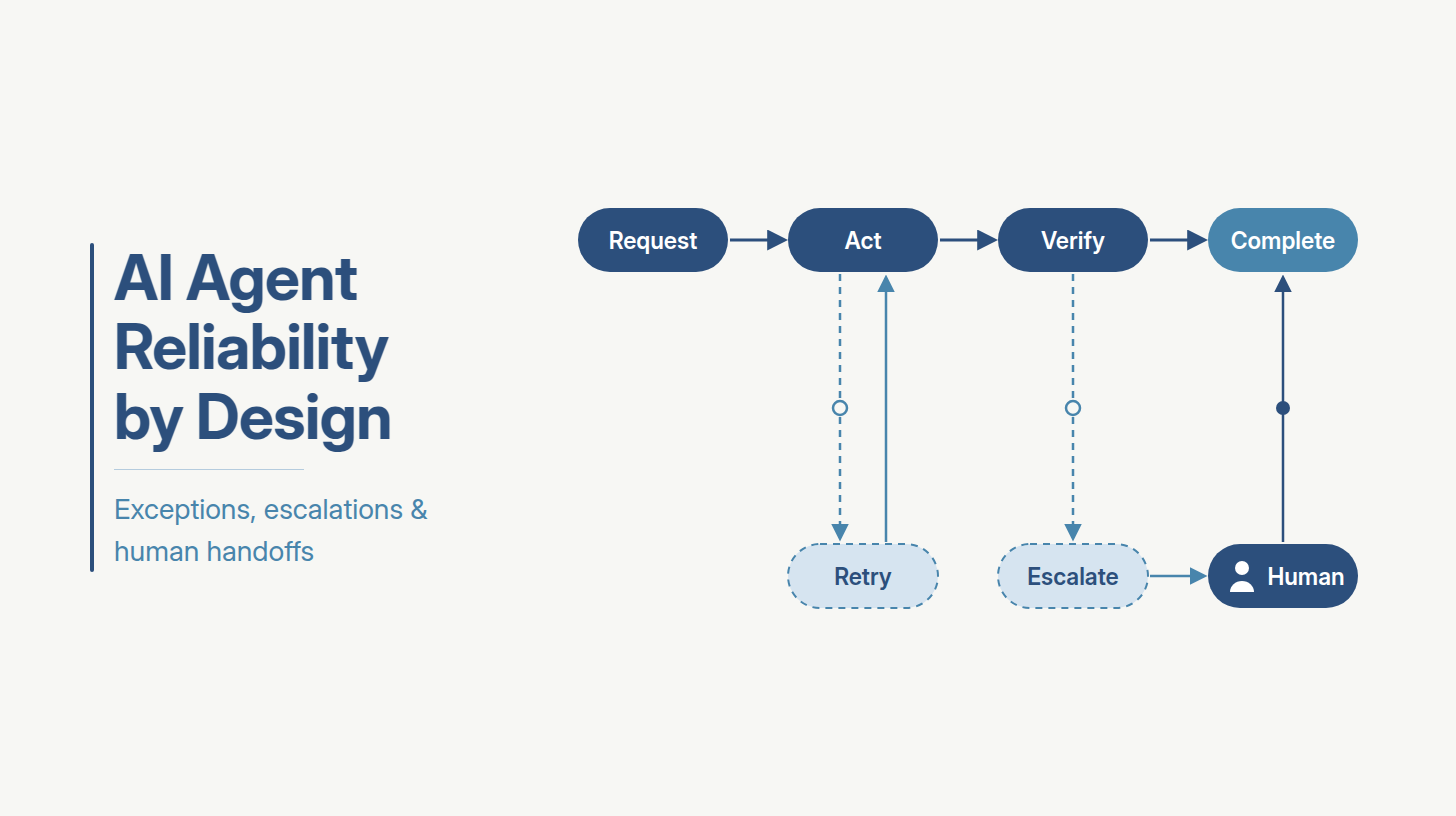
Most programs plateau at 40–60% STP and cannot improve. The cause is almost always the same: the model is not learning from production overrides. When an underwriter corrects the model's recommendation and that correction is not captured with a structured reason code and fed back into the retraining pipeline, the model stagnates on that segment. The STP ceiling is the absence of Component 5, the feedback loop built into the architecture from the start.
Use Case 3.2: adverse action generation produces compliant adverse action notices for every AI-driven decline or modification. An ML model that evaluated 2,500 variables cannot produce a meaningful adverse action notice from a pre-written template. The system must identify which factors from the model's actual decision most materially influenced the outcome and translate them into the plain language ECOA requires: not "insufficient credit" but "debt-to-income ratio exceeds program maximum."
Use Case 3.3: portfolio monitoring and renewal triage runs the in-force book continuously. Renewal triage routes expiring policies: straight-through re-rate for unchanged risks, re-underwriting referral for materially changed ones. Bordereaux data for reinsurance reporting is produced from policy administration data without manual extraction.
Use Case 3.4: covenant monitoring reads borrower financial statements, extracts the specific metrics required by each loan agreement, and checks them against covenant thresholds continuously. Traditional covenant monitoring is a quarterly manual cycle: borrower delivers statements, analyst reads and spreads them, ratios are checked. For a large commercial book, this takes 2–4 weeks per quarter and produces compliance snapshots that are outdated by review time. The AI covenant monitoring agent processes statements on the day they arrive. It flags outright breaches, metrics within defined proximity of breach thresholds as early warnings, and trends suggesting a future breach before it occurs surfacing renegotiation opportunities 30–90 days earlier than a quarterly batch process, a material difference in recovery position for deteriorating credits.
Deployment decision: Renewal triage and covenant monitoring are high-ROI Agentic AI deployments because they run continuously on existing data. The model needs the existing data to flow through a workflow that was previously manual. A Renewal Triage Agent or Covenant Monitoring Agent built on the existing policy or loan data produces value immediately and improves as it accumulates renewal decisions.
Every use case in the three domains draws on shared building blocks. The operations that build these six components as shared infrastructure rather than rebuilding them per use case get to their second and third use case dramatically faster and the whole architecture improves as a system rather than as isolated tools.
Ready to map this to your specific operation?
Ideas2IT offers a $0 scoping session: which domain is the right entry point, which horizontal components you already have versus need to build, what the data gaps are, and a realistic build sequence and timeline for your vertical and regulatory environment.
Book a $0 Scoping Session →
The Highest-ROI AI Application by Industry
The underwriting function structure is consistent across industries. What changes is the data source AI unlocks and the specific metric that moves.
The Three Failure Modes Most AI Underwriting Programs Hit
These are operational failure patterns. Every one of them is recoverable but recovery after deployment costs more than prevention before it.
Failure Mode 1: The STP Plateau at 60%
Most AI underwriting programs reach 40–60% straight-through processing and stop improving. The model accuracy on standard risks is fine. The number refuses to move.
The cause is almost always the same: the model is not learning from production. When an underwriter overrides the model's recommendation on a segment where the model is consistently wrong and that correction is never logged with structured reason codes and fed back into the retraining cycle, the model stagnates. The STP rate on that segment stays at whatever it was on day one.
Failure Mode 2: Model Accuracy Stagnation from Data Drift
A model trained on 2022 data is pricing 2026 risk. Application mix shifts, broker behavior changes, macroeconomic conditions evolve. The model does not know any of this. Its feature distributions are moving away from the training baseline, and if no one is monitoring, the pricing accuracy degrades silently.
Failure Mode 3: The Governance Gap Found in Examination
The NAIC's 2025 health insurance AI survey found that one-third of health insurers have no regular bias testing, and 71% have no consumer contestability process. [16] The 12-state NAIC AI Systems Evaluation Tool pilot launched in March 2026. [17] The Massachusetts AG settled with Earnest Operations for $2.5 million in July 2025, the first enforcement action specifically targeting AI underwriting bias. [18]
Where to Start: A Decision Framework for CUOs
The right starting point depends on where the highest-volume bottleneck is and what data is available to feed the model. Four diagnostic questions:
1. Where is your team spending the most time before the actual risk judgment begins?
If the answer is document preparation, start with Generative AI for document intelligence. Target metric: hours per submission. Expected timeline to production value: 8 to 12 weeks.
2. Which segments in your book are you pricing from proxies where measured data is acquirable?
That is your dynamic pricing bet. Telematics for auto, live scan for cyber, EHR for life AU, bank transaction data for consumer and SMB lending. Target metric: loss ratio improvement on the repriced segment. Timeline: one full pricing cycle to confirm.
3. What is your current STP rate and do you have a structured feedback loop?
If STP is below 60% and there is no override capture architecture, the Agentic AI build has a ceiling before it starts. Fix the feedback loop first. Then build to 80 to 91% STP.
4. Do you have a written AI governance program, documented bias testing, and individual-decision-level explainability?
If not, these are not optional pre-build tasks. They are the prerequisite for the AI program continuing past the first regulatory examination. The NAIC 12-state examination pilot launched March 2026. The Massachusetts AG settlement in July 2025 set the enforcement template.
How Ideas2IT Builds AI Underwriting Systems
Ideas2IT builds AI underwriting systems for the insurance and financial services organizations that cannot afford to reach 60% STP and plateau there. The work is architecture specifically, the data pipeline, the feedback loop, and the governance layer that determine whether the model improves from production experience or stagnates after six months.
Forward Deployed Engineers embed inside the client's existing environment from Day 0, the policy administration system, the LMS, the data architecture, the underwriting workflow. The same team that designs the data unification layer owns the production deployment. A platform serving 1,300+ community-based care organizations runs on Ideas2IT-built infrastructure.
Most AI underwriting programs that plateau at 60% STP have the same root cause: no structured feedback loop from production overrides back into model retraining. If your automation rate is not moving, or you are about to start a build and want to avoid this before it happens, a 45-minute scoping session with Ideas2IT's underwriting engineering team will identify exactly where your architecture is creating the ceiling.
Book your $0 session.
References
[1] Hiscox Group, “Hiscox’s generative AI-enhanced lead underwriting model enabled by Google Cloud goes live.” December 8, 2024. https://www.hiscoxgroup.com/news/press-releases/2024/12-08-24
[2] Carrier Management, “Telematics Master Class: How Progressive Offers Competitive Prices.” 27M enrolled, ±40% rate modification, 87.4% FY2025 combined ratio. https://www.carriermanagement.com/news/2023/03/07/245838.htm
[3] Banking Dive, “Upstart boosts loan approval 27% with alternative data in CFPB test.” 101% more approvals, 91% automation. https://www.bankingdive.com/news/upstart-CFPB-alternative-credit-data-test/560426/
[4] Carrier Management, “AIG: Turning One Human Underwriter Into Five, ‘Turbocharging’ E&S.” April 2025. https://www.carriermanagement.com/features/2025/04/28/274588.htm
[5] FFNews, “Markel Records 113% Productivity Increase Following Cytora Partnership.” https://ffnews.com/newsarticle/insurtech/markel-records-113-productivity-increase-in-its-underwriting-team-following-cytora-partnership/
[6] Rocket Companies, "Rocket Companies Introduces Rocket Logic AI Platform to Make Homeownership Faster and Easier". https://www.rocketcompanies.com/press-release/rocket-companies-introduces-rocket-logic-ai-platform-to-make-homeownership-faster-and-easier/
[7] Zest AI, VyStar Credit Union Case Study. +22% approvals, $40M new annual credit, 24% lower delinquencies. https://www.zest.ai/learn/success_stories/vystar-cu/
[8] Coalition / Corvus Insurance, Coalition: 64% fewer claims than industry average. Corvus: 36% ultimate loss ratio 2022. https://aragonway.com/cyber-insurance/coalition/
[9] Munich Re, U.S. AU trends. EHR ranked #1 protective value 20% of decisions change when EHR is added. 66% of carriers estimate 6–15% mortality slippage. https://www.munichre.com/us-life/en/insights/future-of-risk/ehr-retro-studies--non-fluid-accelerated-underwriting-.html
[10] CAPE Analytics, 110M US structures, 80+ enterprise clients, 95% roof age accuracy. Acquired by Moody’s January 2025. https://capeanalytics.com/resources/roof-age-solution/
[11] Root, Inc., Q3 2025 Shareholder Letter. Loss ratio 58% Q1 2025, down from 96.5% FY2021. https://ir.joinroot.com/static-files/88dab31a-3160-4d86-9954-85f66a7d9b5b
[12] Gen Re, “Individual Life Accelerated Underwriting Highlights of 2024 U.S. Survey.” 57–59% AU-eligible, 86% vs. 63% placement, 5-day vs. 23-day average. https://www.genre.com/us/knowledge/publications/2024/november/surveylhau24-en
[13] AAAI / MassMutual, “Transforming Underwriting in the Life Insurance Industry.” M3S: 6% lower projected mortality loss, 40-second median decision. https://ojs.aaai.org/index.php/AAAI/article/download/4985/4858
[14] Ocrolus, Detect: 10X more fraud detected vs. manual review, >90% true positive rate. https://www.ocrolus.com/fraud-detection/document-fraud/
[15] Fannie Mae / PR Newswire, “Fannie Mae Launches AI Fraud Detection Technology Partnership with Palantir.” May 2025. https://www.fanniemae.com/newsroom/fannie-mae-news/fannie-mae-launches-ai-fraud-detection-technology-partnership-palantir
[16] NAIC, “NAIC Survey Reveals Majority of Health Insurers Embrace AI.” 84% use AI; one-third lack bias testing; 71% lack contestability. https://content.naic.org/article/naic-survey-reveals-majority-health-insurers-embrace-ai
[17] Fenwick & West, “NAIC Expands AI Systems Evaluation Tool Pilot Program to 12 States.” March 2026. https://www.fenwick.com/insights/publications/naic-expands-ai-systems-evaluation-tool-pilot-program-to-12-states-key-updates-for-insurers-and-ai-vendors-supporting-insurers
[18] Consumer Finance Monitor, “Massachusetts AG settles with Earnest Operations LLC.” $2.5M, July 2025. https://www.consumerfinancemonitor.com/2025/07/18/massachusetts-ag-reaches-settlement-with-student-loan-company-earnest-operations-llc/