Just In
Ideas2IT is now an OpenAI Select Partner - recognized to help enterprises build, deploy, and scale AI with GPT-5, responsibly and at speed.
Read the announcement
A Micro GCC is a dedicated engineering team built and operated in India by a specialist partner, on behalf of a US company, under the client's brand, OKRs, and product roadmap. The model sits between outsourcing and a captive entity, and the partner you choose determines which one it actually becomes in practice.
For an enterprise, a Micro GCC represents a focused, high-leverage engineering unit built to solve specific transformation priorities, AI adoption, data platform modernization, or product acceleration without the overhead of a full-scale GCC.
Instead of building a 200–500 person offshore center over 12–18 months, enterprises deploy a Micro GCC as a 10–40 member, AI-native team that integrates directly into core business and technology workflows.
This changes what a GCC is expected to do.
Traditional GCC mindset:
Micro GCC reality:
A Micro GCC is closer to a forward-deployed engineering unit than a remote delivery center. It operates inside the enterprise’s roadmap.
The model is designed for enterprises that:
In practice, a Micro GCC becomes the starting point for capability building. High-performing Micro GCCs often expand into full-scale GCCs but only after proving measurable business impact.
Every Micro GCC vendor presents the same pitch: dedicated team, your brand, your culture, embedded delivery, full IP ownership. The language is consistent because the slide decks are consistent. What differs and what almost no buyer examines before signing is the operational architecture underneath that language. Who owns the team's output targets? How does the India-side delivery lead connect to your OKRs? What happens to the institutional knowledge your engineers accumulate when the engagement ends or a senior engineer rotates to a higher-margin account? These are the variables that determine whether a Micro GCC compounds in value over three years or quietly becomes another line item on a vendor invoice.
This guide covers the full decision chain: what the model actually promises, the four distinct partner types operating in this space, how to evaluate and score any partner before you sign, what the first 90 days should tell you, and what a well-structured engagement looks like in practice.
The Micro GCC model is a specific answer to a specific failure mode: the governance costs, knowledge drain, and incentive misalignment built into conventional outsourcing and staff augmentation. It makes three structural promises that distinguish it from those models.
Owned accountability: The partner builds and operates a delivery function, but accountability for product outcomes is contractually shared with the client. The India-side delivery lead is measured against your OKRs and your sprint metrics. The implication is direct: when your delivery trajectory stalls, there is a named person on the partner's side whose performance depends on fixing it.
Compounding knowledge: Engineers in a well-structured Micro GCC accumulate institutional knowledge of your codebase, architecture, and business context inside your systems. That knowledge compounds with every sprint. NASSCOM's 2025 GCC Evolution Report found that GCCs with clearly defined product mandates retain engineers 2.3 times longer than those without. [2] The retention is a consequence of the knowledge architecture: engineers who own product context stay.
Delivery infrastructure that doesn't depend on the client: A Micro GCC partner who relies entirely on the client's existing tools and processes is not a delivery system, they are headcount with a different org chart. A well-structured partner brings proprietary delivery infrastructure: tooling, documented delivery patterns, platform depth that accelerates the engagement structurally. The client should not have to build the operational scaffolding for their own Micro GCC.
The test for any Micro GCC vendor is simple: which of these three promises is actually in the contract, and what happens when they don't deliver on it?
Three mechanisms explain why a Micro GCC engagement collapses into managed-service dynamics even when both parties intend otherwise.
First, accountability sits with account managers rather than delivery leaders. The person who attends your quarterly review is measured on renewal probability. Second, the India-side team is evaluated on utilization and SLA compliance rather than product outcomes which means their incentives diverge from yours the moment a sprint underdelivers. Third, institutional knowledge of your codebase, architecture decisions, and business context accumulates inside the partner's environment. When a senior engineer rotates off to a higher-margin account, that knowledge leaves with them.
This is the operational gap between a Micro GCC and traditional outsourcing or staff augmentation.
Outsourcing is transactional by design: the vendor owns the delivery model and is accountable to defined outputs.
Staff augmentation places engineers inside your structure but leaves governance entirely to you. A Micro GCC, correctly structured, sits between those two: the partner builds and operates the delivery function, but accountability for product outcomes is contractually and operationally shared. The word 'correctly' is doing significant work in that sentence.
The cost consequence is concrete. Vendor governance overhead, program managers, SLA reviews, escalation paths, and contract renewals on your side runs at 5 to 8 percent of total engagement value annually. [2] On a three-million-dollar engagement, that is up to two hundred and forty thousand dollars per year spent managing a vendor rather than building a product. Separately, vendor margins on outsourced teams typically run 25 to 45 percent above actual talent cost, the equivalent of 12 to 22 engineers on your invoice every month who are not building anything for you. [3] A well-structured Micro GCC eliminates both costs. A poorly structured one carries them under a different name.
The research on what predicts failure is direct. Governance gaps in the first 12 months of a GCC engagement are the single strongest predictor of whether that engagement succeeds or collapses by month 24. [4] Most buyers discover those gaps after the contract is signed.
Most buyers treat Micro GCC partners as interchangeable. Four distinct partner types operate in this space, and the type determines the ceiling on what the engagement can deliver. Understanding the landscape is the prerequisite to evaluating any specific partner.
1. Pure-Play Micro GCC Operators
What they do: India-based firms that specialize in setting up and running GCC operations. Strong on compliance, entity structure, labor law, and transfer pricing. Their core capability is operational infrastructure, HR, payroll, office build-out, regulatory compliance.
Best for: Companies that want to own a legal entity in India and need a specialist to build the operational foundation. Best in the first 18 months of a captive-track engagement.
Watch for: Delivery depth varies significantly. Many have strong operations capabilities and shallow engineering capabilities. Verify that the partner who sets up your center is not also responsible for hiring standards and technical delivery quality.
2. BOT (Build-Operate-Transfer) Specialists
What they do: Partner builds and operates your center for 18 to 36 months, then transfers full ownership to you. You get speed to first hire (8 to 16 weeks versus 16 to 24 for captive setup),
Watch for: Companies with a 3 to 5 year India commitment and the appetite to own the entity eventually. BOT was the entry strategy for several major enterprise GCC builds.
3. Engineering Services Firms with Embedded Delivery Models
What they do: Deliver a staffed, operating engineering function inside the client's product environment embedded from day one in the client's stack, standups, and OKRs. Knowledge lives in client-owned systems. Accountability is shared at the delivery level.
Best for: Companies that need delivery depth, not just operational infrastructure. The right fit when engineering is core to your product and the engagement needs to compound in value rather than simply execute against a backlog.
Watch for: This category has the widest quality variance of the four types. The pitch language is identical across strong and weak partners. The evaluation framework in Section 5 was designed specifically to separate them.
4. EOR-Led Arrangements
What they do: Employer of Record providers place engineers in India compliantly without requiring a legal entity. Fast to spin up (weeks, not months), low commitment, no capex. Frequently pitched as a Micro GCC entry point.
Best for: Companies testing India's talent market before committing to a full model. A legitimate bridge for pilot teams of 10 to 30 engineers before transitioning to a captive or BOT arrangement.
Watch for: An EOR arrangement is not a Micro GCC. The engineers are legally employed by the EOR provider, not by the client. IP ownership, governance structure, and accountability architecture are all materially different. If a partner is pitching EOR as a Micro GCC, clarify the distinction before the proposal stage.
The selection criteria question follows directly: most buyers in the market are evaluating Type 3 partners: engineering services firms who claim an embedded delivery model. That claim is the hardest to verify and the most consequential to get wrong. The framework below was built for exactly that evaluation
What follows is a diagnostic eight questions designed to surface the operational architecture beneath the pitch. For each one, a credible answer looks specific and structural. A weak answer involves a lot of reassurance and very few details.
1. Who owns our delivery on your India side and what are they measured on?
This question probes the accountability structure before it becomes a governance problem. The India-side leader in a well-structured engagement is measured on your sprint velocity, release quality, and OKR progress instead of on utilization rates and account retention. NASSCOM's 2025 GCC Evolution Report found that GCCs with clearly defined product mandates retain engineers 2.3 times longer than those with vague 'support the HQ team' briefs. [5] The implication runs in both directions: when the India-side leader does not own a defined product outcome, neither retention nor delivery compounds over time.
A credible answer names the delivery lead, describes their reporting structure, and explains which of your business metrics they are held against. Deflection sounds like: 'Our engagement manager will be your primary point of contact.'
2. How does your team learn our product and where does that knowledge stay when someone leaves?
Knowledge ownership is the sleeper variable in every Micro GCC evaluation. Most buyers think about IP ownership in terms of legal contract language. The more consequential question is operational: does institutional understanding of your codebase, architecture decisions, and business logic accumulate in your systems or the partner's?
A credible answer includes a named onboarding process, a clear statement on which tools, wikis, and repositories the team works in from Day 1, and a description of how knowledge transfer is designed into the engagement structure. Deflection sounds like vague references to 'knowledge management practices' with no concrete answer on tooling ownership or documentation protocol.
3. What does your ramp timeline actually look like week by week?
Indian candidates require 60 to 90 day notice periods before they can join a new engagement. [6] A partner who cannot give you a week-by-week ramp plan first hire, first sprint, first independent delivery has not built one. The '4 to 6 weeks to a productive team' claim that appears in many vendor proposals either assumes a pre-built bench already allocated to your account or compresses expectations to close the deal.
Ask for the specific hiring timeline. Ask whether current candidates are identified or whether recruiting starts at contract signature. Ask what happens to your ramp timeline if the first two offers are rejected. A partner with real delivery depth has answered these questions before.
4. Who owns our IP and where exactly is that written in the contract?
IP ownership language in a proposal is marketing. IP ownership language in a contract is binding. These are often different documents with meaningfully different language. A well-structured engagement gives you immediate, unconditional IP assignment in the MSA.
Ask to see the IP assignment clause before the negotiation stage. Watch for 'background IP' exceptions without a clear scope definition. Any mention of standard IP provisions without specifics on what those provisions say is a signal to look more carefully at the contract language before signing.
5. What do you bring to our delivery setup and what do you need from us?
A partner who relies entirely on your existing tools and processes are headcount. A Micro GCC partner who brings genuine delivery infrastructure proprietary tooling, platform depth, documented delivery patterns accelerates the engagement structurally rather than depending on your team to provide the operational scaffolding.
A credible answer names the tooling stack, distinguishes what the partner brings versus what they need from you, and explains what that infrastructure specifically accelerates and by how much. 'We adapt to your existing environment' is a true statement for almost every vendor. The question is what they add to it.
6. What happens when a sprint underdelivers and who handles it?
Every partner will tell you they take quality seriously. Ask what happens when a sprint delivers below expectation. The escalation path is the tell. In a well-structured engagement, underperformance triggers a conversation between your engineering leader and the partner's delivery leadership and not a support ticket to an account manager whose primary interest is contract renewal.
Ask for a specific example of how they have handled a delivery problem with a current client. Ask where the escalation path goes and who has authority to make changes to team composition or delivery structure without a commercial negotiation. A partner who cannot answer this question concretely has not designed an accountability structure. They have designed a sales relationship.
7. What is your minimum team size and what breaks below it?
Some partners require 30 to 50 person commitments before they engage seriously. That commercial threshold is a margin requirement. A partner who will not disclose their minimum engagement size is protecting that threshold.
Ask for the honest minimum and ask what delivery model makes that size viable. A partner who can start with 8 to 12 engineers and sustain delivery coherence at that scale has built a model for it. One who 'is flexible' on minimum size without a concrete explanation of how flexibility works in practice is negotiating.
8. What does an exit look like and how long does handover take
A partner who cannot describe a clean exit in operational detail has not designed one. This question also reveals the most important thing about knowledge ownership: how much of what your India team has built and learned lives in your systems versus the partner's environment. The answer to that question will cost you something, either at contract renewal time or at exit.
Ask for the knowledge transfer protocol. Ask for the timeline. Ask whether they can provide references from clients who have exited the engagement, not only from clients still under contract. Discomfort with this question is itself diagnostic. A partner with nothing to hide will answer it without hesitation.
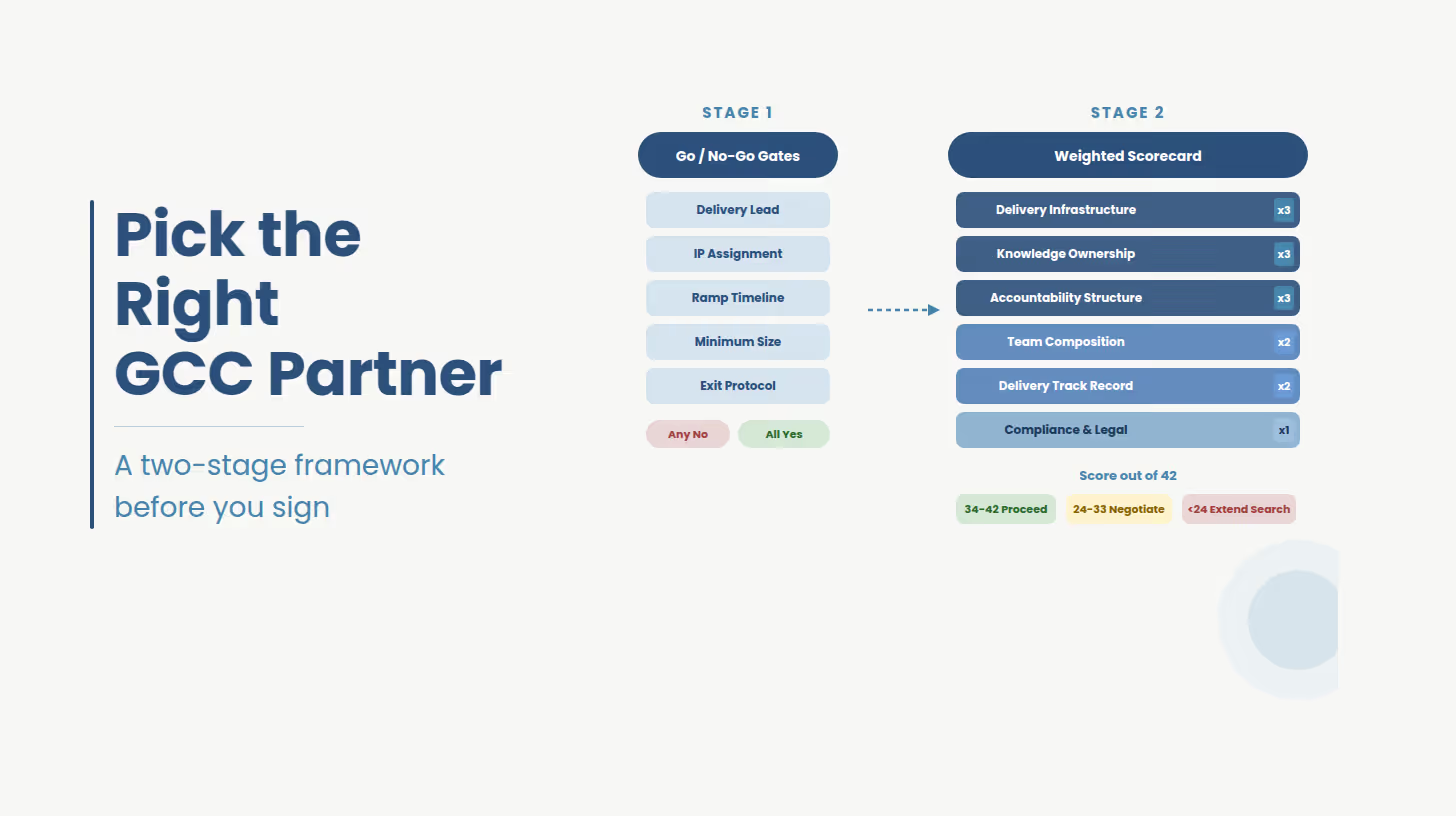
The framework has two stages for a specific reason. Hard gates reduce the shortlist before you invest time in a full evaluation. Partners who fail a gate do not get scored, they get removed. Partners who pass all five gates earn a full evaluation against the weighted scorecard.
Run the gates in the first or second conversation. The scorecard takes a second conversation and reference calls to complete accurately. Separating the two stages prevents weak partners from surviving through a balanced evaluation they should have been removed from earlier.
Any single no is a disqualifier. There is no compensating factor that justifies proceeding past a failed gate.
Partners who clear all five gates have designed for the failure modes that sink most Micro GCC engagements. That is the population worth scoring.
Stage 2: How to Score the Partners Who Pass
Score each partner independently before comparing. The weight tier reflects the business consequence of getting that criterion wrong over a 24-month engagement. Multiply each raw score by its weight, sum across all six criteria, and read the result against the decision bands below.
Max weighted score
×3 criteria (3 × max 9 = 27) | ×2 criteria (2 × max 6 = 12) | ×1 criterion (max 3) | Total maximum: 42
Selecting the right partner is the first decision. The second decision happens in the first quarter: whether to course-correct early or let a structural problem compound until it is expensive to fix. Three signals tell you which trajectory you are on.
Signal 1 - Sprint velocity trajectory in weeks 3–8
In a well-structured engagement, sprint velocity climbs in weeks 3 through 8 as the team builds familiarity with your codebase. A flat or declining velocity is a knowledge architecture problem. If the team is delivering against a backlog without accumulating product context, velocity will plateau and the ramp cost will repeat with every team change.
Signal 2 - Where documentation lives at day 30
Check where knowledge is being documented at day 30. If the India-side engineers are maintaining notes, architecture decisions, and onboarding materials in the partner's systems rather than yours, the knowledge ownership architecture has already failed. This is recoverable at day 30. It is not recoverable at month 18 when a key engineer departs.
Signal 3 - Whether the delivery lead is in your OKR reviews by week 6
The India-side delivery lead should be participating in your OKR reviews, sprint retrospectives, and product roadmap conversations by week six. If the delivery lead is still operating at arm's length from your business decisions at week six, the accountability structure from the proposal has not been operationalized. Raise it directly. A strong partner will correct it. A weak one will schedule a meeting to discuss it.
None of these signals require a governance review or a board conversation. They are observable in the first six weeks of a normally-run engagement. A partner who has designed for long-term delivery will welcome the scrutiny. A partner who has not will respond to it with reassurance.
Against the five gates, Ideas2IT's Forward Deployed Engineer model clears each one structurally as a contract and delivery design decision. The India-side delivery lead shares the client's OKRs and is measured against their sprint metrics from week one. IP assignment is unconditional in the MSA with no background carve-outs. Ramp plans are built week-by-week around India's 60 to 90 day notice period reality. [6] Minimum engagement starts at 8 engineers with a delivery model designed for that scale. Exit protocols are designed at engagement start.
On the scorecard, the criteria weighted ×3 delivery infrastructure, knowledge ownership, and accountability structure reflect what Ideas2IT's proprietary platform suite and FDE model are specifically built to address. Code intelligence, automated test generation, and AI-native SDLC tooling are contractual deliverables.
Knowledge lives in client-owned systems from day one. Escalation paths go to delivery leadership.
Ideas2IT has run this model with US companies since 2009 across insurance, healthtech, financial services, and enterprise AI infrastructure. The 99 percent client renewal rate is a consequence of that accountability structure.
You have run your shortlist through both stages and you know which partners have earned a contract conversation.
The next step is verifying those scores in a conversation with a partner who has answered these questions before with specifics.
Ideas2IT has embedded engineering teams inside US companies since 2009. If you want a clear answer on whether the Forward Deployed Engineer model fits your context, the right starting point is a 45-minute working session with no agenda other than getting you to a decision.