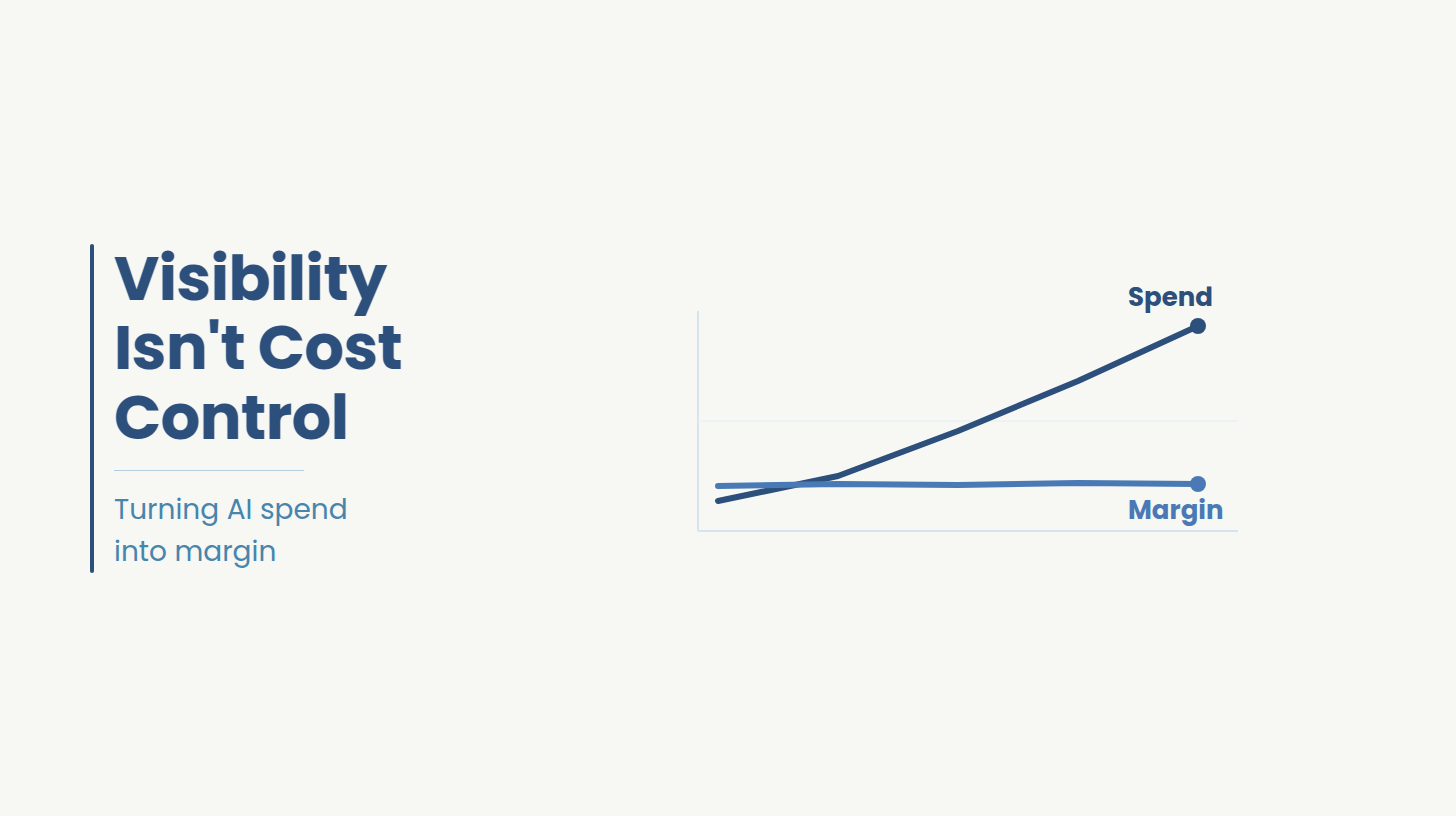

- Most PE portfolio companies have ChatGPT Team or Claude for Work licenses and still most of them have nothing in production.
- The real problem: no one has mapped which business processes are worth automating, whether the data can support it, or what scaling AI from pilot to production actually requires inside a specific portco environment.
- Without structured use case discovery, AI spend produces activity, pilots, demos, internal chatbots instead of the AI ROI your board demands.
- Ideas2IT's Solution Consulting for Generative AI (6–8 weeks) uses the DBIL methodology to produce a ranked AI adoption roadmap with effort-vs-ROI scoring, a feasibility matrix, and an executive-ready plan grounded in the portco's actual systems and data.
- For portcos ready to move from roadmap to build, the Technology Blueprint (4 weeks) delivers the production-grade architecture needed for scaling AI from pilot to production at enterprise scale.
- Schedule a complimentary scoping session at ideas2it.com/ai-private-equity. Walk away with a clear picture of which workflows qualify and which do not.
Think of this, Six months ago, your fund sent an email stating that "AI is a top priority". Following which, Licenses have been procured by the portfolio to move on. Now, You, The portco CTO forwarded it to the engineering team, set up a working group, and started a pilot.
Today, the pilot is still running but no one is using the output. The board is asking for the third time where the ROI is. And you are sitting across from the Operating Partner with no clean answer because nothing that could be measured has changed.
This failure is structural. Without a coherent AI implementation strategy for private equity, one that connects model capability to specific business workflows inside a specific portco environment, a license is a search engine that no one has organised any searches for. The question of how to achieve ROI from AI is not answered by signing an enterprise agreement. It is answered by the discovery work that comes before the build.
Why a ChatGPT or Claude License Doesn't Deliver AI ROI
The assumption behind most fund-level AI mandates is that access is the constraint. Get the portco on an enterprise AI plan, and the teams will figure out what to do with it. That assumption is wrong for most mid-market operating companies, and the evidence on AI adoption challenges after M&A makes this consistently clear.
Primary research across 60 conversations with deal professionals like PE partners, operating partners, portco CTOs, M&A advisors found that 45% of firms are still in individual-level experimentation. Only 10% have reached firm-wide integrated use.[1] The licenses are deployed while the workflows are not.
McKinsey data shows that 60% of portfolio companies are experimenting with AI but only around 5% have scaled to production.[2] One large PE firm surveyed all its portfolio companies and found approximately 200 AI projects underway. Roughly 25 showed any signs of return.[3] This is what AI not delivering ROI looks like at portfolio scale which is not a technology failure, a prioritisation and implementation failure.
Enterprise AI licenses give a team a general-purpose capability. They do not tell that team which of their specific business processes has the data quality to support AI, which use case has the highest return relative to implementation effort, or what the production architecture looks like inside their specific tech stack. Those are engineering and discovery problems. The license solves neither.
A CFO interviewed during this research put it plainly: "When you want to automate a process, you need to have a standard process first." Most portcos have not done that mapping. The AI vendor does not do it for them. This is the gap between AI experimentation and private equity value creation that actually compounds across a hold period.
Why Fund-Level AI Partnerships Do Not Close the Implementation Gap
Platform-level AI agreements whether a fund negotiates enterprise access to a frontier model or a co-sell arrangement with a cloud provider solve the access problem. Where as they do not solve the implementation problem. The gap between the two is where most portco AI programs permanently stall, and it has three consistent failure modes.
No process owner, no workflow map.
Most portcos cannot name who owns the AI output or which process it replaces. The technology execution risk in private equity almost always lives here: the model has been procured but there is no process for it to plug into, and no individual accountable for connecting the two.
Data exists but is not usable.
Candidate use cases fail in production not because the model cannot handle the task but because the underlying data is fragmented across legacy systems and inaccessible in a form the model can consume. This is the layer that post-merger IT integration in private equity consistently exposes and the layer that fund-level AI partnerships are not designed to resolve.
Pilot success does not transfer.
Pilots run against clean or synthetic data in sandboxed environments. Production runs against live operational data inside real system constraints. BCG's research confirms the pattern: 70% of AI value creation comes from people, processes, and data , not from the model.[4] The gap between pilot and production is almost always a data architecture, system integration, and process ownership problem . AI implementation that delivers business value requires all three to be resolved before a build begins.
Most Operating Partners who reach out to Ideas2IT start from the same position: licenses live, pilots running, nothing on the board deck that counts as ROI.
The scoping conversation is a free half day workshop. You leave with a clear picture of which workflows in your portco's environment have the data readiness and process clarity to justify a build and which do not. No commitment required.
Schedule a complimentary session.
What the Big PE AI Deals Leave Unsolved
In April 2026, a huge PE signed a multi-year partnership with Google Cloud, giving its $300 billion portfolio access to Gemini and Google's forward-deployed engineering teams. OpenAI is finalising a $10 billion joint venture with TPG, Bain Capital, and Brookfield structured to push enterprise AI through PE-backed companies. Anthropic is anchoring a $1 billion vehicle with Blackstone and Hellman & Friedman to embed Claude across portco operations.
These are rational investments. They solve the access problem at scale. Every portco in those funds now has a clear path to enterprise-grade model access, vendor support, and in some cases technical assistance from the model provider's own engineering teams.
What they do not include is the discovery work that has to happen before any of that is useful at a specific portco. Google's forward-deployed engineers are not going to spend six weeks mapping a mid-market manufacturing portco's data readiness across twelve legacy systems to identify which three workflows have the combination of data quality, process clarity, and ROI potential to justify a production build. That is not what they are there for. The technology execution risk in private equity almost always lives in that gap between what a vendor provides and what an operating company actually needs to move.
What Structured AI Discovery Actually Produces
Ideas2IT's Solution Consulting for Generative AI is a 6–8 week structured discovery engagement with an accelerated 4–6 week option designed for enterprise environments where AI capability exists but no structured AI adoption roadmap has been built.
Ideas2IT structures this discovery work through its DBIL methodology: Define, Build, Iterate, Learn with four interdependent stages that together determine whether a use case is viable, valuable, and buildable inside a specific portco environment.
The engagement runs across four analytical layers, sequenced to the DBIL stages.
Layer 1 — Define: System and Integration Context
How data flows across the portco's applications and APIs where the integration points are, where the gaps are, and what is and isn't accessible to an AI system in practice. This is the layer that most post-merger integration challenges expose as the primary bottleneck for AI readiness.
Layer 2 — Build: Data Readiness
Whether the data required for each candidate use case actually exists in a form that a model can use, quality, accessibility, and completeness. Poor data readiness is the leading cause of AI not delivering ROI in enterprise environments, and the leading reason pilot success does not transfer to production. Scaling data platforms in PE is frequently a prerequisite to AI viability.
Layer 3 — Iterate: Business Priority Alignment
Which strategic themes operational efficiency, revenue acceleration, cost reduction, customer experience the portco's leadership is measured against. Use case prioritisation that is not anchored to board-level priorities produces technically interesting pilots that no one owns after the engagement ends.
Layer 4 — Learn: Feasibility and ROI Scoring
For each shortlisted use case: the technical effort, the dependency map, the organisational readiness, and a projected value realisation estimate, a number derived from this portco's data, systems, and operating environment. This is the layer that produces a defensible AI ROI in private equity business case rather than a directional estimate.
The portco CTO walks out with four deliverables: a ranked use case roadmap tied to implementation effort and ROI, a feasibility and impact matrix for each shortlisted use case, a data and infrastructure gap analysis, and an executive-ready AI adoption roadmap aligned to the portco's business objectives. Each use case exits the engagement as a fully scoped, decision-ready build candidate .
When the Use Cases Are Clear, the Architecture Question Starts
For portcos that have completed use case prioritisation and are ready to move to production, the next constraint is architectural. A well-defined use case still requires someone to specify how the LLM, the data, and the agent layer fit together inside the portco's existing enterprise environment, an environment that, in most cases, carries the technology integration complexity of years of acquisitions, legacy systems, and fragmented data infrastructure.
Ideas2IT's Technology Blueprint for Agentic Systems is a focused 4-week engagement that produces that architecture. The deliverables are specific: an enterprise readiness report mapping systems, dependencies, and integration gaps; an enterprise reference architecture covering orchestration, data flow, agent layers, and governance controls; a component blueprint specifying tools, configurations, and integrations for the portco's actual infrastructure; and a phased implementation roadmap with governance checkpoints and a skilling plan.
The two engagements are designed to sequence. Solution Consulting identifies what to build and why. The Technology Blueprint defines how to build it inside this environment. Together they form a complete AI implementation strategy that takes a portco from 'we have licenses and nothing in production' to a fully scoped, architecturally sound build plan with the AI ROI case documented and the path to scaling AI from pilot to production cleared.
How Ideas2IT Portco Engagements Produce Measurable Outcomes
For portco CTOs evaluating an implementation partner, this reflects the engineering depth behind the engagement methodology.
For PE-backed operating companies, the pattern from Ideas2IT's portco engagements is consistent: the use case roadmap produced in Solution Consulting typically identifies two to three workflows where the combination of data readiness, process clarity, and ROI potential justifies an immediate build. Those workflows reach production within the Technology Blueprint engagement window. For Operating Partners managing scalable delivery teams across PE portfolios, the DBIL-structured model provides a replicable playbook across multiple portcos rather than a bespoke engagement at each one.
You already have the licenses. The pilots are running. What you don't have yet is a clear answer to the question they're going to ask: which of these workflows is actually worth building, and when does the ROI show up?
That's what the scoping conversation produces.
In a half day workshop, Ideas2IT will map which workflows in your portco's environment have the data readiness and process clarity to justify a build, which don't, and what needs to close before any of them can move to production. You'll leave with a specific picture of where to go next instead of a proposal or a pitch deck.
Schedule your $0 Workshop
References
[1] McKinsey & Company. 'The state of AI in 2024.' McKinsey Global Survey, 2024.
[2] AI Operating Partners. Survey data on AI project ROI across PE portfolios, 2025–2026.
[3] Boston Consulting Group. 'A Leader's Guide to Winning with AI.' BCG Henderson Institute, 2023. The 10-20-70 rule: 10% technology, 20% algorithms, 70% people, process, and data.