Just In
Ideas2IT is now an OpenAI Select Partner - recognized to help enterprises build, deploy, and scale AI with GPT-5, responsibly and at speed.
Read the announcement


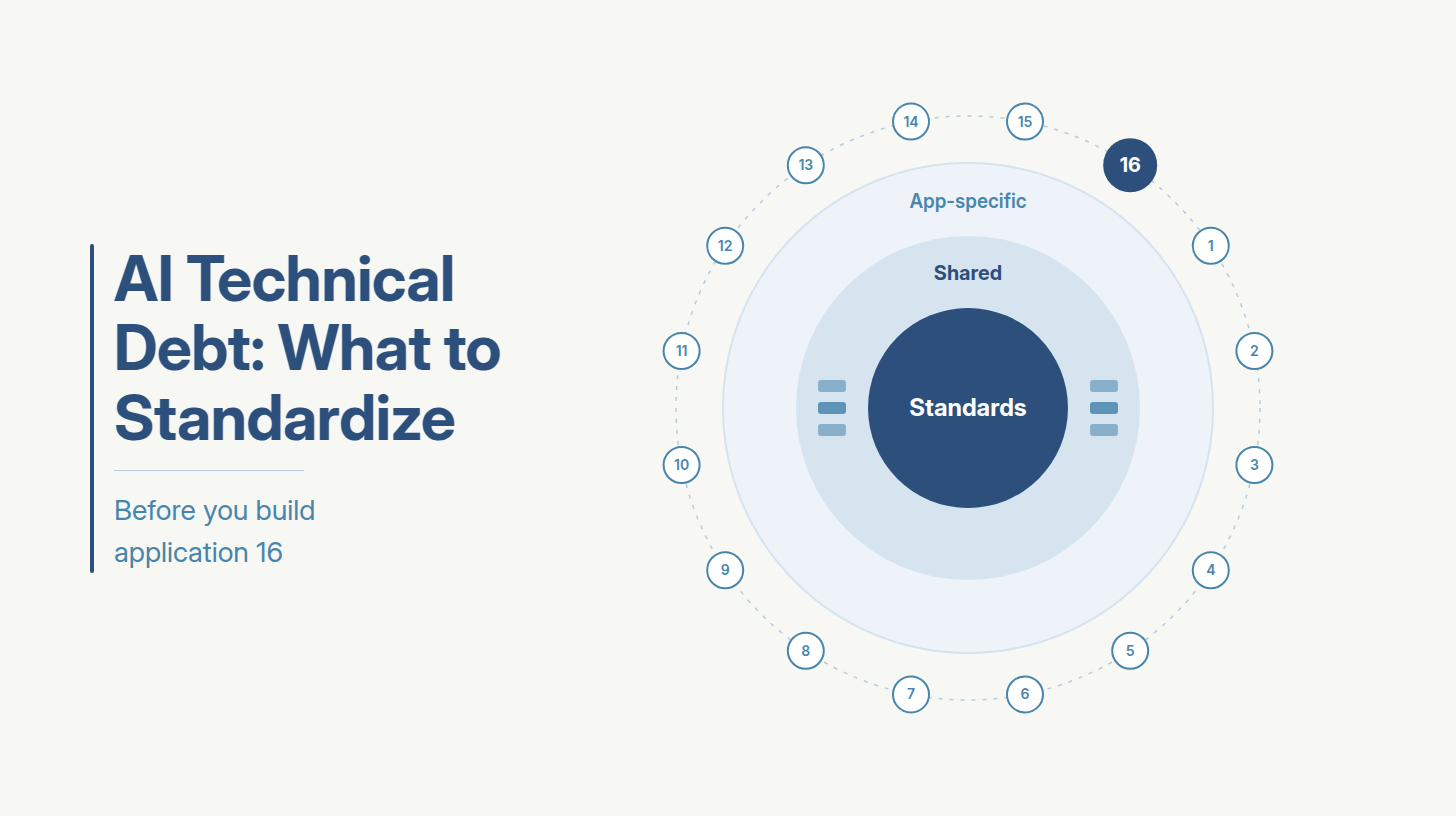
Your sixteenth AI application was approved last week. Its team is now spending the first sprints on a model client, a PDF ingestion pipeline, prompt logging and a set of evaluation scripts. All of these already exist in your estate. None of them exist in a form the new team can pick up.
This is what AI technical debt looks like in an enterprise with 15 applications in production. The code in each application may be clean. The debt comes from building the same capability many times, in different ways, by different teams. Now each version has to be maintained on its own.
Ideas2IT's FDE teams have read enough of these estates to name the pattern precisely: the duplicated capability that hurts the most is never the prompt. It is the evaluation code. When each application built its own test harness, nobody can say with confidence whether a model upgrade is safe to ship until it has broken something in production.
You can reduce AI technical debt, and manage it from here on, but only if you know where it sits. That starts with the expertise your teams built along the way, and with the parts of it they built twice.
The count keeps climbing across the market. Zapier's December 2025 survey on AI sprawl found that 28 percent of enterprises already run more than 10 different AI apps. Two in three planned to add more within a year. The same survey found that 76 percent had at least one bad outcome because their AI systems were not connected.
Every new application that copies a duplicated pattern adds one more place where a model change or security fix must be done by hand. Before you decide what to standardize, map where that duplication lives.
Duplication builds up in the capabilities that every application needs and no single team owns. The table shows where it usually sits and what it costs you the next time something changes.
Model access and evaluation carry most of the risk as you scale. Vikram Venkat of Cota Capital, writing in VentureBeat in May 2026, points out that a prompt tuned for one model can perform badly after a switch to another. He also notes that enterprises still have no release pipeline for prompts that works the way CI/CD works for code. In a duplicated estate, you face both problems once per application.
One cost does not fit in the table. Each of your teams learned, on its own, how to chunk contracts and how to build an evaluation set that catches real regressions. That expertise lives in separate codebases and in the heads of the engineers who wrote them. When one of them leaves, the application keeps running. The knowledge needed to change it safely leaves with them.
The table shows where duplication exists. Deciding what to do about each row is the next question, and treating every row the same way is the most common mistake. Some capabilities need an enforced standard, and some need a shared component. The rest belong inside each application.
A capability belongs in the standard tier when a mistake in one application creates risk or cost for the whole estate. Standards here are contracts and controls. They say what every application must meet and leave the build to the team.
Zapier's April 2026 survey on AI vendor lock-in found that 89 percent of executives think they could switch AI vendors within a month. Among those who had tried, 58 percent said the move failed or took far more effort than expected. With a gateway in place, a switch is one change instead of fifteen.
Keep this list short, because each standard binds 15 teams today and 30 next year. A rule about how something is built belongs in the next tier.
With the contracts set, most remaining duplication is in how things are built, such as fifteen ingestion pipelines. Those are candidates for reuse, which needs a lighter touch than enforcement.
A capability belongs in the reusable tier when most applications need it and a good shared version saves each team real effort. The choices inside it vary for good reasons, so teams need room to configure it.
A platform team offers, versions and owns these components. Teams adopt them because it is faster than building their own. If you mandate a component before it earns that place, teams fork it or work around it. You then maintain the shared version and the forks.
Build the evaluation harness first. It is what makes every later change safe to ship. If agents are part of your estate, the practices that keep AI agents reliable in production build on the same harness.
A shared component without an owner turns into one more fork. Give each one an owning team and a versioning and deprecation policy before you announce it.
The first two tiers cover what applications share. The third tier matters just as much, because it holds the reason each application exists.
Some capabilities should stay inside each application because they hold the domain judgment of one use case. Domain prompts belong here. So do the business logic and workflow around the model, the evaluation dataset and its pass thresholds, retrieval tuning for one set of documents, and the screens and review steps your users see.
If a central team owns these, every change to a claims assistant's prompt waits in the platform team's queue. Application teams notice the delay within a sprint and start building around the platform. Over-standardizing this tier is how platform programs lose the teams they were built to serve.
The full boundary fits in one table.
With the boundary drawn, the obvious next move is to write standards and build shared components. That skips a step. Your 15 applications already hold at least one version of every capability in the first two tiers. Whichever version you build on will shape the standards you write.
If you can already name several capabilities that exist in duplicate across your applications, the table above likely matches what you see. Confirming it means reading 15 codebases built by different teams, then choosing which version of each capability becomes the baseline before anyone writes a standard.
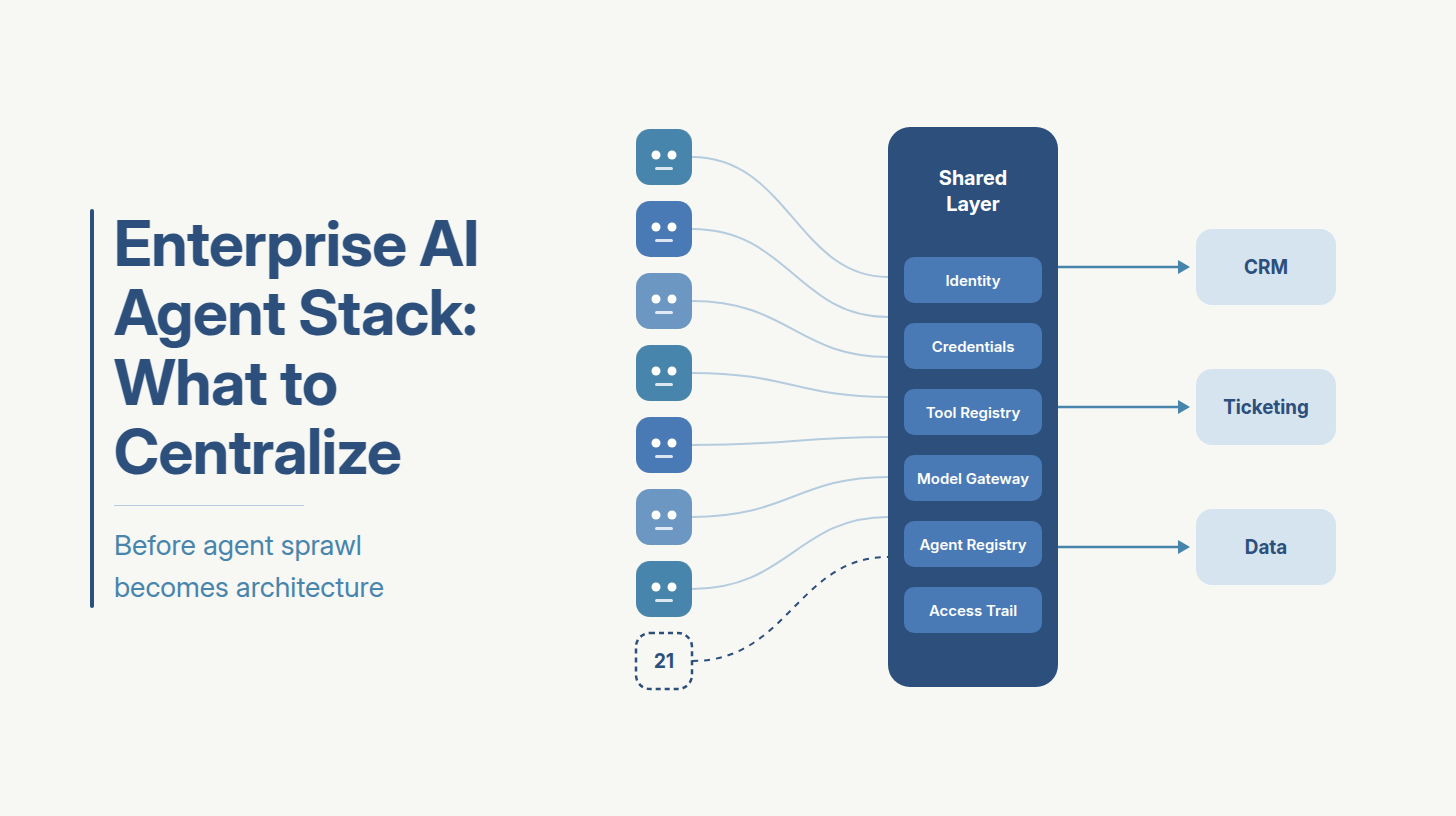
Rationalization sits between the map and the standards. For each capability in the first two tiers, look at every existing version and make one of four decisions.
The last row deserves attention. Some of your first 15 applications were built to test an idea that did not hold up. Retiring them takes their duplicated capabilities off the migration list, which is the cheapest consolidation you have.
Sequence the work against your roadmap. If the next five applications are retrieval-heavy assistants, the retrieval service and ingestion pipeline come first. The tool registry can wait until the first agent workflow is scheduled.
Consolidation is finished when the old versions are gone. A shared version running beside the old ones is only halfway. Budget the move of existing applications onto shared components as part of the program. The VentureBeat analysis makes the same case, calling for AI debt reduction programs with their own budgets, backed by leadership the way security and cloud programs were. Without that budget, you end up with sixteen versions of each capability.
From that point on, managing AI technical debt becomes a release habit. Every new application is checked against the tiers before it starts, and any new duplication is a choice someone makes on purpose.
The payoff shows up in the first application that starts after the consolidations land. Application 16 begins with a gateway credential and a retrieval service pointed at its documents. Its evaluation harness is already wired into the pipeline, and its traces already flow into your logs. The team spends its first sprint on the prompts and evaluation dataset that make the application useful.
Model changes get easier too. When a provider retires a model, you make the change once at the gateway. Each application's evaluation gate then tells you which applications are safe to move and which need prompt work first.
Expertise stops leaving with people. The team that learned to chunk contracts well has built that knowledge into the shared pipeline. Every later application gets it by default, and your platform team owns it.
Here is an anonymized engagement pattern drawn from a published delivery. A Fortune 500 insurer running several generative AI use cases needed one LLM platform that worked across multiple foundation models. Shared evaluation harnesses and vector databases ran under common governance workflows for every use case built on top of it.
Getting to that outcome takes engineering work inside your estate, which is where the choice of partner matters.
Ideas2IT deploys Forward Deployed Engineers who work inside your estate from day one, in your repositories and your platform team's backlog. Rationalizing 15 applications means reading every codebase and knowing which differences were deliberate. That takes engineers who sit with the teams who wrote the code. Ideas2IT has built AI systems for enterprises since 2017. FDEs bring that AI engineering expertise into your platform team, with the aim of leaving it there when the work ends. You can read how Ideas2IT rebuilt its own delivery around AI-native engineering.
During rationalization, FDEs use Explayn.ai, Ideas2IT's code comprehension platform, to read each application's codebase. It documents how each one handles model access, retrieval, evaluation and guardrails. You receive a capability-by-capability map of your estate that shows where versions overlap and where they differ. Every retain, consolidate, replace or retire decision rests on that map.
Once standards and shared components are in place, FDEs build your next applications with Anticlock. It is the platform Ideas2IT's engineers use to run AI-driven development with the same tooling and security guardrails for every engineer. Each new application is built on your shared components and evaluation gates by default, through one repeatable and auditable process. Ideas2IT's teams measure at least 50 percent faster sprint velocity on work run this way, as part of its AI-powered custom software development practice.
Ideas2IT holds the AWS Generative AI Services Competency and SOC 2 Type II certification. Both cover the review your security team will run before anyone touches production AI systems.
The engagement starts with an assessment of your existing AI applications against the three tiers and produces the rationalization plan. Consolidation and the build of your next applications on the shared foundation follow from that plan.
You have 15 AI applications in production and a roadmap asking for 15 more. Each of those new applications will copy whichever duplicated pattern its team finds first, unless you set the boundary between shared and application-specific capabilities before they start.
Didn't find what you were looking for?