
- An AI agent can be accurate on the happy path and still be unreliable in production. Reliability is determined by how predictably it handles failures, partial execution, and unexpected inputs.
- Before expanding autonomy, define every failure as an explicit workflow state with a clear owner, exit condition, timeout, and recovery path.
- Escalation should be enforced by policy, not left to the model's judgment. Set human handoffs around reversibility, business impact, evidence gaps, scope boundaries, and repeated failures.
- Design retries, idempotency, compensating actions, and handoff packages so failures do not create duplicate work or leave systems in inconsistent states.
- This guide shows how to engineer AI agent reliability beyond the happy path, so autonomy can expand without pushing unpredictable failure handling back onto your operations team.
Enterprise AI agent reliability is decided on the cases your agent was never tested on. This piece shows how to engineer exception handling and human handoffs into your agent, so every failure has defined behavior before its autonomy expands.
Take a hypothetical situation. An accounts payable agent clears a queue of invoice exceptions in minutes while stakeholders watch, and the evaluation dashboard justifies the budget. On day three in production, a supplier portal times out halfway through a payment hold. The agent retries and places the hold a second time, and by the afternoon the supplier has escalated to your finance director.
Your operations lead then asks a question nobody on the build team can answer: what is this agent supposed to do when something goes wrong?
That question is the gap between accuracy and reliability. Accuracy is how often the agent gets the right answer on inputs you prepared. Reliability is how predictably it behaves, and how cleanly it recovers, on inputs you did not prepare. Your evaluation set holds the cases your team thought of, which makes it a sample of the happy path.
The cost of that gap is uneven. Routine cases were already cheap for your people to handle. Exceptions are where your operators spent their time, and those are the cases your agent fails on.
Gartner predicted in June 2025 that over 40% of agentic AI projects will be canceled by the end of 2027, and inadequate risk controls is one of the causes it named. An agent whose failures nobody can predict is a risk control problem, and it can end a program after the pilot was declared a success.
Predictability starts with knowing exactly where your agent will break, and those points are more specific than "edge cases."
Ideas2IT's FDE teams have seen this play out repeatedly: agents fail most visibly in the same three places across different clients like tool calls that return ambiguous success responses, retries that proceed without verifying whether the first call landed, and escalation paths that depend on the model flagging its own uncertainty. They are orchestration design gaps, and they show up in the first two weeks after a pilot expands.
Where AI Agents Fail Outside the Happy Path
Each failure mode below shows up in transactional agents that write to real systems. Read the table against the agent you are about to scale.
For each row, ask your team what the agent does today and who finds out when it happens. If the honest answer for several rows is "whatever the model decides," your agent's behavior outside the happy path is undefined. Undefined behavior is what your operations and risk teams are refusing to sign off on.
The exposure is already showing up across enterprises. A Cloud Security Alliance survey of 418 IT and security professionals, published in April 2026, found that 65% of organizations had experienced at least one AI agent-related incident in the previous 12 months, and 43% reported operational disruption as a result.
If you are counting the rows your agent has no answer for, you are at the point where agent programs stall. The problem underneath is that failure behavior was never designed, so nobody can predict it.
An agent reliability assessment maps one of your pilot or live workflows against these failure modes and gives you:
- A failure-mode map of the workflow, showing where each failure can occur
- A list of states with no defined behavior today, ranked by business impact
- The first fixes to make before the agent's autonomy expands
Book an agent reliability assessment
Every row in that table has one thing in common: when the failure happens, the model is left to improvise. The engineering fix starts by taking that decision away from the model.
Design Exceptions as Explicit Agent States
In a typical pilot build, failure handling lives in the prompt. Somewhere in the system prompt is a line telling the agent to try again or ask the user for help if something goes wrong.
That instruction turns every exception into an improvisation. The model decides in the moment what "something goes wrong" means and how many times "try again" should run. The decision can differ between two runs of the same case, and it leaves no reviewable record of why it was made.
AI agent exception handling belongs in the orchestration layer, where each exception becomes a named state in the workflow. The model still does the reasoning inside each state. The workflow decides which state comes next, and the workflow is code your team can test and audit.
Where Exception Logic Should Live
Each layer of an agent system can enforce some things and not others. The failures that hurt are the ones a layer lets through without raising an error.
Your orchestration framework determines how much of this you get out of the box, so the choice deserves scrutiny before the build starts. If you are still weighing options, this guide to AI agent frameworks compares the main candidates.
What Every Exception State Needs
A state without an exit is a place where cases sit until a customer notices. For each exception state you define, specify five elements.
A starter set for most transactional agents includes awaiting clarification, blocked on tool, pending approval, partially complete, escalated, and failed closed. Failed closed means the agent stops and takes no further action on the case until a person releases it.
Two of those states, pending approval and escalated, carry most of the weight in production, because they decide where your agent's autonomy ends.
Know When the Agent Should Escalate
Escalation is the decision your agent makes least well on its own. Language models report confidence poorly: an agent that misreads an ambiguous invoice sounds as sure of itself as one that read it correctly. If your escalation logic depends on the agent deciding it is unsure, it depends on the weakest signal in the system.
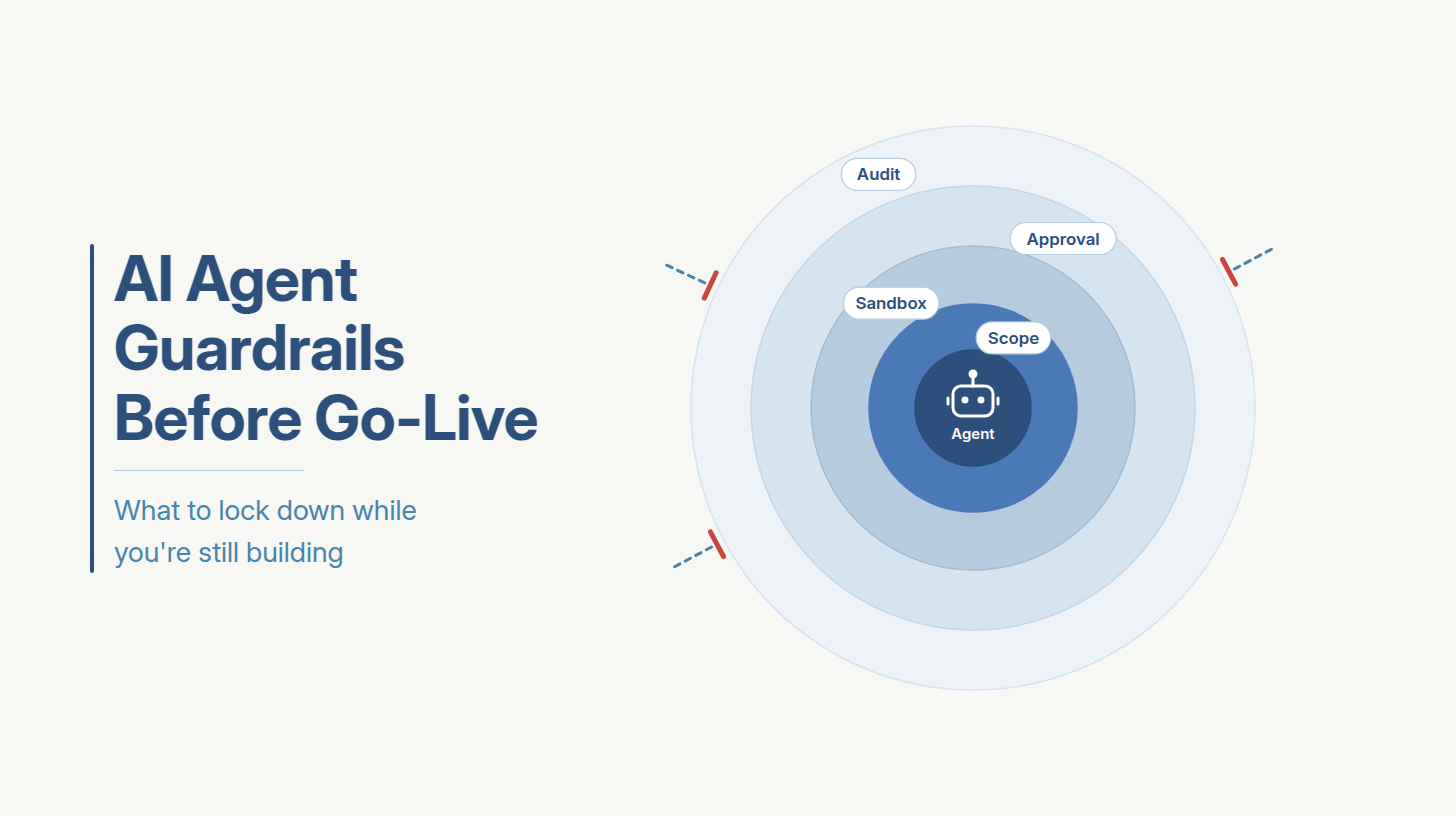
Escalation triggers belong in policy that your workflow enforces. The model can contribute evidence to that policy, such as a flag that retrieval found no supporting document, and the policy makes the call. These are the triggers that hold up in production.
Set Autonomy by What the Action Can Break
Human handoff design gets simpler once you sort every action your agent can take by two properties: whether it can be undone, and how much damage it does when it is wrong.
Over-Escalation Is Also a Failure
Set every trigger too tight and your agent becomes a routing layer that hands your people the same work with an extra step added. Your escalation rate is a number you tune, and it belongs on the same dashboard as accuracy.
Watch the approval side with the same care. A reviewer whose rejection rate has fallen to zero has stopped reviewing. Audit a sample of approved actions every week so the approval step keeps its meaning.
The calibration itself is domain work. In claims operations, for example, the override logic that routes cases to adjusters has to be built with senior adjusters and tuned against the real claims mix, which this guide to AI agents in insurance claims processing covers in detail.
You can probably see where your agent's autonomy boundary sits today, and that nobody on your team formally decided where it should sit. The problem underneath is that escalation policy is a business decision that has been left inside an engineering artifact.
An escalation design session for one workflow produces:
- An autonomy matrix that maps each agent action to its approval requirement
- Escalation triggers written as enforceable policy, with thresholds your operations lead signs off on
- A target escalation rate and the review sampling plan that keeps approvals meaningful
Design your escalation policy
Deciding to hand a case to a person is half of the work. The other half is the state the case is in when it arrives, and what happens to everything the agent already did.
Engineer Recovery, Retry and Handoff Paths
Multi-step agents fail in the middle. Step three of five fails after steps one and two have already changed real systems. A reliable AI agent has a defined path forward and a defined path back for any partial work.
Retries That Do Not Duplicate Work
A retry is safe only when the agent knows what the failed call actually did. The error type tells you what to assume.
Every write your agent performs should carry an idempotency key, so the target system recognizes a repeated call with the same key and ignores it. Where the target system does not support idempotency, your tool wrapper has to check the current state before it writes.
Uncapped retries also cost money, since every loop consumes tokens without producing an outcome. Retry limits belong in the same budget conversation as token-level cost accounting for AI workflows.
Partial Execution and Compensating Actions
Checkpoint the workflow state after every step that changes an external system. For each of those steps, define a compensating action, such as releasing a hold or voiding a draft invoice.
When a later step fails, the workflow chooses between resuming from the last checkpoint and compensating back to a clean state. That choice follows rules your team wrote in advance, and the model plays no part in it.
What a Person Receives at Handoff
If your handoff is a message saying the agent failed on case 4417, your operator reopens the case and repeats the investigation the agent already did. The handoff package should let a person act within minutes of opening it.
Resuming After the Person Acts
Decide in advance which cases return to the agent after a person acts and which ones leave its lane for good. When a case returns, the person's decision becomes a logged input to the next state. When a case leaves, the agent closes its own record so two parties are never working the same case.
Every path described so far is a design on paper until you have watched it hold under failure. Testing is where you find out what you actually built.
Test AI Agents Against the Failures You Expect
A single passing run proves little for a system that can answer the same input differently twice. AI agent testing for production needs failure scenarios, run repeatedly, with results measured as pass rates across runs.
Build the exception suite from the failure modes your agent can hit. Every failure mode becomes a set of test scenarios, and every exception state gets a test for each of its exits.
Make incident regression a closing condition: a production incident is not closed until a test reproduces it. Model upgrades deserve the same discipline, because a new model version can change how your agent fails even when its accuracy holds steady.
Set a pass-rate bar for each scenario class and hold any release that falls below it. A scenario that passes nine runs in ten contains a failure your customers will eventually find.
Testing tells you if the reliability work holds. It cannot add reliability that was never designed in, which is why the decision that matters most comes before the build.
Build AI Agent Reliability Into the Design
Adding exception states to an agent built around a single prompt means rebuilding the orchestration and retesting every path. Teams that attempt it after launch do it with live cases in the queue and an operations team that has already lost confidence in the agent.
Score your agent against these questions before its autonomy expands.
If you answered no to more than two, your agent is not ready for wider autonomy, regardless of its accuracy score. When the agent sits inside an application your team built quickly with AI coding tools, the application needs the same scrutiny, and this production readiness guide for AI-built applications walks through it.
After launch, ensuring reliability in AI agents comes down to tracking the metrics your savings case depends on.
The decision in front of you is concrete. Before the next expansion of your agent's autonomy, its failure behavior is either designed and tested by your team, or discovered by your operations team one incident at a time.
AI Agent Reliability in a Live Deployment
One real engagement shows these decisions working at scale. Ideas2IT built a post-acute care automation platform end to end, and 21 of the top 30 post-acute providers in the US now run on it.
The platform handles eligibility checks, prior authorizations, audits, and collections. A wrong action in any of these costs money and can create a compliance problem. The inputs are messy, including handwritten notes and faxed forms that rule-based tools could not read.
The team made agent behavior predictable before building a single workflow. Ideas2IT deployed AgentHero, the open-source agent infrastructure it built, and limited each agent to a fixed set of allowed actions. A human review route takes over when the agent's measured uncertainty is high, and every agent action is traced and logged for audit. After launch, round-the-clock monitoring and regular workflow updates keep the automation current, so providers do not need their own engineers to maintain it.
The platform now runs millions of automated tasks a month. High-volume tasks complete without a person checking each step, because the controls were in place before the first workflow went live. You can read the full engagement in the agentic post-acute automation case study.
How Ideas2IT Engineers AI Agents for Production
Ideas2IT builds production agents through Forward Deployed Engineers (FDEs). They work inside your stack and join your standups from the first day, and their delivery is measured against your OKRs. That matters for reliability, because the failures that break agents live in your systems and your case history.
FDEs build the list of exceptions from your real case data and from the operators who handle the hard cases today. They do this before any state is designed. They also stay accountable for autonomy and escalation metrics after go-live, when thresholds get tuned against live traffic.
Qadence covers the testing your agent depends on. It generates test automation for the flows and integrations your agent touches, including the downstream systems where it writes land. It auto-generates 70% of test cases as standard Playwright code that your team owns, with no platform lock-in. Your fault-injection and regression suites exist from the first sprint and grow with every incident. The FDE team builds the evaluation of the agent's reasoning alongside them, backed by Ideas2IT's AI-driven QA and test automation services.
Ideas2IT holds SOC 2 Type II certification and ISO 27001 accreditation. These are the controls your security team will ask about before an agent writes to systems holding customer and financial data. Ideas2IT is also an AWS GenAI Specialist Partner and Open AI select partner.
Where the Engagement Starts
Your agent may work on the happy path while your operations team refuses to expand its autonomy. The missing piece is failure behavior, because exception handling and recovery are still left to the model. The entry point is a reliability engagement on one workflow, run by an FDE team. It produces:
- A failure-mode map of the workflow, grounded in your case history
- Exception state designs, each with a named owner and a defined exit
- An escalation policy matrix your operations lead signs off on
- A failure test backlog, ready to run against your tool layer
That work becomes the reliability foundation for every agent you build after it.
Engineer Your AI Agent for Production Reliability
References
- Gartner. "Gartner Predicts Over 40% of Agentic AI Projects Will Be Canceled by End of 2027." June 25, 2025. https://www.gartner.com/en/newsroom/press-releases/2025-06-25-gartner-predicts-over-40-percent-of-agentic-ai-projects-will-be-canceled-by-end-of-2027
- Cloud Security Alliance. "New Cloud Security Alliance Survey Reveals 82% of Enterprises Have Unknown AI Agents in Their Environments." April 21, 2026. https://cloudsecurityalliance.org/press-releases/2026/04/21/new-cloud-security-alliance-survey-reveals-82-of-enterprises-have-unknown-ai-agents-in-their-environments