
- Global M&A activity reached $3.1 trillion across roughly 47,000 deals in 2025, and the integration work that follows each deal is rarely scoped with the same rigor as the deal itself.
- A large share of M&A value destruction is attributed to poor integration execution, the operational work of actually combining two organizations.
- For data teams, this shows up as a recurring pattern: every new acquisition, partner, or onboarded entity arrives with its own systems, schemas, and data quality issues, and has to be manually mapped into the existing platform before it contributes value.
- Most organizations handle this with one-off, manually-built pipelines per source, a model that becomes a structural bottleneck once acquisitions happen repeatedly rather than once.
- The fix is a four-stage maturity path: Manual, Assisted, Augmented, and Autonomous ingestion, where each stage requires a specific foundation to be in place before the next becomes possible.
- If you're already fielding an acquisition today, the priority is the foundation work, since that is what determines whether the next deal gets faster or slower to onboard.
A mid-sized company completes an acquisition and the deal team moves on to the next target. Three weeks later, your data engineering team is still buried in M&A data integration work, trying to figure out which fields in the acquired company's catalog system map to which fields in yours, which records are duplicates, and which "active" flag in their system means the same thing as the "active" flag in yours.
This according to Bain & Company's 2025 global M&A report, mergers and acquisitions totaled $4.8 trillion in deal value in 2025, up 36 percent from the prior year and the second-highest total on record. PitchBook's own count put deal volume at more than 50,000 announced transactions for the year, also a record. Harvard Business Review's long-standing research put M&A failure to create shareholder value somewhere between 70 and 90 percent of the time, and a statistical analysis of 40,000 deals across four decades reaffirmed a similar failure rate of 70 to 75 percent. Integration execution is cited as a contributing factor in a meaningful share of those failures.
Most of that integration conversation focuses on people, culture, and finance systems. Data infrastructure rarely gets the same attention, yet it is often the layer that determines how quickly the acquired business starts contributing to revenue, reporting, and decision-making.
If your organization acquires repeatedly, this pattern compounds. Bain's research found that megadeals worth $5 billion or more drove 75 percent of strategic deal value growth in 2025, and most of that came from companies that rarely make acquisitions suddenly making large bets. If you are one of those companies now facing post-merger integration challenges for the first time at scale, the data problem below is probably already on your desk.
How Post-Acquisition Data Integration Repeats
Across the data platform work we've done, a consistent pattern shows up. Organizations struggle because every newly onboarded entity, whether an acquisition, a partner, or a new customer running its own systems, arrives with different data structures, different governance assumptions, and different operational definitions for things that sound identical. "Active," "completed," and "owner" rarely mean the same thing twice.
The organizations that handle repeated growth well stop treating each new source as its own project. They start treating ingestion as a platform capability, something the organization gets faster at with each new deal instead of resetting to zero every time.
An Illustrative Example
Consider a scenario we see regularly in media and entertainment. An organization grows through a merger of two content distribution businesses, each with its own catalog and metadata conventions. Onboarding the combined catalog takes significant engineering effort at first. Metadata standards, rights-window definitions, and even basic fields like "title status" vary between the two systems, and reconciling them requires careful, mostly manual mapping.
The shift comes from building a canonical content data model and a set of automated validation rules, including duplicate detection and rights-window conflict checks, that any future catalog can be mapped against. The next time a new content source needs integrating, most of the mapping work runs against that canonical model, with exceptions flagged for review instead of discovered downstream. The effort doesn't disappear, but it stops scaling linearly with each new source.
This is the shift the maturity model below is meant to capture: a deliberate move from treating every source as a new project to treating every source as a mapping exercise against a model you already trust.
Why Point-to-Point Pipelines Don't Survive Repeated M&A
That trust doesn't happen by accident, and it definitely doesn't happen if every acquisition still gets a bespoke, one-off pipeline. The default approach to onboarding a new data source is familiar to every data engineering team. An engineer gets assigned, spends time understanding the source schema, writes extraction and transformation logic specific to that source, and stands up a dedicated pipeline. It works, the first time.
The second acquisition gets the same treatment, and so does the third. Each pipeline is bespoke, built for that source's specific quirks, maintained independently, and untouched by lessons learned on the previous one.
This is a point-to-point integration model, and it has a well-understood failure mode. The maintenance surface grows with every new source while your engineering capacity to maintain it usually doesn't. A schema change on an acquired entity's side, which happens constantly in the months after a merger as the acquired company's own systems get migrated or retired, can silently break a pipeline nobody has looked at in months. This is one of the AI adoption challenges in PE portfolios after M&A that shows up long before anyone gets to talk about AI: the underlying pipelines are too fragile to build anything reliable on top of.
If your organization handles repeated M&A well, you've usually already learned this the hard way once. The question is whether the next acquisition repeats the pattern, or whether the lessons from the last integration get encoded into the platform itself. Rather than treating agentic ingestion as a single capability you either have or don't, it helps to think of it as a maturity curve: four stages, each building on the foundation of the one before it.
The 4-Stage M&A Data Integration Maturity Model
Encoding those lessons into the platform is easier described as a maturity curve than a single leap: four stages, each building on the foundation of the one before it, rather than a capability you either have or don't.
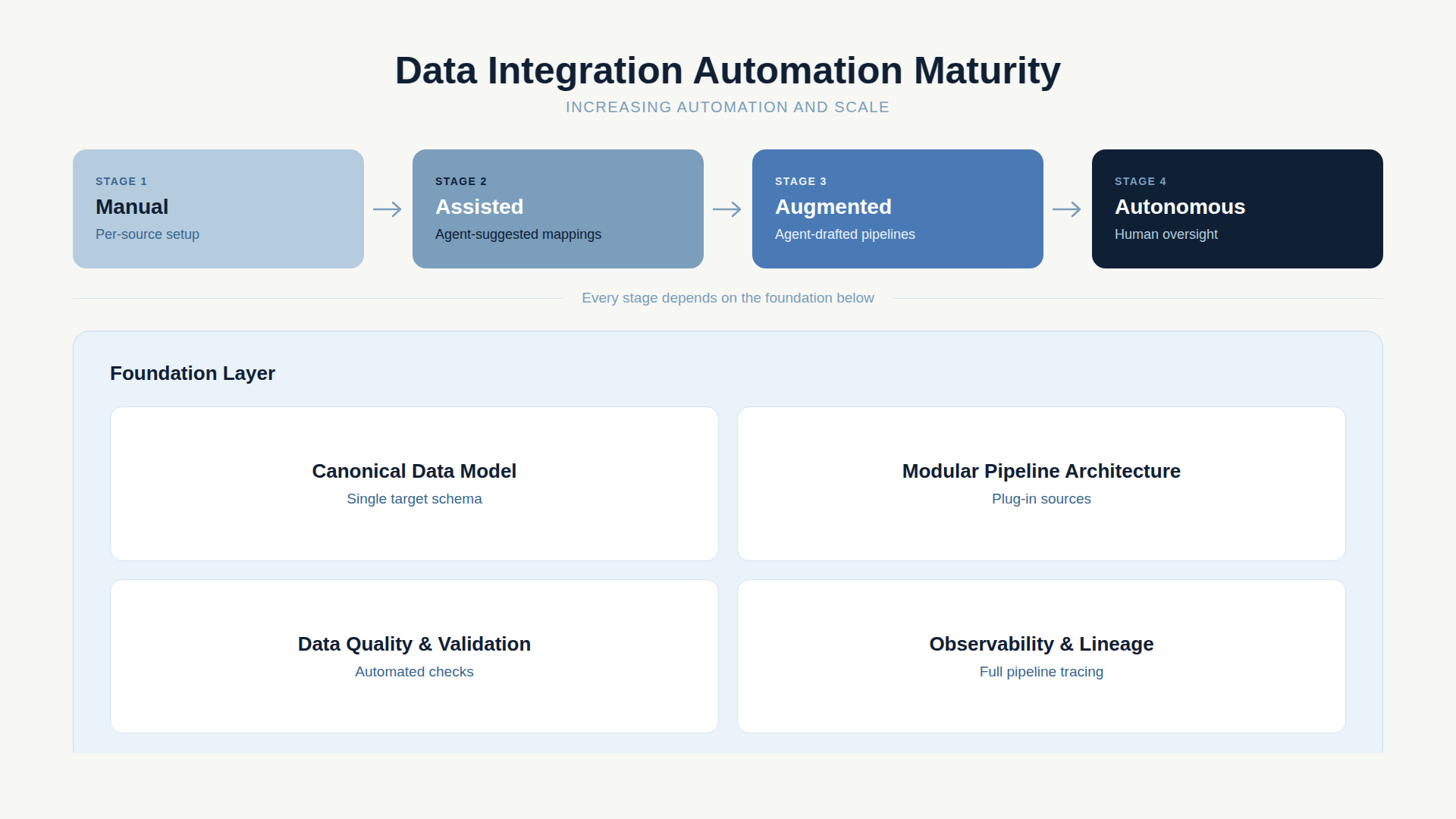
Here are the four stages, each building on the foundation of the one before it.
Most organizations evaluating agentic AI development for data ingestion are really asking how to get from Stage 1 to Stage 2 or 3, and the honest answer is that whether Stage 3's prerequisites (a canonical data model, modular pipelines, observability) exist yet. Skipping ahead to deploy agents on top of Stage 1 infrastructure tends to produce agents that are only as reliable as the fragmented foundation underneath them.
How Agentic Pipelines Work End to End(Autonomous Ingestion):
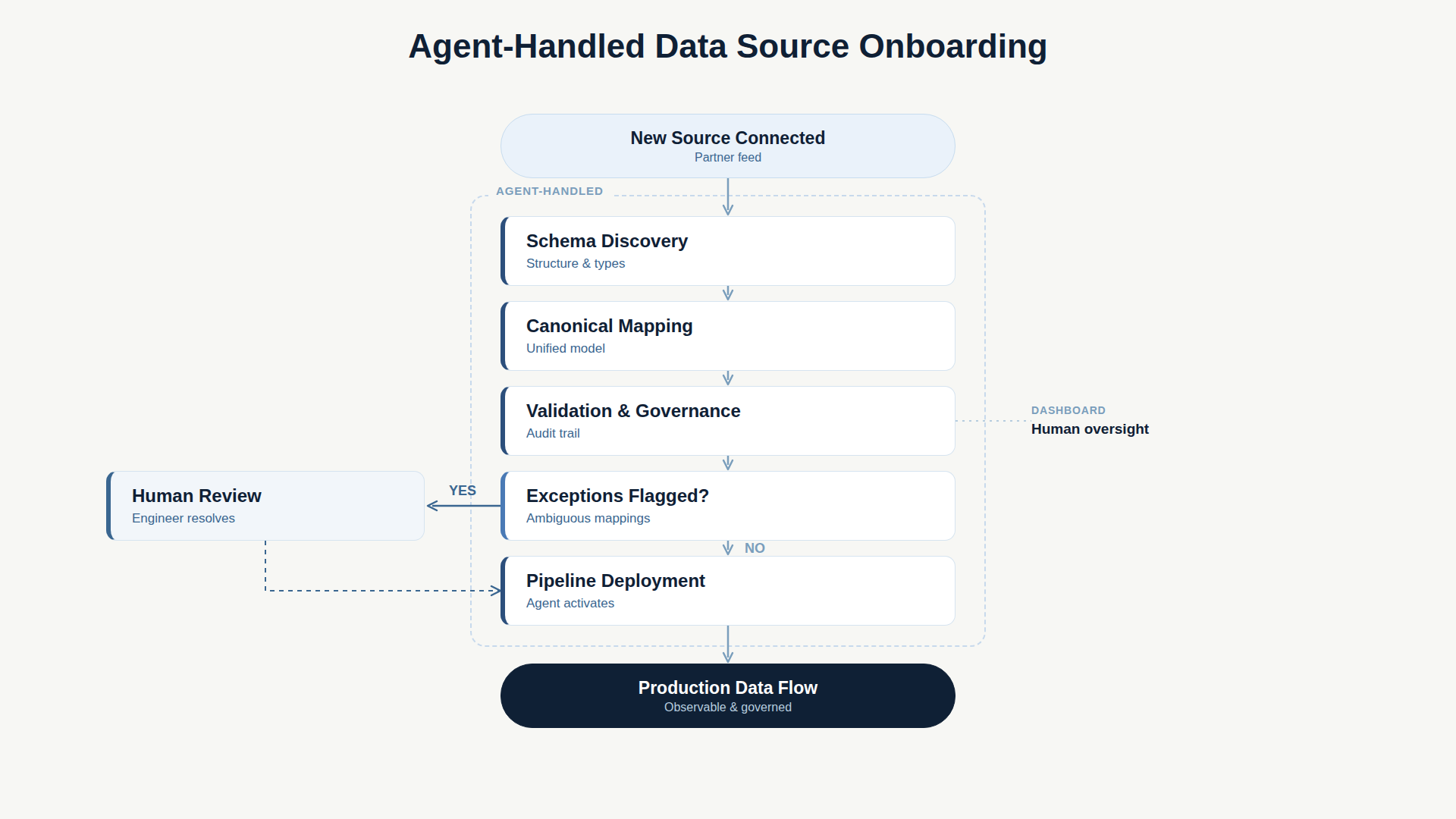
Assuming that foundation exists, here is what Stage 4 looks like once it's running end to end, from the moment a new data source arrives:
- Source connection: The new data source connects to the platform. The agent reads its structure without requiring documentation or manual schema mapping.
- Schema inference: The agent profiles the source, identifying field types, value distributions, and likely semantic meaning based on naming conventions and data patterns.
- Canonical mapping: The agent maps source fields to your canonical data model and flags ambiguous mappings, fields that could reasonably map to more than one canonical field, for human review.
- Validation against governance rules: Before any data moves, the agent runs the source against defined quality and governance rules: completeness checks, referential integrity, rights-window conflicts, or compliance flags depending on the domain.
- Pipeline deployment: If validation passes within defined thresholds, the agent deploys the ingestion pipeline. If it doesn't, the specific failures route to the exception queue with context attached.
- Ongoing monitoring: The deployed pipeline runs under continuous observability. Schema drift on the source side triggers an alert instead of a silent failure.
The key distinction from earlier stages is that humans are not in the critical path of every new source onboarding. They are in the exception path, reviewing and resolving the ambiguous cases the agent flags, and in the oversight layer, monitoring through dashboards rather than doing the work themselves.
M&A Data Integration in Healthcare, Media and Entertainment, and Financial Services
The specific data being integrated varies by industry, but the underlying pattern, and the path through the maturity model, looks remarkably similar.
Healthcare: Managing Patient and Provider Data Across Acquired Networks
When a healthcare network grows by adding provider groups, clinics, or practices to a shared platform, each new provider arrives with its own patient records system, billing data formats, and operational tooling. At Stage 1, this is weeks of manual mapping per provider, a cost that scales directly with how fast the network grows.
Moving to Stage 2 starts with a canonical provider and patient data model that new sources get mapped against, then agent-assisted schema inference and mapping suggestions for each new provider's data. The biggest early win is usually exception flagging, catching mismatches (a "discharge date" field that means something subtly different from the network's own) before they propagate into reporting or billing.
Media and Entertainment: Reconciling Rights, Catalog, and Licensing Data
Each acquired content library or distribution rights package brings its own metadata structure, rights and licensing data, and content management conventions. At Stage 1, reconciling an acquired catalog, resolving duplicate titles, conflicting rights windows, and mismatched format metadata, is manual and error-prone, and errors flow directly into royalty calculations and distribution decisions.
The path to Stage 2 and 3 starts with a canonical content and rights data model, automated quality checks, and a lakehouse-style architecture that absorbs a new catalog without a pipeline rebuild. From there, agent-assisted mapping of newly acquired metadata, with conflicts flagged rather than silently merged, turns catalog integration into a repeatable workflow.
Financial Services: Reconciling Accounts and Portfolios Under Audit
Acquired account, transaction, and compliance data has to be reconciled against existing systems with a full audit trail, often under regulatory scrutiny. Governance isn't optional here. It's the prerequisite for everything else. Every field mapping and transformation has to be traceable, which matters even more for data integration for PE-backed portfolio companies where multiple portfolio companies get consolidated onto shared reporting infrastructure over time.
For financial services firms, the maturity path is governance-first. Lineage and audit trails need to exist before agents touch reconciliation work. Once that's in place, agents can take on schema interpretation and reconciliation of acquired portfolio data, with every mapping decision logged, turning a high-risk manual process into something faster, more consistent, and auditable by design.
What Your Data Foundation Needs Before Agentic Ingestion Can Work
Across all three patterns, the same prerequisites show up, Agents depend on them. A canonical data model for the domain, whether that's provider data, content and rights data, or account data, that every new source gets mapped against, so onboarding a new source means mapping it to one known target rather than deciphering yet another bespoke schema.
- Modular, composable pipeline architecture, typically built on data lakes and warehouses rather than point solutions, where adding a new source doesn't require redesigning existing pipelines.
- Automated data quality and validation, applied at ingestion, so issues get caught before bad data reaches reporting, billing, or compliance systems.
- Observability and lineage, so that when an agent makes a mapping or transformation decision, there is visibility into what happened, why, and a way to audit it later.
Organizations that try to deploy agents directly onto Stage 1 infrastructure, without these foundations, tend to get agents that produce plausible-looking mappings nobody can fully trust, because there is no canonical model to validate against and no observability to catch errors. The agents aren't the problem. The foundation is.
This is also why the maturity model matters for planning. An organization at Stage 1 doesn't need to buy agentic ingestion. It needs to build toward Stage 2, and the foundation work that requires is valuable on its own, independent of whether agents get involved yet.
Build vs. Buy for Agentic Ingestion
Once you know you're building toward Stage 2, the next question is what to build and what to buy. The table below breaks the agentic ingestion stack into six layers and sorts each one by how much is genuinely commodity infrastructure versus how much requires engineering judgment specific to your organization.
The pattern across this table is consistent. Infrastructure is commodity, but the layer that makes agentic ingestion trustworthy, the canonical model, the validation rules, the governance framework, requires engineering judgment specific to your organization. Ideas2IT's data engineering services sit in that custom layer rather than trying to sell you a commodity infrastructure product you likely already own.
Why Ideas2IT for M&A Data Integration
Ideas2IT's Forward Deployed Engineering model puts engineers inside your existing data platform and acquisition pipeline from day one. They work within your stack, your standups, and your OKRs rather than handing over a set of tools and a document. For a problem like M&A data integration, where every acquisition brings different systems and different institutional knowledge, that embedded model is what lets the canonical model and validation rules actually reflect how your organization defines its data, not a generic template.
AgentHero, Ideas2IT's open-source agentic infrastructure platform, is the layer that makes Stage 3 and Stage 4 ingestion buildable instead of theoretical. Every team that tries to stand up agentic ingestion ends up assembling the same infrastructure first: orchestration, guardrails, human-in-the-loop routing, drift monitoring, before a single agent maps a single field. AgentHero is that infrastructure pre-built across five layers, including the decision layer that handles the uncertainty quantification and human-in-the-loop routing behind flagging an ambiguous mapping for review instead of merging it silently, and the monitoring layer that runs the drift detection and tracing behind catching a schema change on the source side before it becomes a silent pipeline failure. It's fully open source with no lock-in to a specific LLM, cloud, or framework, so the ingestion agents you build on top of it are yours to keep regardless of which model vendor you're using next year. Teams building on AgentHero report removing roughly 12 weeks of infrastructure assembly from an agentic build before it starts.
MigratiX, Ideas2IT's agentic data migration platform, addresses a narrower and later moment in this story: the point where you decide to fully decommission an acquired system and move its data permanently into your target platform, distinct from the ongoing ingestion work that happens while that system is still running in parallel. MigratiX's pre-migration phase handles discovery, readiness assessment, and AI-driven schema mapping with business context before a single record moves, and its post-migration phase runs schema drift detection and business rule validation before sign-off. Ideas2IT's data on MigratiX deployments shows roughly 80 percent of migration heavy lifting completed before execution begins, and zero data integrity issues post-migration where validation runs end to end, across SQL, cloud, on-prem, and file-based sources. For the acquisition where three legacy systems are finally being retired into one target platform, that's the tool for the final move, not the recurring mapping work upstream of it.
For healthcare organizations, Ideas2IT's AWS Healthcare Competency and SOC 2 Type II certification mean the canonical models and governance frameworks built for provider and patient data are constructed to HIPAA-compliant standards from the start, not retrofitted after an audit finding. For engagements outside healthcare, the same SOC 2 Type II certification and AWS GenAI Competency apply, along with an air-gapped deployment option where data sensitivity requires it, and AgentHero's no-lock-in architecture gives regulated teams a way to keep model choice under their own control rather than a vendor's.
The typical entry point is a working session against your current data platform and integration patterns. If you're staring down a data engineering team that's three weeks into mapping an acquired catalog by hand, or a board review where the next acquisition's integration timeline is already a question, that session produces a maturity assessment showing where your ingestion approach sits on the model above, a canonical data model gap analysis for your specific domain, and a prioritized roadmap sequenced against your acquisition pipeline. It also feeds directly into AI portfolio monitoring for PE firms if your integration work needs to roll up into ongoing portfolio-level reporting.
Not sure where your organization sits on the maturity curve?
Ideas2IT runs a working session against your current data platform and integration patterns. The session produces:
A maturity assessment where your current ingestion approach sits on the 4-stage model, and what's blocking the next stage
A canonical data model gap analysis for your specific domain (provider data, content/rights data, account data, or other)
A prioritized roadmap for foundation work, sequenced against your acquisition or growth pipeline
Recommendations on where agent-assisted capabilities would deliver the fastest return
Schedule the working session
References
Bain & Company. "Global M&A Stages Great Rebound in 2025 With $4.8 Trillion Deal Value to Mark Second-Highest Total on Record." Bain & Company. December 2025. https://www.bain.com/about/media-center/press-releases/20252/global-ma-stages-great-rebound-in-2025-with-$4.8-trillion-deal-value-to-mark-second-highest-total-on-record
PitchBook. "2025 Annual Global M&A Report." PitchBook. January 2026. https://pitchbook.com/news/reports/2025-annual-global-m-a-report
Harvard Business Review. "The Big Idea: The New M&A Playbook." Christensen, Clayton M., Richard Alton, Curtis Rising, and Andrew Waldeck. March 2011. https://hbr.org/2011/03/the-big-idea-the-new-ma-playbook
Fortune. "We Analyzed 40,000 M&A Deals Over 40 Years. Here's Why 70-75% Fail." Lev, Baruch, and Feng Gu. November 2024. https://fortune.com/2024/11/13/we-analyzed-40000-mergers-acquisitions-ma-deals-over-40-years-why-70-75-percent-fail-leadership-finance/