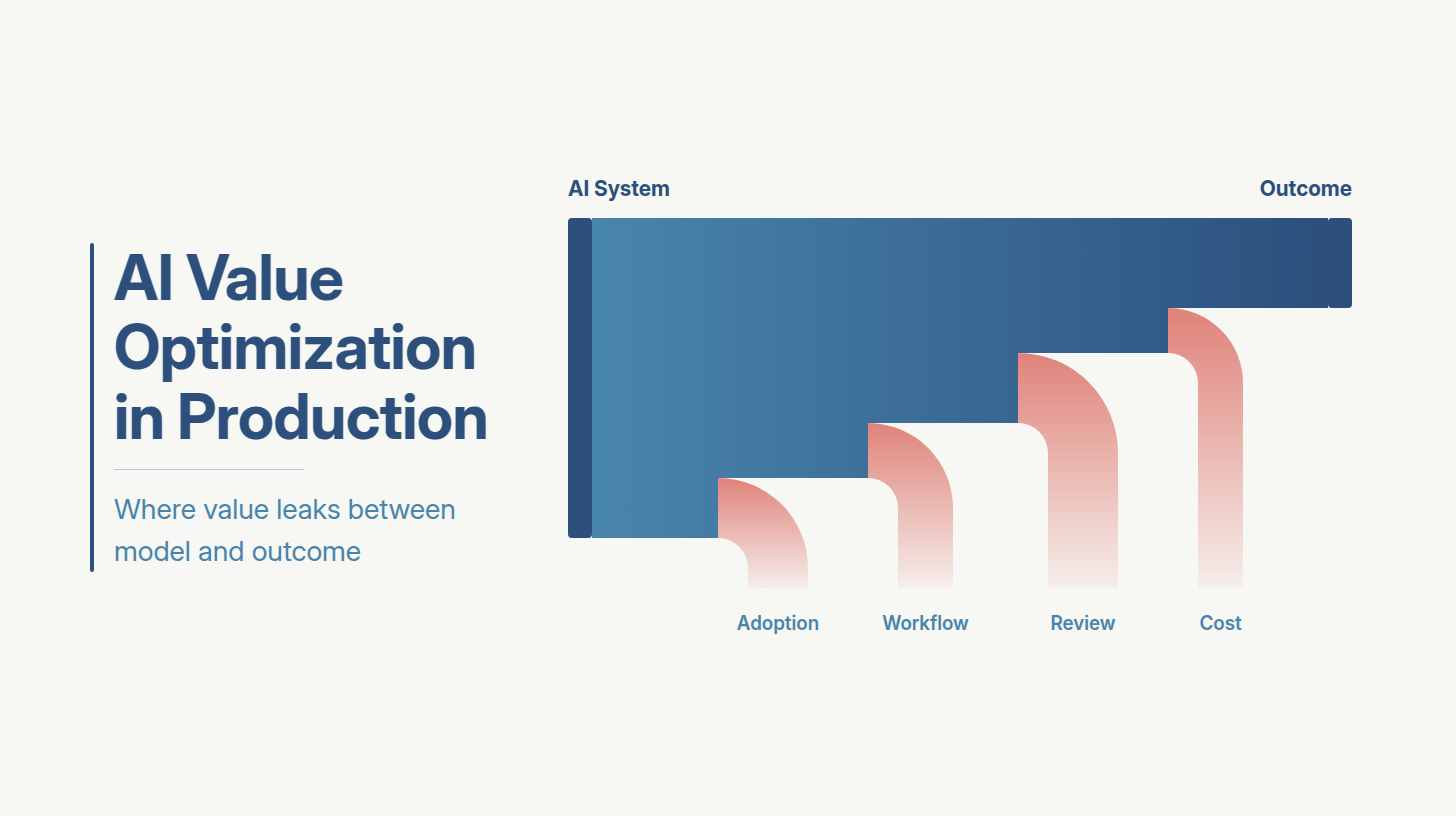

- The constraint holding back your portfolio’s AI program is that your portfolio companies are sitting at different AI maturity levels right now, and a plan built for one company does not survive contact with the rest of the fund.
- A portco with a clean product data stack can start an AI use case within weeks. Another cannot produce a reliable board number without a week of manual reconciliation first. Applying the same rollout timeline to both wastes budget on the one and stalls the other.
- Every portfolio-wide AI plan has to start with a data-readiness read across every company before a dollar gets allocated to a use case, because that read is what determines which company gets budget in month one and which gets a modernization sprint instead.
An operating partner building an AI roadmap for private equity portfolio companies sits down with a fixed budget and five portfolio companies on the table. One is a healthcare services roll-up with three years of bootstrapped acquisitions and no unified reporting, while other is a payments platform with a clean data stack and a product team already asking for a fraud-detection model. One just closed, and the new CTO is still mapping what exists. The mandate from the fund is the same for all five: build the AI story for the next board meeting.
There is no framework on the market built for this exact decision. McKinsey's maturity ladder tells you where a single company sits, BCG's Deploy, Reshape, Invent model tells you which motion a single company should be in but neither tells you how to compare several companies against each other and decide who gets the engineering budget first.
That decision, is the actual job and if you get it wrong the fund spends a year explaining why the AI story at half the portfolio still doesn't have numbers behind it.
What an AI Roadmap for Private Equity Needs to Achieve
AI touches every stage of the investment lifecycle, from fundraising through deal sourcing, investment decision, deal structure, value creation, and exit. BCG's own research on AI-first private equity narrows its focus deliberately to one stage: value creation within portfolio companies, distinct from how a fund sources deals or raises capital. An AI roadmap for private equity works the same way. It is not a fund-level AI strategy. It is the operational plan for what happens inside each portfolio company once the fund has decided AI needs to be part of the value creation story.
BCG frames that operational plan as three distinct plays, not a maturity ladder a company climbs in order.
A fund does not choose one play for the whole portfolio. It chooses a play, or a mix of plays, for each company based on what that company's data, team, and market position can actually support right now. That is the decision an AI roadmap for private equity portfolio companies exists to make explicit.
Most of the AI spend in a portfolio currently goes toward Deploy, the play with the smallest measurable P&L impact. According to BCG's 2025 Build for the Future research, which studied roughly 1,250 companies, 14% are still AI stagnating and 46% are AI emerging, meaning close to 60% have yet to realize measurable value from AI despite deploying tools broadly.
The gap shows up clearest in BCG's own case work. On a technology company that set out to double developer productivity, BCG found that people, organization, and process changes accounted for 70% of the resulting productivity uplift, with the AI tooling itself responsible for roughly 10%. A separate BCG case example reinforces the same finding from the commercial side: a global logistics company redesigned its entire RFP workflow around an AI document analyzer, and that workflow redesign is what produced a 40 to 50% faster proposal creation cycle and a 10% increase in win rate.
Reshape and Invent require the reshaping work most portfolio companies skip, and that work has to be sequenced deliberately across a portfolio instead of funded evenly across it. That sequencing question, not the choice of AI tool, is what the rest of this piece answers.
Why One AI Roadmap Cannot Work Across Every Portfolio Company
Most operating partners already split the AI opportunity into two buckets: AI inside the product a company sells, and AI inside the operations that run the business. That split is useful, but it assumes a single company. A portfolio runs several companies at once, each at a different point in that split, and each with a different amount of usable data to act on it.
McKinsey's AI value creation ladder captures this well at the single-company level, with opportunistic adoption at the bottom and business building at the top. According to McKinsey's 2026 research on AI value creation in private equity, companies at the highest maturity level traded at a median revenue multiple of 31x between 2023 and 2025, against 13x for companies that adopted AI opportunistically. McKinsey notes the Level 4 sample is small, so this multiple is directional rather than a predictive target.
What the ladder does not do is tell an operating partner how to weigh a company two levels up against one still doing opportunistic adoption, when both are asking for the same engineering hours in the same quarter. That comparison problem is the one a portfolio-wide AI roadmap for private equity actually has to solve. It gets skipped whenever a fund adopts a maturity model built for judging one company against itself over time, rather than several companies against each other right now.
How to Assess AI Readiness Across Portfolio Companies
The spread exists because portfolio companies enter a fund from different starting points, and none of them were built with a fund-wide AI plan in mind. A company acquired for its market position several years ago carries different technical foundations than one acquired last quarter for its growth trajectory. Bootstrapped companies in particular tend to run with thin data and engineering teams, often one or two people responsible for keeping systems running with little capacity left to build anything new.
BCG's survey of 100 senior PE investors found that only 15% of portfolio companies have IT infrastructure investors would call very mature, while roughly 75% sit at a moderate level. That moderate label hides a wide spread of actual readiness. One company might be a single data-cleanup sprint away from being AI-ready. Another might not be able to produce a clean reporting number without weeks of manual reconciliation. Both get scored "moderate" on a self-reported survey, and neither deserves the same treatment on an AI roadmap for private equity. This is the same gap technology due diligence is supposed to catch before close, and it rarely does at this level of granularity.
Firms that modernize core systems first see AI deployment move 40% faster once that foundation is in place, per the same survey. The modernization has to happen somewhere in the sequence regardless. The only real choice is whether it happens deliberately, as a planned phase, or by accident, as the reason a use case stalls six months in.
What Happens When Every Portfolio Company Gets the Same AI Strategy
Applying one AI timeline to a portfolio with different starting points produces specific costs. None of them show up on the invoice for the AI tools themselves.
How to Sequence an AI Roadmap Across Your Portfolio
A portfolio-wide roadmap works differently from a single-company playbook because it has to answer a comparison question before it answers an execution question. The model below runs on four time gates. Every portfolio company enters at the same first gate. What differs is which gate each company is actually working through at any given time, and that difference is the entire point of running the assessment portfolio-wide instead of company by company.
The Day 0–30 read covers five dimensions: data availability, data quality, infrastructure reliability, reporting accuracy, and team capacity. Companies that clear all five are AI-ready immediately. The others get a gap summary that maps directly to which gate they enter next, and how long they're likely to spend there.
How Data Readiness Determines Which AI Use Case Comes First
The following is an anonymized engagement, not a hypothetical. A mid-market portfolio company that had grown through acquisition had a finance team assembling board reporting by hand from three separate systems that had never been integrated. The fund's instinct going in was to start with an AI use case on the product side, since that was where the growth story lived. The data-readiness read reordered that. The reporting gap was consuming enough analyst time that no AI initiative downstream had a reliable number to build on. The first sprint was a data integration pass, not an AI model. Once the reporting layer was reliable, the first AI use case reached production within eleven weeks, and the pattern from that integration became the template applied to two other companies in the same portfolio with similar acquisition histories.
That sequencing decision, data integration before the AI use case, is a small piece of a larger roadmap. It is also the piece that gets skipped most often when a portfolio-wide plan treats every company as AI-ready simply because the fund is ready to fund AI.
For a closer look at how to turn a validated use case into a credible ROI estimate for your investment committee, see AI ROI Modeling for Private Equity Portfolio Companies.
Once the sequencing decision is made and a portfolio company is ready for its first AI use case, the harder problem is execution inside the hold period.
Why Ideas2IT Is the Right Technology Value Creation Partner for US Private Equity Firms walks through the five-step process that turns a validated use case into a sequenced, IC-ready build backlog. Once the roadmap moves into execution, the same ongoing tracking question comes up again at the next board meeting, which is why portfolio-wide AI monitoring tends to become the natural next step after the first use case ships.
How Ideas2IT Builds an AI Roadmap for Private Equity Portfolios in Practice
Ideas2IT runs this portfolio-wide sequencing work through the same model that runs every engagement: Forward Deployed Engineers embedded inside each portfolio company from Day 0, aligned to that company's own OKRs rather than managed from a central delivery team. The FDE model is what makes cross-portfolio replication possible in practice rather than in name. The same engineers who build the modernization pattern at one portco carry that pattern, and the judgment behind it, into the next one.
Ideas2IT has run this pattern across PE-backed portfolios in healthcare and fintech, among other sectors, including clients such as AEA Investors, Vistria Group, and Insight Partners. For the criteria that separate execution-ready partners from strategy-only firms, Choosing an AI Implementation Partner for PE Portfolios is worth reading before any partner conversation.
Get an AI Roadmap for Your Portfolio Ready
Most operating partners can already tell you which portfolio company is asking loudest for AI budget. What they usually cannot tell you, with evidence, is which company is actually closest to ready, and that gap is exactly what stalls the roadmap once the board expects results.
Ideas2IT runs a structured data-readiness assessment across your portfolio companies and returns a phased allocation plan: a data-readiness score for every company against the five-dimension framework, a ranked sequencing recommendation for who enters the 0–30, 90–180, and 6–18 month gates, a flag on which companies need a modernization sprint before any AI use case can start, and a first sequenced use case recommendation for the companies that are ready now.
Book an AI roadmap session for your portfolio with Ideas2IT.
References
- McKinsey & Company (2026). Beyond Productivity: How AI Creates Value in Private Equity. mckinsey.com/capabilities/business-building/our-insights/beyond-productivity-how-ai-creates-value-in-private-equity
- Boston Consulting Group (2026). Private Equity's Future Is Digital First and AI Powered. bcg.com/publications/2026/private-equitys-future-digital-first-and-ai-powered
- Boston Consulting Group (2026). AI-First Companies Win the Future: Private Equity, Value Creation in Portfolio Companies (Executive Perspectives, January 2026). bcg.com/publications/2026/inside-the-ai-first-private-equity-firm
- Bain & Company (2025). Field Notes from the Generative AI Insurgency: Global Private Equity Report 2025. bain.com/insights/field-notes-from-generative-ai-insurgency-global-private-equity-report-2025
- FTI Consulting (2026). 2026 Private Equity AI Radar. fticonsulting.com/insights/reports/2026-private-equity-ai-radar
References
- McKinsey & Company (2026). Beyond Productivity: How AI Creates Value in Private Equity. mckinsey.com/capabilities/business-building/our-insights/beyond-productivity-how-ai-creates-value-in-private-equity
- Boston Consulting Group (2026). Private Equity's Future Is Digital First and AI Powered. bcg.com/publications/2026/private-equitys-future-digital-first-and-ai-powered
- Boston Consulting Group (2026). The AI-First Private Equity Firm. bcg.com/publications/2026/inside-the-ai-first-private-equity-firm
- Bain & Company (2025). Field Notes from the Generative AI Insurgency: Global Private Equity Report 2025. bain.com/insights/field-notes-from-generative-ai-insurgency-global-private-equity-report-2025
- FTI Consulting (2026). 2026 Private Equity AI Radar. fticonsulting.com/insights/reports/2026-private-equity-ai-radar
Frequently Asked Questions
FAQ's