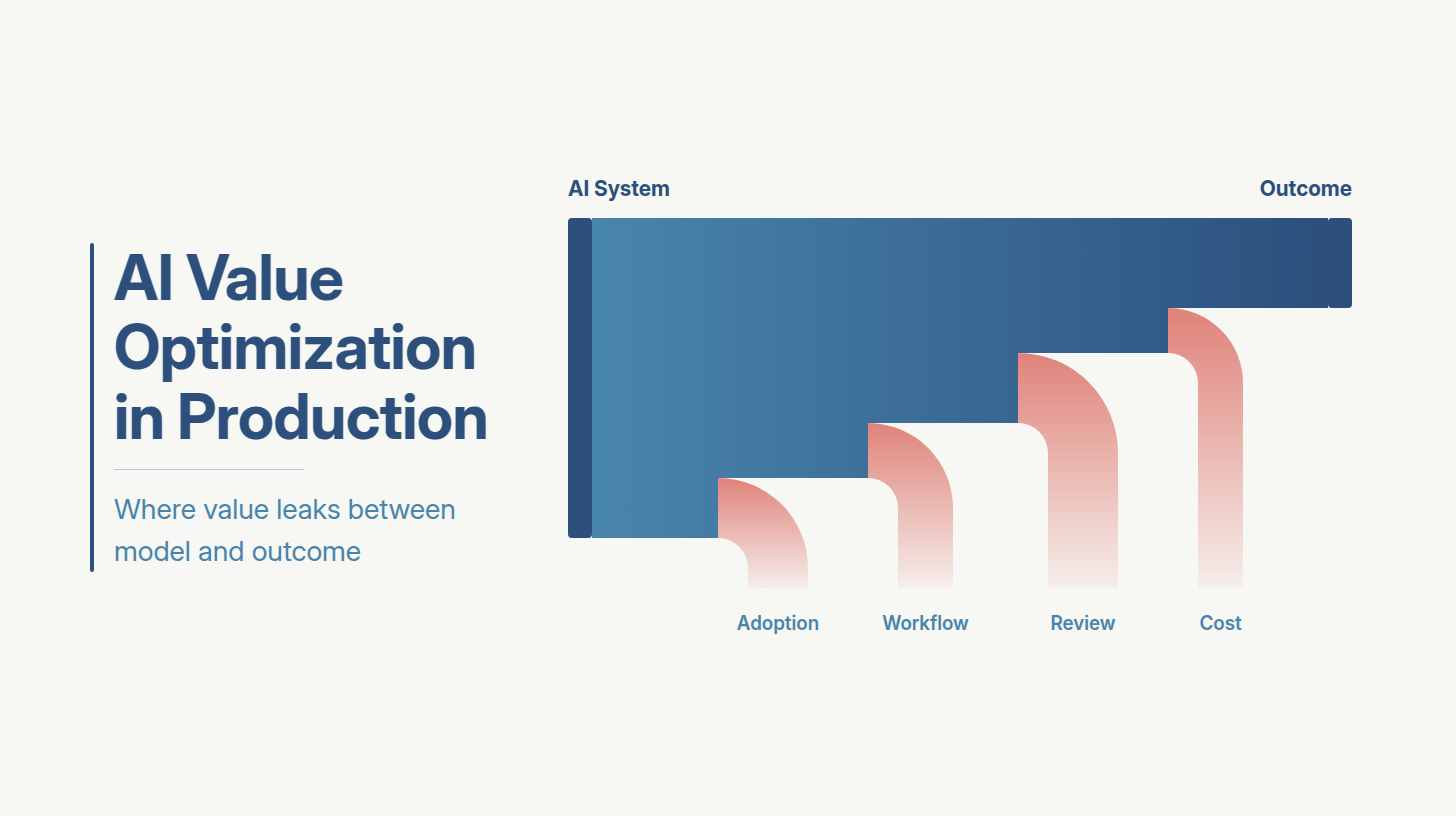

Imagine this: You closed the deal with a technology value creation plan tied to specific EBITDA targets. The strategy is sound, the use cases connect directly to the investment thesis, and the portco CTO has the capability to execute.
And the engineering backlog is already six months longer than the hold period allows.
This is an execution problem, and it is the one problem the consulting firm that built your value creation plan was never hired to solve.
According to Bain's 2025 research, 80% of PE-backed portfolio companies have not operationalized AI use cases delivering measurable returns. McKinsey's 2026 data shows 70% of GPs expect AI to deliver high impact within three to five years, while only 6% report seeing it today. The use cases exist inside these portfolios. The plans exist. What does not exist is the engineering execution layer that converts a value creation plan into a sprint backlog before the hold period closes.
The strategy firm produced the roadmap and moved to the next engagement. The IT services firm responded with a six-month SOW. The portco's internal engineering team is maintaining the current system with no capacity left for transformation work. The gap between the plan and production software has no owner, and the hold period clock does not wait for anyone to claim it.
Understanding what type of partner is actually built to close that gap, and why most firms are not, is what the rest of this article works through.
What a Technology Value Creation Partner Actually Does
A technology value creation partner translates a PE investment thesis into engineering execution within the hold period. The role is distinct from two types of firms that operating partners typically engage, and understanding the distinction is what separates a value creation plan that delivers from one that produces a deck.
A consulting firm produces the strategy and exits at delivery. Their economic model does not support staying through the engineering phase. When they attempt implementation, they bring in an arm running the same long-cycle SOW economics as the IT services shops they were meant to replace.
An IT services firm executes the build but arrives without investment thesis context. They receive a requirements document. Before the first sprint starts, they need discovery, scoping, contract negotiation, and team ramp. In a PE context where the IC is expecting progress at the next quarterly review, that sequence does not fit.
A technology value creation partner like Ideas2IT bridges both. It models use case ROI before any build commitment, deploys engineers aligned to the portco's OKRs from Day 0, and delivers working systems within the 45 to 90-day window PE deals require. The output is measurable EBITDA impact inside the hold period: working software with EBITDA attached.
Before evaluating any external technology partner, the honest prior question is whether the portco's existing engineering team, with some targeted augmentation, can handle the value creation plan's technology initiatives on their own. Sometimes the answer is yes. If the portco has a strong engineering team, a reasonably documented codebase, and the technical debt is manageable, adding one or two senior engineers in specific domains may be the right call. Ideas2IT's engagement model includes adding engineers precisely for that scenario. The cases where a full external engagement creates the most value are those where the codebase is undocumented, the data infrastructure for AI initiatives does not exist yet, the hold period is short, and the value creation plan has technology initiatives the portco's existing team cannot execute in parallel with their current maintenance responsibilities. The free tech audit in week one is specifically designed to surface which situation you are actually in, before any resource commitment is made.
The hardest version of this problem, and the one most content on this topic skips entirely, is the buy-and-build portfolio company, where the execution gap does not appear once. It appears at every acquisition close.
Why Portfolio Companies Struggle to Execute Technology Value Creation Plans
With each add-on acquisition multiplies the engineering problem. Three failure modes appear in almost every deal and block the cross-sell and operational efficiency plays the investment thesis was built on. The post-merger integration challenges PE firms encounter most frequently follow a consistent pattern regardless of vertical, and understanding them before close is what separates deals that integrate smoothly from ones that consume the first year of the hold period in recovery work.
Data fragmentation stops unified reporting
Each acquired entity stores its data in a system that was never designed to talk to the platform company's stack. The result is a quarterly board report that takes a week of manual consolidation to produce, carries enough reconciliation error to make IC-level analysis unreliable, and occupies the two analysts who should be working on something that moves the EBITDA line. Until an integration layer is built, this does not improve. It compounds with each additional acquisition close.
Duplicate SaaS subscriptions stay on the books
A platform company with three add-ons is typically paying for the same CRM, the same project management tooling, and the same analytics licences across four separate entities. The consolidation opportunity is visible on day one. It stays unaddressed because migrating users, mapping data, and deprecating the redundant instances is engineering work, and it sits precisely in the gap between what the strategy firm scoped and what the IT services firm will touch without a full SOW.
Incompatible API layers block the cross-sell plays
The cross-sell and upsell motions that justified the acquisition premium require the platform company's systems to see the add-on's customer data in real time. If the API layers between the two core systems were built on different authentication models or data schemas, that visibility does not exist until someone rebuilds the connection. Doing that retroactively, without an architecture assessment at close, costs more time and more budget than doing it right the first time.
Each failure mode has a specific cost. Together they can consume a quarter of the hold period in recovery work that was never in the value creation plan. What makes them solvable is an engineering partner who arrives at close already knowing how to sequence the fix, which brings us to the process that makes that sequencing possible.
The Five-Step Process Ideas2IT Uses to Prioritize Technology Investments
Most portco technology decisions go from identifying a use case to starting the build. The step that gets skipped (modeling the ROI on each initiative before committing engineering resources) is what separates technology investments that get IC approval from those that get deferred.
The five-step process below runs before a line of code is written. It produces the documents most portcos never have at the start of a technology engagement: a filtered use case list, IC-ready ROI estimates, and a sequenced build backlog.
Step 1: Portco Tech Audit
Explayn - Ideas2IT's AI-powered Code Comprehension platform connects to the portco's codebase via Git, cloud storage, or direct upload and generates full technical comprehension automatically: dependency graphs, architecture maps, API references, logic flows, and tech debt extracted from code behavior. The output maps what actually exists against what the investment thesis assumed. In almost every PE engagement, these two things diverge. Where the audit surfaces applications that need modernization, Legacyleap runs a dedicated assessment on those modules, producing risk indicators and modernization cost estimates before any build commitment is made.
Step 2 and 3: Use Case Identification and ROI Modeling
Each technology initiative in the value creation plan is assessed against the audit findings and filtered to what is technically feasible within the hold period. Each validated use case then receives a one-page ROI estimate: expected EBITDA impact, build cost, and time to first measurable return. This is the document most technology investment decisions go to the IC without, and it is the one that converts technology spend into an EBITDA initiative the committee can evaluate and sequence. A detailed breakdown of AI ROI modeling for PE portfolio companies covers how these estimates are structured and what makes them credible to an IC with industry knowledge.
Step 4: Build Prioritization Matrix
Use cases are ranked by return per engineering week, hold period fit, and dependency sequencing. Some high-return initiatives depend on infrastructure a lower-return initiative must build first. The prioritization matrix maps those dependencies and produces a sequenced backlog. The portco CTO most needs this document and almost never has it at the start of an engagement.
Step 5: Execution Sprint Design
The first sprint is scoped, the team is structured, and the delivery timeline is confirmed against the 100-day plan. The engineering team starts executing on Monday. The operating partner enters the IC conversation with a prioritized investment proposal.
In Ideas2IT's portco engagements, this diagnostic phase consistently surfaces more viable use cases than the hold period can absorb. The real challenge is in sequencing the initiatives that can produce measurable impact within the available window. Once the prioritized backlog exists, the practical question shifts to which lever produces the fastest return.
The Five EBITDA Levers Custom Engineering Creates in PE-Backed Companies
Custom engineering creates measurable EBITDA impact through five specific mechanisms. Each maps to a failure mode present in most portcos at the time of acquisition. Each has a documented return range.
SaaS subscription replacement: margin impact in the first quarter
Portcos pay enterprise SaaS rates for products they use partially, on contracts that auto-renew because no one owns the rationalization work. A custom internal tool built to the portco's exact workflow eliminates unused modules, per-seat pricing above actual headcount, and annual escalation clauses. The margin improvement appears in the first quarter after the legacy subscription is deprecated. This requires an engineering partner who understands the portco's workflows well enough to build a replacement the team will actually use.
Post-acquisition data integration: unified reporting in 45 to 60 days
When acquired entities run on separate data systems, the unified board visibility the investment thesis assumed does not exist until someone builds the integration layer. MigratiX, Ideas2IT's AI-Powered data migration platform automates every phase: schema analysis, transformation code generation, pre-validation, data loading, and post-validation. 80% of the heavy lifting is completed before execution begins, with zero data integrity issues when validation runs end-to-end. ETQ consolidated SQL Server, Oracle, and MySQL across multiple schema versions into a single MySQL RDS on AWS. Unified board reporting arrived before the next quarterly review. According to FTI Consulting's 2026 PE AI Radar, firms deploying AI tools properly see EBITDA gains of 5 to 25% across industries, but the data infrastructure those tools require almost always has to be built first.
AI pricing and revenue optimization: 5 to 25% revenue upside where the data is ready
Pricing decisions that currently run on historical averages get replaced by real-time demand signals. The prerequisite is clean, integrated data, which is why data integration almost always precedes AI use case execution in Ideas2IT's portco engagements. This lever appears most often in value creation plans and stalls most often in pilot. The stall is almost always a data infrastructure problem, not an AI capability problem.
Workflow automation: headcount recovery without a headcount reduction
Every portco has a version of this: the reconciliation process consuming two analysts for three days each month, the compliance report assembled manually from four systems, the customer onboarding workflow requiring five handoffs. Automating the top-cost manual workflows recovers those hours and redirects them to the product roadmap the value creation plan requires.
Billing accuracy and revenue capture: revenue that was never in the P&L
Billing errors in healthcare IT, logistics, and fintech portcos leak revenue that never appears in the P&L because it was never captured. Automated billing reconciliation and charge capture systems close that gap without adding headcount. In healthcare IT portcos, billing automation for CMS codes alone recovers revenue that recurs in every billing cycle after deployment.
Where the EBITDA Levers Hit Hardest - Vertical wise
The EBITDA levers hit the hardest when verticals are targeted specifically basis their industry specifics.
Fintech and payments: the integration layer that compliance requires
Fintech portcos carry legacy core systems built for older transaction volumes, manual reconciliation sitting between the core system and the reporting layer, and compliance reporting fragmented across systems producing outputs in incompatible formats. The highest-leverage intervention is an API integration layer connecting the core system, reconciliation, and compliance stack into a single data flow. It eliminates the manual steps consuming the most expensive headcount and builds the audit trail the regulatory environment requires. Ideas2IT's work with Oportun, a fintech platform serving underbanked consumers, produced this outcome directly: payment infrastructure modernization that created margin expansion through SaaS replacement and faster product release cycles.
Healthcare IT: where compliance infrastructure determines whether engineering can start
Healthcare IT portcos need a delivery partner with the infrastructure to operate inside HIPAA constraints from day one, not after a compliance buildout that adds three months before engineering can begin. EHR integration gaps are the most common entry point. Billing complexity in behavioral health and chronic care management portcos leaks revenue in every reimbursement cycle. Ideas2IT's AWS Healthcare Competency designation and HIPAA-compliant delivery infrastructure handle these constraints as standard delivery capability. A leading behavioral health technology platform in Ideas2IT's engagement history saw FHIR R4 integration, clinical workflow automation, and billing automation for CMS codes recover a material share of annual revenue in the first post-deployment billing cycle. The SOC 2 Type II and ISO 27001 certifications matter here for the same reason: they eliminate a class of compliance friction before the engagement starts.
Logistics: turning operational data into a revenue asset
Logistics portcos carry their technical debt in the operational layer: route optimization on spreadsheets, no real-time visibility connecting dispatch, customers, and billing, and a TMS, a telematics system, and a billing platform that were procured independently and never integrated. Ideas2IT's work with Alaska Airlines is built on exactly this type of data pipeline and integration challenge, and it produced both primary EBITDA levers in logistics: fuel and labor cost reduction through route optimization, and new revenue through data-as-a-service offerings that only become viable once the real-time visibility layer exists.
At this point the framework is clear: the problem, the process, the levers, and the verticals. The practical question that follows is what the engineering execution looks like and which tools compress the timelines where hold period value is lost.
How Ideas2IT Executes Faster Than Traditional Partners
Each platform enters an engagement only when the specific problem it solves is present. Not by default, not as a bundle. When the portco's situation calls for it.
Explayn: Use this when the codebase is undocumented and the team is starting blind. Explayn connects to any stack and generates dependency graphs, architecture maps, API references, logic flows, and tech debt in three to five days. It has analyzed over 50 million lines of code across Ideas2IT's client base. A portco with complete, current application documentation at exit answers an acquirer's technical team in days instead of weeks.
Legacyleap: Use this when legacy applications are blocking modernization and the investment thesis assumed a level of technical maturity that does not exist. Five specialized agents cover the full modernization lifecycle: assess, document, recommend, modernize, and validate. A global credit scoring firm migrated 1.5M+ lines of Ab Initio code to Java Spark, cutting total cost by 55% and accelerating go-to-market by 60%. A semiconductor manufacturer modernized a fragmented VB6 stack to .NET, automated 70% of previously manual processes, and improved application speed by 40%. Legacyleap runs air-gapped on the portco's infrastructure when code sensitivity is a concern.
MigratiX: Use this when post-acquisition data fragmentation is blocking board reporting or AI use case execution. Three automated phases: pre-migration covers discovery, schema mapping, and auto-generated transformation scripts; migration handles dry run execution and data movement; post-migration runs schema drift detection and business rule validation. 80% of the heavy lifting is done before execution begins. Zero data integrity issues when validation runs end-to-end.
Anticlock: Use this when the portco's engineering team needs to move faster without growing headcount. A product brief converts into a sprint-ready architecture in six hours. 70% of test cases are written before engineers start a sprint. Medtronic LABS delivered 60% faster with zero compliance compromise. A Series B fintech went brief to production in six weeks against a six-month expectation.
Qadence: Use this when QA is the velocity bottleneck. 70% of test cases auto-generated across functional flows, integrations, regression, and edge cases before sprint begins. Bloomberg ships faster with Qadence embedded in their delivery pipeline. Standard Playwright code, zero platform lock-in, zero seat licences.
SLM in a Box: Use this when AI workloads involve sensitive data that cannot leave the portco's environment. A production-ready Small Language Model is deployed inside the portco's infrastructure in six to eight weeks, with zero ongoing licence cost and 100% model artifact ownership permanently. Healthcare portcos keep PHI inside HIPAA boundaries with a model that never calls an external API.
What the portco owns when the engagement ends
Every output from an Ideas2IT engagement transfers to the portco at close. The code, the documentation, the architecture decisions, the model artifacts: all of it. There are no licensing dependencies, no platform fees that continue after the engagement ends, and no requirement to maintain a commercial relationship with Ideas2IT to keep what was built running.
By the time a typical engagement concludes, the portco's engineering team has not been managed around. It has absorbed capability. FDEs work alongside the internal team throughout and not above it. The documentation Explayn generates stays current with every commit after the engagement ends. The test coverage Qadence built compounds with every release. The portco CTO leaves the engagement with a team that understands the codebase better than when Ideas2IT arrived, because the FDEs worked inside it with them instead of parallel to them.
What the portco holds at exit is a working system, living documentation, and an internal engineering team that can maintain and extend both independently. That is what clean engagement exit looks like.
What Makes a Good Technology Partner for PE-Backed Businesses?
Operating partners evaluating technology partners for PE-backed companies are comparing three structurally different firm types. The criteria that matter in a PE engagement are not the same ones that govern standard software procurement.
The 99% client renewal rate reflects something this table cannot capture: the FDE model earns the portco CTO's trust within the first 30 days. The failure pattern in most technology engagements is not technical. It is relational. The external team and the internal CTO quietly work against each other by week six. "Our partnership with Ideas2IT resulted in the most successful software rollout I've seen in my 30-year career," said Shawn Powers, CIO of uLab Systems.
Once the partner decision is made, the conversation that follows is the one with the investment committee.
Why Should a PE Firm Choose Ideas2IT as Their Technology Value Creation Partner?"
Technology spend that cannot be tied to an EBITDA line gets cut. The operating partner who walks into an IC meeting with a technology budget and no return model is in a weak position. The one with a one-page estimate per initiative (expected impact, build cost, time to first measurable return) is in a different conversation entirely.
Ideas2IT's use case modeling process produces those estimates before any build begins. The IC framing that holds is direct: here are three initiatives, here is what each returns, here is the timeline, and here is the documentation the exit process will require.
That last part matters more than most operating partners anticipate at the start of an engagement. According to PwC research, companies with structured AI capability documentation achieve exit multiples 1.3 to 1.8 times higher than those without in competitive auction processes. The premium does not accrue to companies that deployed AI. It accrues to companies that can show an acquirer exactly what their AI systems do, how they perform in production, and what their regulatory compliance posture is. Ideas2IT produces that documentation as a standard output of every engagement.
How Ideas2IT Engagements Handles Friction
Most vendor articles do not answer this question. The ones that do not answer it are either unaware of where their engagements face friction or unwilling to say. Both are problems for an operating partner making a decision under time pressure.
Two situations consistently create friction in Ideas2IT engagements.
- The first is when the portco CTO has not been brought into the engagement framing before day one. When the operating partner and the portco CTO are aligned on what the engagement is for, what success looks like, and what the FDE team's role is before anyone arrives, the team earns the room within the first two weeks. When that conversation has not happened, the first sprint carries avoidable friction. The fix is a thirty-minute conversation between the OP, the portco CTO, and the Ideas2IT engagement lead before the engagement starts. Operating partners who do this have consistently smoother engagements than those who surface the framing questions at the first sprint review.
- The second is when the codebase is significantly more fragmented than the diligence assessment suggested. The tech audit in week one surfaces this every time, which is why it runs before any build commitment is made. When the divergence is large enough to shift the build prioritization meaningfully, it requires a revised IC conversation before the first sprint begins. That conversation is easier to have at week one than at week six. Operating partners who have been through this consistently say the early flag was the right call, even when the IC conversation was uncomfortable.
Neither situation is a reason to avoid an engagement. Both are reasons to structure the first week so the information that surfaces in the tech audit reaches the right people before it becomes a constraint on the build sequence.
Start Your Portco Assessment
If you are 30 to 90 days post-close and the gap between the value creation plan and what engineering can actually deliver is already visible, the most useful next step is a technical read of where the portco actually stands.
The problem underneath the gap is almost always the same: the investment thesis assumed a level of technical maturity that does not match what actually exists in the codebase, the data infrastructure for AI initiatives has not been built yet, and the portco's engineering team does not have the capacity to execute the value creation plan in parallel with their current maintenance responsibilities.
In one week, you get:
- A full codebase assessment with technical debt quantified in dollar terms, delivered via Explayn
- Where modernization is a priority: a dedicated application assessment with risk indicators and a prioritized modernization roadmap with cost estimates, delivered via Legacyleap
- A use case list mapped to your investment thesis with one-page ROI estimates per initiative
- A 90-day execution roadmap the portco CTO can hand to their team on Monday
Book Your Free Portco Assessment
References
Bain & Company (2025). Global Private Equity Report 2025. bain.com/insights/topics/global-private-equity-report
McKinsey & Company (2026). Global Private Markets Report 2026: Private Equity: Clearer View, Tougher Terrain. mckinsey.com/industries/private-capital/our-insights/global-private-markets-report/private-equity
FTI Consulting (2026). 2026 Private Equity AI Radar. fticonsulting.com/insights/reports/2026-private-equity-ai-radar