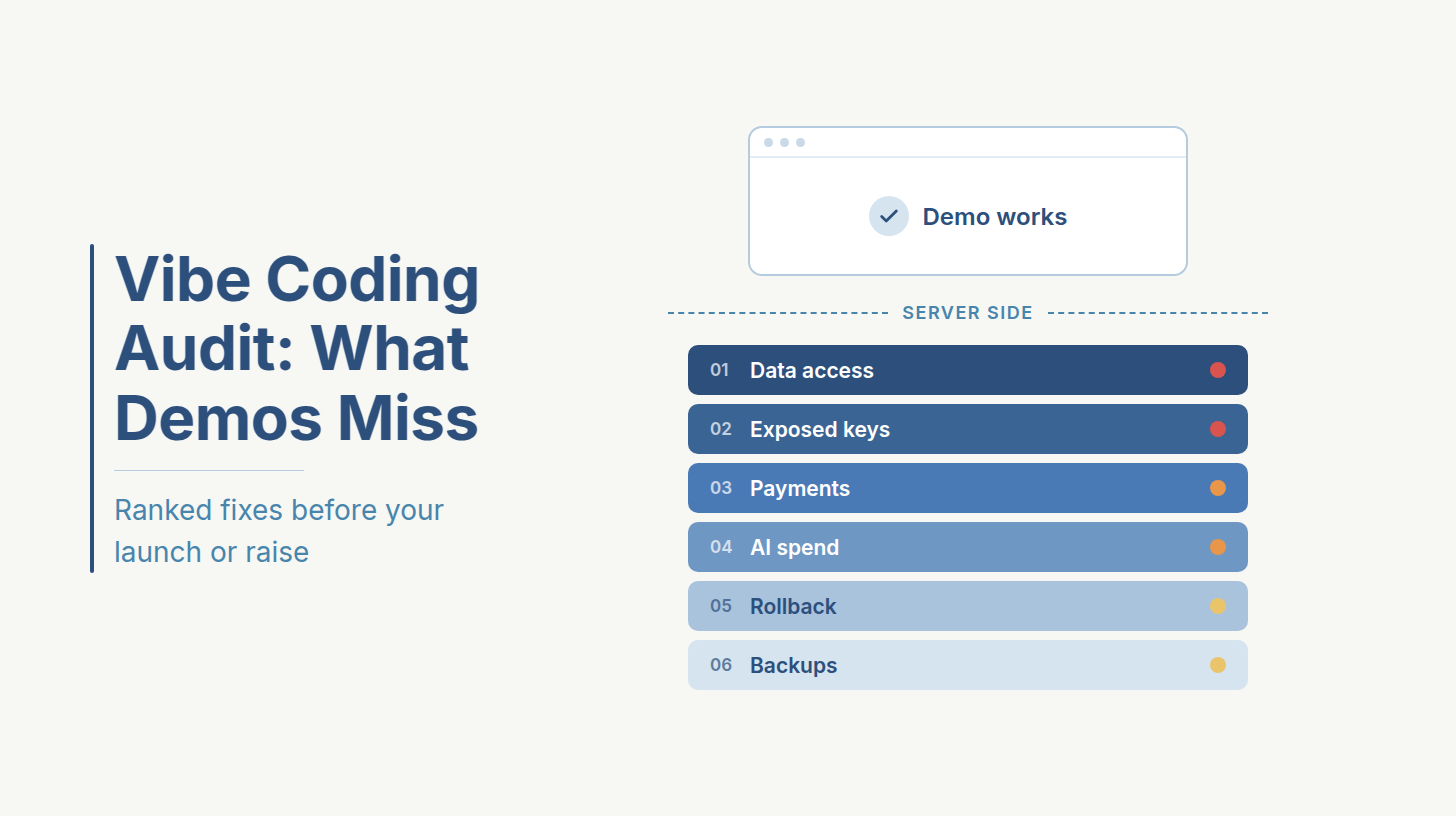

- Most AI implementations fail because the use case, data, ownership, or vendor wasn't evaluated properly before the project began.
- Before launching a pilot, validate three things: measurable business value, production-ready data, and a single accountable owner.
- Don't judge an AI initiative only at launch. Evaluate adoption, data quality, operating costs, and ROI again 60–90 days after deployment to catch problems early.
- Choosing the right implementation partner matters as much as choosing the right use case. Look beyond demos and prioritize production experience, governance, and long-term scalability.
- This guide walks through the frameworks, checklists, and ROI model you can use to plan, evaluate, and scale enterprise AI initiatives with confidence.
Enterprise AI implementation in the US runs into the same handful of challenges regardless of industry, and none of them are about whether the model is good enough.
Data readiness - It is the most common one. Most mid-market companies assume their data is usable because a pilot ran on a small, cleaned sample of it, then discover the production data is fragmented across systems that have never talked to each other. IDC research found 88% of AI proof-of-concepts never reach production deployment, and data readiness is the single most cited reason work stalls between the two stages. That figure has improved. The 2026 Lenovo CIO Playbook found nearly 46% of AI POCs now progress to production. But data readiness and ownership gaps remain the leading reasons the other half stall.
Ownership - A pilot with broad enthusiasm and no accountable owner survives exactly as long as the initial excitement does. When a reorg happens or budget gets tight, an initiative with a named owner defending it survives. One without doesn't.
Measurement - it's the one that shows up latest and hurts the most. MIT's 2025 research on enterprise GenAI found 95% of organizations see no measurable financial return on their AI investment, not because the systems don't work, but because most organizations never defined what "return" meant in dollar terms before building.
Compliance - state AI laws in the US remain fragmented and fast-moving. Texas's Responsible AI Governance Act took effect January 1, 2026. California has multiple AI laws in force or phasing in through 2027. Colorado repealed its original AI Act in May 2026 and replaced it with a narrower automated decision-making framework effective January 1, 2027. Companies that treat governance as a final step before launch rather than a day-one architecture decision end up rebuilding it under deadline pressure.
These four are decisions that either get made deliberately early or get made by default and discovered late. For a broader look at how data infrastructure gaps and talent shortfalls compound across a full transformation effort, see Enterprise AI Transformation: Strategy and Execution Guide.
Self-Diagnostic: Is a Current AI Initiative Already Heading Toward a Stall?
Before looking at new use cases, check any AI pilot already in flight against this list. The more of these that are true, the more likely it stalls before reaching production, regardless of how well the underlying model performs.
- The pilot has been running more than three months with no committed production date
- Nobody can name the current dollar cost of the process this pilot is meant to replace
- The data it runs on was manually curated or cleaned specifically for the pilot, not pulled from live systems
- There is no single person accountable for the outcome if the pilot fails to scale
- The vendor or model was chosen because of a demo, not because it was tested against internal data
- Procurement and legal were brought in after the vendor was already selected
If three or more of these are true, the problem sitting in front of you isn't the AI. It's a decision that was skipped or made by default before implementation started.
What Successful AI Implementation Looks Like
A 400-person logistics company automates invoice processing for a finance team that was spending roughly 60 hours a month manually keying vendor invoices, a cost of about $4,500 a month once you account for the analyst's fully loaded rate. The system costs $70,000 to build, with $12,000 a year in ongoing monitoring and retraining. The full ROI math on this example is broken out later in this piece, but the short version: the investment doesn't pay off in year one, and it pays off decisively in year two, once the build cost is behind it.
That's a smaller, less exciting outcome than a customer-facing AI feature would produce in a demo. It's also a number a board will actually believe, because it comes from a measured baseline instead of an estimate borrowed from a vendor's case study.
The Use Cases US Companies Actually Choose, and Which Ones Pay Back
Most shortlists in the US look similar regardless of industry: a customer-facing chatbot, a demand forecasting or inventory model, fraud or anomaly detection, invoice or back-office finance automation, and increasingly, AI coding assistants for the engineering team itself.
MIT's 2025 research found that when leaders were asked how they'd hypothetically allocate AI budget, roughly 70% went to sales and marketing, the most visible, most demoable use cases like customer-facing chatbots. Legal, procurement, and finance functions, the same research notes, tend to produce quieter but real efficiencies, harder to put on a slide but easier to measure precisely, which is exactly what the invoice automation example demonstrates. Before committing to any use case on your own shortlist, score it against three questions: does it have a cost you can put a dollar figure on today, does usable data for it already exist in a system you can reach, and is there one person who will own the outcome and answer for it in six months.
Signs a Use Case Is Set Up Well Before It Goes to Pilot
Distinct from the stall checklist above, these are the signs a use case is set up well before it ever goes into a pilot:
- The process it replaces has a dollar cost someone can state without checking.
- The data it will run on comes from live systems and not a demo.
- One named person is accountable for the outcome and reports on it regularly.
- The vendor's capability was confirmed against internal data.
- Procurement, legal, and compliance were involved before the vendor was selected.
Evaluating AI Implementation Midway: The 60 to 90 Day Check
Most guidance on AI implementation covers the start and the end, and skips the middle. The 60 to 90 day mark after a pilot goes live with real users is where a project that looked healthy at launch quietly starts to drift.
A project passing all five checks at the 60 to 90 day mark is on track for the kind of two-year ROI case detailed below. A project failing two or more needs an intervention now, while it's cheaper to fix than after another quarter of drift.
How Much Weight the Vendor Decision Should Carry
Teams routinely spend weeks scoring which use case to build and days, sometimes hours, deciding who builds it. That imbalance is a real risk in the current market. Gartner has documented vendors rebranding an existing chatbot or basic automation script as agentic AI without the underlying autonomous capability the term implies, and estimates that of the thousands of vendors currently marketing agentic AI products, only around 130 have genuine agentic functionality. Gartner's related forecast, that more than 40% of agentic AI projects will be canceled by the end of 2027, traces back to exactly this kind of under-scrutinized vendor commitment.
For a full vendor-selection checklist beyond the five questions above, see Choosing the Right AI Software Development Partner.
What Most Teams Try Before Bringing in a Partner
Before landing on an outside engineering partner, most mid-market companies work through the same sequence of alternatives, and it's worth being honest about where each one runs out of road.
The first attempt is usually an internal build. This works when the team already has retained machine learning and MLOps talent, which most mid-market engineering orgs don't, and a minimum viable in-house AI team runs into the mid six figures annually before it ships anything, a cost that doesn't disappear after launch since production systems need ongoing monitoring and retraining indefinitely.
The second is an off-the-shelf SaaS AI tool. This works for genuinely generic use cases and fails the moment the use case touches proprietary or regulated data, since a platform vendor can't customize their compliance posture to specific data governance requirements the way a custom build can. This is also where switching costs and vendor lock-in tend to surface later than expected; for a closer look at that risk, see 7 GenAI Investment Traps Every C-Suite Must Navigate First.
The third is hiring a single AI or ML specialist, or a small internal team of two or three, to own the initiative. This works temporarily and hits a ceiling, since one or two people can build a pilot but can't simultaneously build, monitor, and maintain a growing portfolio of production AI systems.
The fourth, and the most common by default rather than by decision, is waiting. The cost of this option is invisible until a competitor ships the same use case first, or the internal debate itself becomes the reason nothing gets built for another year.
This sequence is also where many AI initiatives stall after proof of concept, regardless of which alternative was tried first.
Signs It's Time to Bring in a Partner
Any one of these, on its own, is a reasonable moment to stop trying to solve this entirely internally:
- More than one of the alternatives above has already been tried and hit its ceiling
- Engineers are spending more time maintaining monitoring and governance on existing AI systems than shipping new use cases
- A compliance requirement now exceeds internal legal or security bandwidth to evaluate properly
- A competitor has shipped the exact use case that's been under internal debate for two or more quarters
- The same use case has been rescoped more than twice without shipping
None of these are failures. They're the point at which the gap each alternative leaves, talent bandwidth, data control, or team capacity, has become the actual bottleneck instead of the AI itself.
How to Measure ROI on an AI Implementation
Most teams either skip a formal ROI calculation or borrow a percentage from a vendor's case study. Neither holds up in a board meeting. The baseline formula is straightforward:
ROI = ((Total Benefits − Total Investment) ÷ Total Investment) × 100
"Total Benefits" should be broken out across categories rather than treated as one number, since lumping them together is how vague ROI claims happen in the first place:
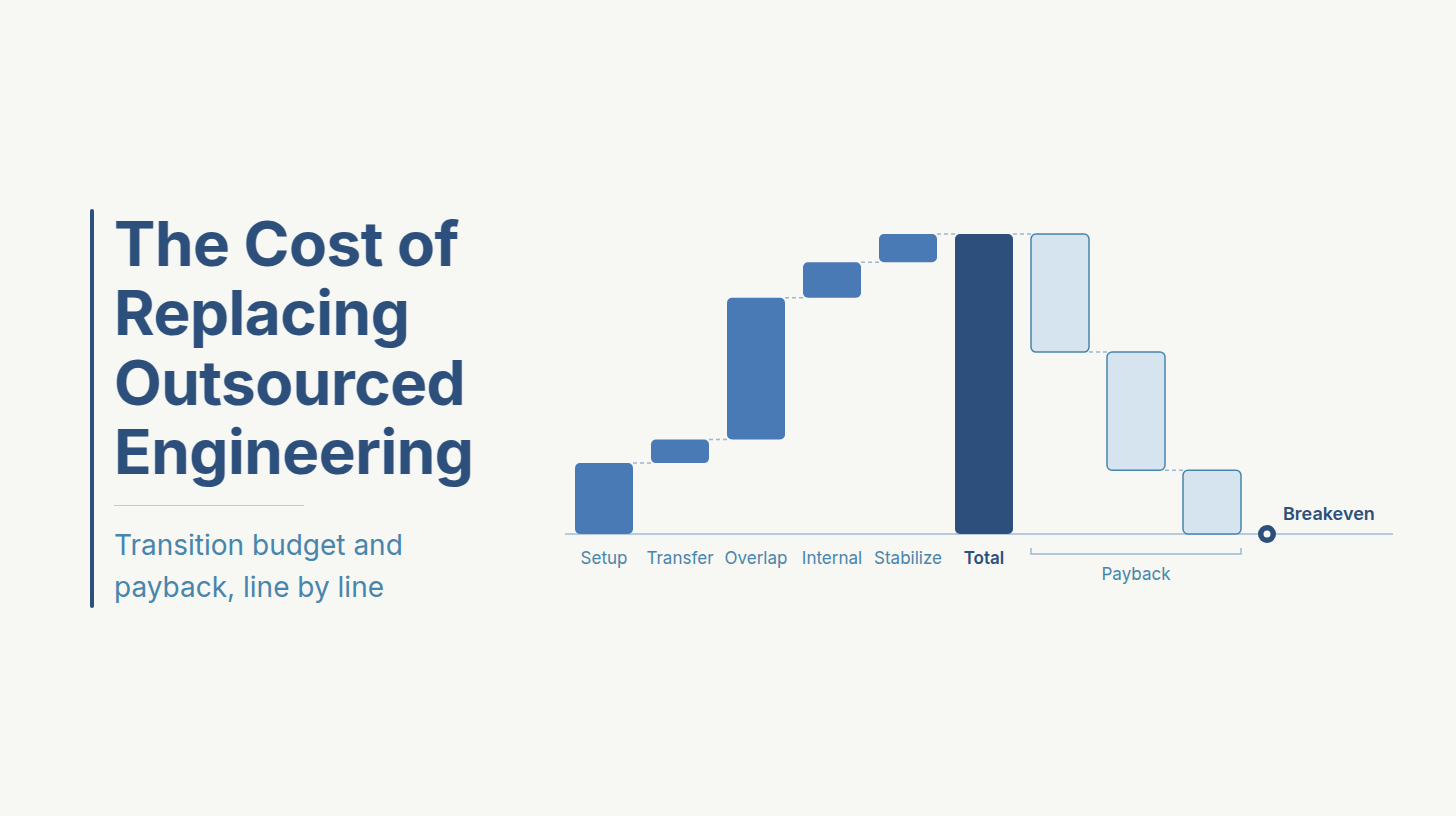
Applied to the invoice automation example used earlier in this piece: the build cost $70,000, with $12,000 a year in ongoing monitoring and retraining. In year one, the system eliminates the $54,000 annual manual keying cost (labor cost recovered) and cuts roughly $18,000 a year in vendor payment disputes tied to keying errors (error reduction), for $72,000 in annual benefit against $82,000 in year-one cost, a return of negative 12%. In year two, with the build cost already sunk, the same $72,000 annual benefit against $12,000 in ongoing cost produces a return of 500%.
That two-year view, is the version a board will trust, because each number traces back to a specific, named category rather than a general claim about efficiency.
What Fortune 500 Companies Do Differently, and Why Their Success Rate Is Higher
JPMorgan runs more than 450 AI use cases in production, with plans to scale to 1,000 by 2026. Walmart's AI coding tools saved approximately 4 million developer hours in 2024, a result that led the company to roll out access to all developers across North America and India in 2025. Neither figure is reachable on a mid-market budget, and neither is the actual reason large enterprises succeed more often.
The structural advantage is shared infrastructure: one model hosting layer, one governance and monitoring layer, reused across every new use case instead of every team standing up its own pipeline from zero. This directly addresses two of the four challenges named earlier, data readiness and measurement, by solving them once instead of once per project.
Fortune 500 scale doesn't fix every challenge automatically. A 2026 ModelOp survey of 100 senior AI enterprise leaders found more than two-thirds of enterprises, Fortune 500 included, still measure AI ROI with estimates rather than the disaggregated, category-based approach outlined above. The companies actually pulling ahead are the ones applying that discipline at scale, not the ones simply spending more.
If your company is backed by a private equity firm rather than operating independently, the pressure is different again: a fixed holding period changes what "success" looks like on a much tighter clock. See Top AI Transformation Partners for Private Equity for how that timeline changes the evaluation.
How Ideas2IT Scores, Builds and Measures AI Implementation
Most clients who come to Ideas2IT have already tried one or more of the alternatives above and hit one of the trigger points listed earlier: an internal build that stalled on talent bandwidth, an off-the-shelf tool that couldn't handle their data governance requirements, or a stalled internal debate that cost them a full budget cycle. An engagement starts by scoring the client's actual candidate use cases against measurable cost, data readiness, and named ownership, then builds the ROI case using the same disaggregated framework outlined above, before any architecture decisions get made.
From there, an Ideas2IT Forward Deployed Engineer team embeds inside the client's existing stack and sprint cycles to build the highest-scoring use case, with the same 60 to 90 day evaluation checkpoints described above built into the engagement from day one rather than left to chance. Behind the build sits Anticlock, Ideas2IT's proprietary AI development platform, which keeps engineering tooling, security guardrails, and deployment standards consistent even as the underlying model changes. Teams using this approach consistently ship their first production use case within a single quarter.
If your team recognizes itself in the stall checklist, the trigger list, or both, that's common, and it's exactly what an outside partner is built to resolve. Book an AI roadmap working session. Ninety minutes, senior engineers, no sales pitch. You leave with a scored use case, a vetted vendor path, and an ROI framework built around your own numbers.
References
- MIT Project NANDA, "The GenAI Divide: State of AI in Business 2025" (Challapally, Pease, Raskar, Chari, July 2025): https://mlq.ai/media/quarterly_decks/v0.1_State_of_AI_in_Business_2025_Report.pdf
- Gartner, "Gartner Predicts Over 40% of Agentic AI Projects Will Be Canceled by End of 2027" (June 25, 2025): https://www.gartner.com/en/newsroom/press-releases/2025-06-25-gartner-predicts-over-40-percent-of-agentic-ai-projects-will-be-canceled-by-end-of-2027
- CIO, "88% of AI pilots fail to reach production, but that's not all on IT" (IDC/Lenovo research): https://www.cio.com/article/3850763/88-of-ai-pilots-fail-to-reach-production-but-thats-not-all-on-it.html
- Lenovo, "Research From Lenovo Reveals AI Is Paying Off, Yet Most CIOs Aren't Ready for What Comes Next" (CIO Playbook 2026, with IDC, January 2026): https://www.businesswire.com/news/home/20260127255538/en/Research-From-Lenovo-Reveals-AI-Is-Paying-Off-Yet-Most-CIOs-Arent-Ready-for-What-Comes-Next
- Interview Node, "How Fortune 500 Companies Are Deploying AI at Enterprise Scale": https://www.interviewnode.com/post/how-fortune-500-companies-are-deploying-ai-at-enterprise-scale
- AI News, "JPMorgan Chase AI strategy: US$18B bet paying off" (450+ use cases, 1,000 by 2026): https://www.artificialintelligence-news.com/news/jpmorgan-chase-ai-strategy-2025/
- CIO Dive, "Walmart doubles down on AI with broader rollout of coding tools" (Doug McMillon, Q4 2025 earnings call, February 2025): https://www.ciodive.com/news/Walmart-generative-AI-agents-coding-tool/740545/
- CNBC, "'Almost every Fortune 500 is tracking overall AI usage': What that means for employees" (ModelOp survey, May 2026): https://www.cnbc.com/2026/05/05/ai-use-work-employee-monitoring-tech-surveillance.html
- Cooley, "State AI Laws Where Are They Now" (Colorado repeal and replacement): https://www.cooley.com/news/insight/2026/2026-04-24-state-ai-laws-where-are-they-now
- King & Spalding, "New State AI Laws Effective January 1 2026" (Texas, California, federal executive order): https://www.kslaw.com/news-and-insights/new-state-ai-laws-are-effective-on-january-1-2026-but-a-new-executive-order-signals-disruption
- Stanford Digital Economy Lab, "The Enterprise AI Playbook: Lessons from 51 Successful Deployments" (Pereira, Graylin, Brynjolfsson, March 2026): https://digitaleconomy.stanford.edu/app/uploads/2026/03/EnterpriseAIPlaybook_PereiraGraylinBrynjolfsson.pdf