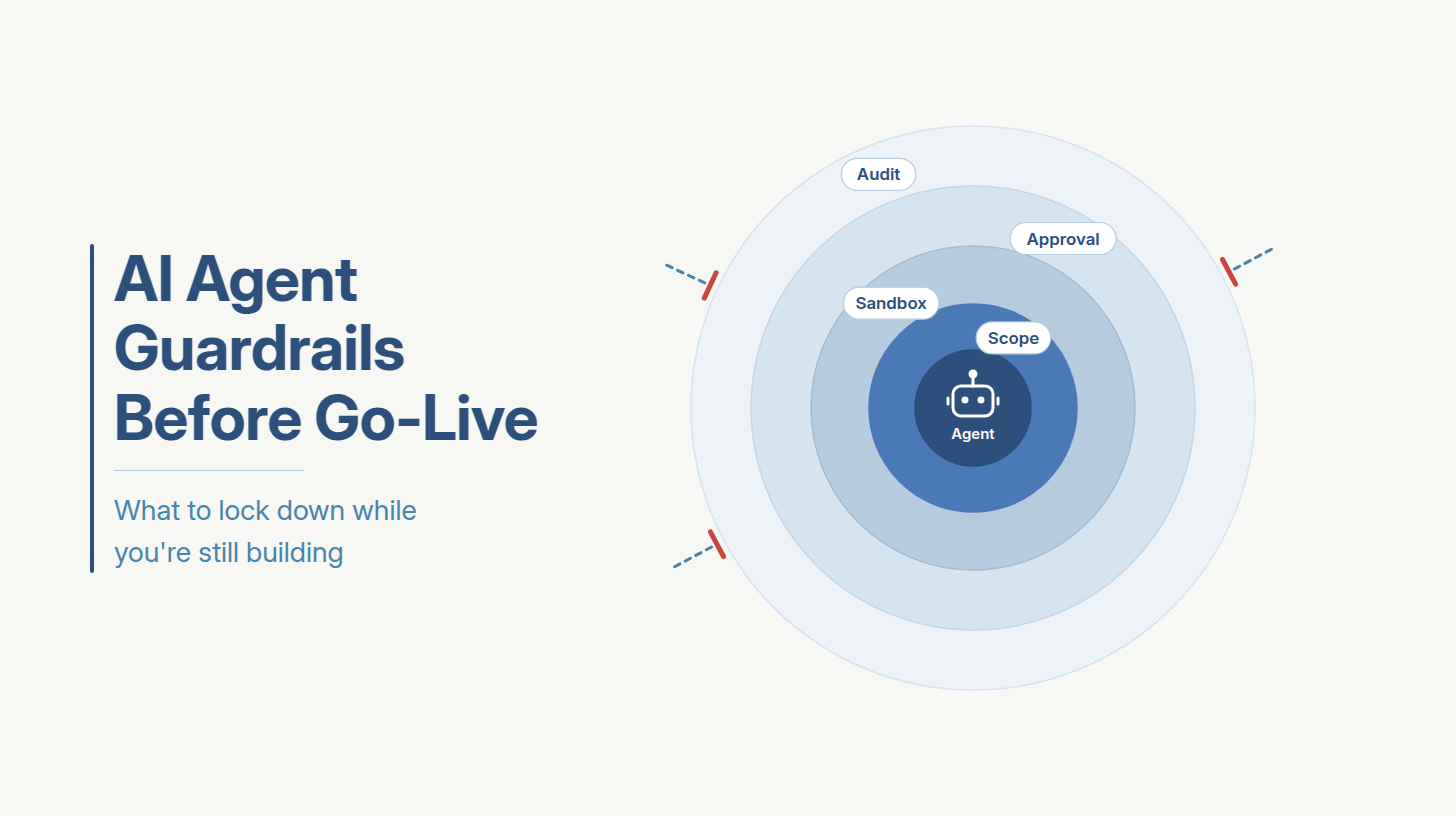

- Agree on one release goal before anyone touches the code. A public launch and a pilot with one enterprise customer put different fixes at the top of the same list.
- Ask for every reported defect to be reproduced first and tied to an acceptance condition you sign off on. That condition is how you'll know a fix is actually done.
- Protect what already works by getting tests written around your most-used flows before fixes start, and keep each change small enough to reverse.
- Do not release until there is a rehearsed rollback plan and one named person who owns the release, and keep the code and every account it runs on in your company's name.
Your app works, and there's a launch date on the calendar. Between the two sits a list of what still has to be fixed before real users arrive. Maybe it came out of an audit, or a customer's security questionnaire handed it to you. Either way, you know what's wrong. What you don't have is an engineering team to fix it with confidence.
Here, vibe coding vulnerabilities means more than security flaws. When Tenzai tested five AI coding agents (Claude Code, OpenAI Codex, Cursor, Replit and Devin), it found 69 vulnerabilities across the 15 apps they built, as InfoWorld reported in January 2026. The researchers called out business logic as a weak spot, since agents follow explicit instructions and have no sense of how a workflow should behave. So your list likely mixes leaked keys and loose access rules with broken flows and sums that come out wrong. Each item blocks the launch just the same.
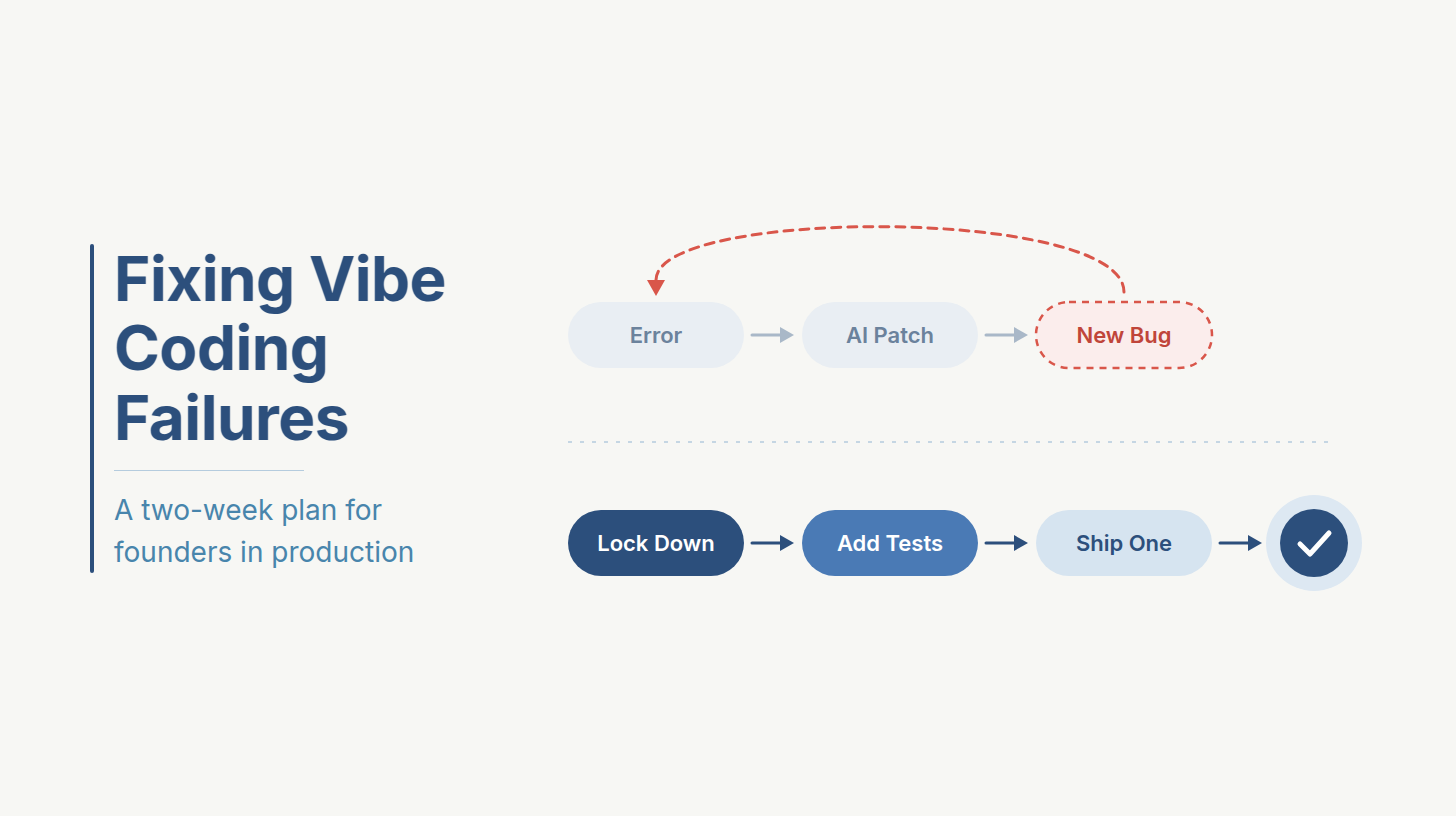
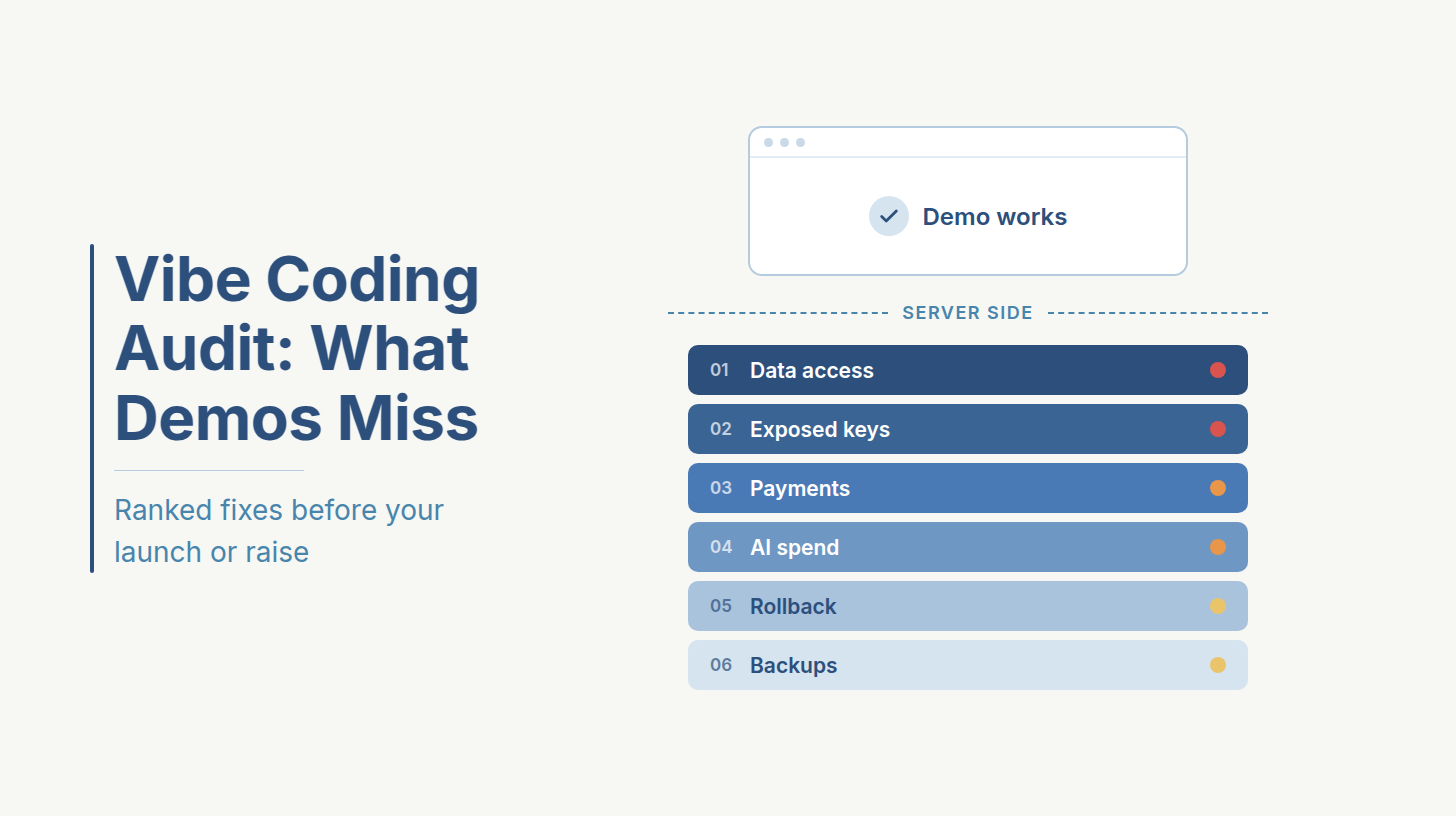
Knowing what's wrong was the easy half. Every fix now lands on code you didn't write line by line. Ask an AI tool to patch one flow and it can quietly break another. The SusVibes benchmark, presented at ICML 2026, found that 57% of solutions from one leading agent setup were functionally correct, while only 11.8% were secure. An app that runs in a demo still has to be made safe to release. You'll find plenty of vibe coding rescue offers promising to fix the app, but far fewer show how you'd know each fix held or who deploys the vibe-coded app once it's ready.
That work starts with turning your list into a plan engineers can act on.
How Does a List of Vibe Coding Vulnerabilities Become a Release Plan?
The first week goes on agreeing the release goal. A public launch and a pilot with one enterprise customer rank the same list very differently, so the goal is written down first.
Then engineers reproduce every reported defect on your actual codebase. Anything they can't reproduce comes back to you with questions. This often reshapes the list, as when two reports turn out to be one bug.
Each confirmed item gets an acceptance condition you sign off on. "Users can only see their own invoices" is something anyone can test, while "fix permissions" leaves the finish line to whoever does the work.
Dependencies get mapped next, since some fixes can't start until another one lands. Moving keys to the server, for instance, needs settings your app may not have yet.
Last comes the split between launch blockers and everything else. A blocker breaks the agreed release goal or exposes user data. The rest goes on a documented list for after launch. If you've already run a vibe coding security audit, its findings feed straight into this step.
A Real Example: Licensing Two Claude-Built Apps
Here's a real engagement, shared anonymously. A founder who runs supported living homes had used Claude to build a Medicaid financial model and a billing platform. He wanted to license both to other agencies, and that goal pushed single-tenant access and a missing audit trail to the top. Billing also had to be checked against timecards before any claim went out. The result was a 22-module plan in three phases, starting with the core platform and access control.
Have a list and a launch date?
Bring the issue list you already have. In one working session, engineers sort it into launch blockers and post-launch items against your release goal, and flag the dependencies that put your date at risk.
Plan your remediation scope
With the scope agreed, the risk moves into the code itself, because every change touches an app that already gets a lot of things right.
How Do You Fix a Vibe-Coded App Without Breaking What Works?
Most of your app should come through remediation intact. The screens your users like and the flows that already complete are assets. Each fix should change as little of them as it needs to.
Before anyone touches a working flow, engineers record how it behaves today. That usually means a few tests around the paths your users rely on most. Those tests become the baseline that tells you later if a fix somewhere else changed something it shouldn't have. Vibe-coded apps rarely ship with these tests, so writing them is part of the remediation work.
The type of issue decides the shape of the fix and what needs protecting while it happens.
Replacing a part of the app is the last resort. It makes sense when the same module breaks in a new way each time it's patched. When that happens, the replacement keeps the interface the rest of the app already calls, so the change stays contained in one place. A full rebuild is a separate decision, and a pre-launch list on a working app seldom calls for one.
Every change stays small, and a second engineer reviews it before it merges. Small changes are easier to test and easier to reverse. A reviewer who didn't write the fix will also catch the assumption its author never questioned.
A merged fix still hasn't been proven, though. The proof is what lets you take an item off the list and stop thinking about it.
How Do You Know Each Fix Solved the Original Problem?
Every item on the list goes through the same sequence. Following that sequence is what turns "we fixed it" into something you can check for yourself.
The test written for each fix stays in your codebase and runs on every future change. So if someone edits that file after launch, or an AI tool does, the same defect can't quietly come back.
The record matters most when a fix falls short. Sometimes a fix only partly meets its condition, or turns up a second defect. That result goes into the record and back into the scope conversation, instead of being folded quietly into the next item.
It's also the honest answer to the question every outside team gets asked: can you promise the app will be bug-free? Nobody can. What you can hold a team to is proof that each agreed item meets the condition you signed off on, and you can check that line by line.
Want proof attached to every fix?
In a scoped engagement, each agreed item is reproduced first. It's closed only when it passes the condition you signed off on, and its test stays in your code when the work ends.
Talk through your app and blockers
Verified fixes sitting on a branch still don't help your users, though. The release is a piece of work in its own right, with its own risks.
What Has to Happen Before You Deploy Your Vibe-Coded App?
If your app has only ever run in an AI builder's hosted preview, the release starts by confirming where it will live. That means a cloud account and a production database, both registered to your company. Staging gets its own separate database, so testing never touches real customer records.
Deployment settings come next. Secrets move into a secret store, and each setting gets a production value. Then the build runs once in staging, just as it will run live. A setting that only ever lived on one laptop is an easy way to lose a release day.
Each service the release depends on, such as payments or email, is checked live with real keys. A webhook that worked in testing will fail without a sound if its live URL was never added on the provider's side. So each one is triggered and confirmed before launch.
Before anything ships, the team writes down how to go back. The rollback plan names the version to restore and explains how any database change gets reversed. It's rehearsed once on staging, because a rollback nobody has ever run is only a guess.
One named engineer owns the release. They run the deployment and stay on it through the first hours of real traffic, ready to make the rollback call if something goes wrong. You'll know who that person is well before release day. As traffic grows, monitoring and load matter more, and the CTO's checklist on making a vibe-coded app production ready covers both in depth.
When the release is out and stable, the engagement closes with a handover. How good that handover is decides how easily you, or the next engineer you hire, can keep going.
What Do You Receive When Vibe Coding Vulnerabilities Are Resolved?
The handover is a package you can check for yourself and pass on to whoever comes next. Each piece answers a question someone will ask you later, usually an investor or a customer's security team.
Ownership is settled on the first day of the engagement. Your repository, cloud accounts and every credential stay in your company's name throughout. The outside team works through access that you grant and can revoke at any time.
The outstanding items list deserves as much care as the resolved one. It's an honest record of what was left for later and why, so your next engineer has a place to start.
How Ideas2IT Runs Vibe Coding Remediation
Ideas2IT runs this work with Forward Deployed Engineers who join your environment from the first day. They work in your repository and your cloud accounts, and they sit in your standups with your launch date as their target. Because they work inside your app, the fixes and tests stay with your codebase when the engagement ends.
Anticlock, Ideas2IT's platform for AI-driven software delivery, keeps every item on the same steps. It sets one way for the team to use AI coding tools, with shared guardrails and deployment standards, so every item on your list leaves the same evidence trail. Ideas2IT reports at least 50% faster sprint velocity on teams working this way. Anticlock sits alongside the rest of Ideas2IT's platforms and accelerators.
If your app handles customer data, Ideas2IT holds SOC 2 Type II and ISO 27001 certifications, which your customers' security reviewers will ask about.
The way in is a scoping call about your app and the blockers you already know about. It ends with an agreed scope that splits launch blockers from later work. From there the team moves straight into fixes and release, with a named owner. If budget is still the open question, the breakdown of what it costs to take a vibe-coded app to production answers it before you talk to anyone.
Get your vibe-coded app through remediation and release
Bring the app and the blockers you know about. You'll leave the first conversation with an agreed release goal, a scope that separates launch blockers from later work, and a named engineer who will own the release.
Book your remediation scoping call
References
- InfoWorld. "Output from vibe coding tools prone to critical security flaws, study finds." InfoWorld. January 2026. https://www.infoworld.com/article/4116937/output-from-vibe-coding-tools-prone-to-critical-security-flaws-study-finds-2.html
- Zhao, Songwen, Danqing Wang, Kexun Zhang, Jiaxuan Luo, Zhuo Li and Lei Li. "Is Vibe Coding Safe? Benchmarking Vulnerability of Agent-Generated Code in Real-World Tasks." International Conference on Machine Learning (ICML). July 2026. https://icml.cc/virtual/2026/poster/61427