Just In
Ideas2IT is now an OpenAI Select Partner - recognized to help enterprises build, deploy, and scale AI with GPT-5, responsibly and at speed.
Read the announcement
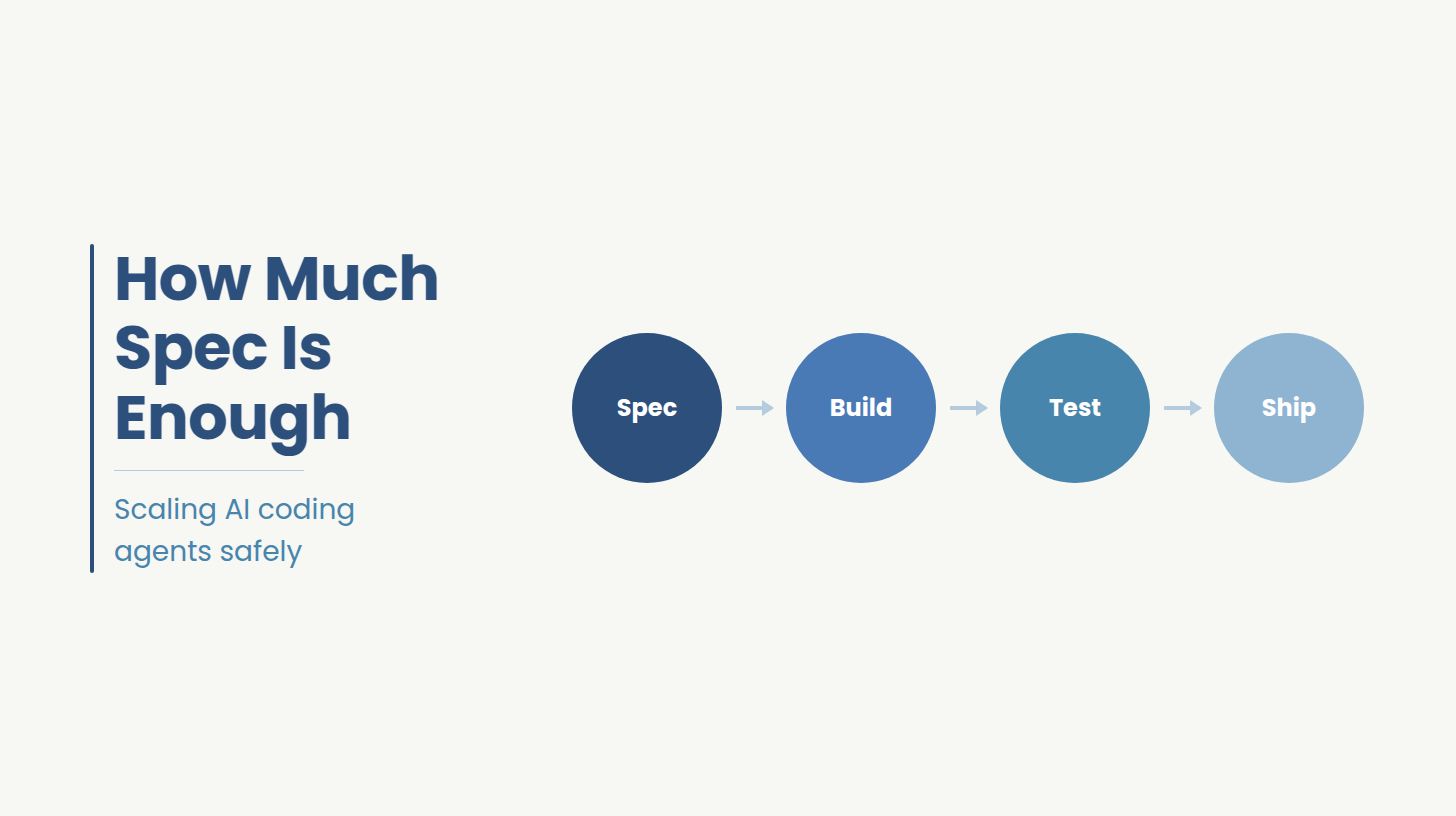
Most enterprise engineering organizations are not deciding whether to adopt AI coding agents anymore. That decision is already behind them. What they are actually deciding, often without realizing it, is whether the velocity those agents produced in the first two quarters holds up once the codebase, the team count, and the audit scrutiny all grow at the same time. This piece walks through what has to be true for that velocity to hold, section by section, starting with where specification actually belongs in your delivery lifecycle.
Your engineering org did not skip AI adoption. Coding agents are already inside your pull requests, your sprint planning, and your onboarding process. According to JetBrains' January 2026 AI Pulse survey of 11,000 developers worldwide, 90 percent of developers now use AI at work, and that figure is no longer a leading indicator of change to come. It is the current baseline. What has not caught up is the layer underneath that adoption: a shared, explicit statement of what each system is supposed to do that both your engineers and your AI agents can work from.
Spec-driven development is the practice of writing that statement before implementation starts and using it as the reference point every contributor, human or AI, is checked against. It does not belong everywhere in your SDLC, and that distinction matters more than most vendor content admits.
If you already run AI adoption initiatives at the product and delivery-management layer, this is the discipline underneath that layer, the one that governs how engineering itself uses those same agents once the initiative moves past a pilot. Ideas2IT has written separately about what changes when AI adoption reaches the delivery organization as a whole, in how AI reshapes software delivery for product and engineering leaders, which is worth reading alongside this piece if your transformation effort spans both layers.
The question worth answering before you read further is not whether spec-driven development matters. It is which of your current SDLC stages are already bleeding value because nothing defines what "done correctly" means before an agent starts building. If you can name two or three of those stages right now, you have the starting point for everything that follows.
Naming the stages is only half the picture. The other half is knowing which projects inside those stages carry enough risk to justify the specification work in the first place, since applying the same discipline uniformly across a backlog is how spec-driven development earns a reputation for slowing teams down.
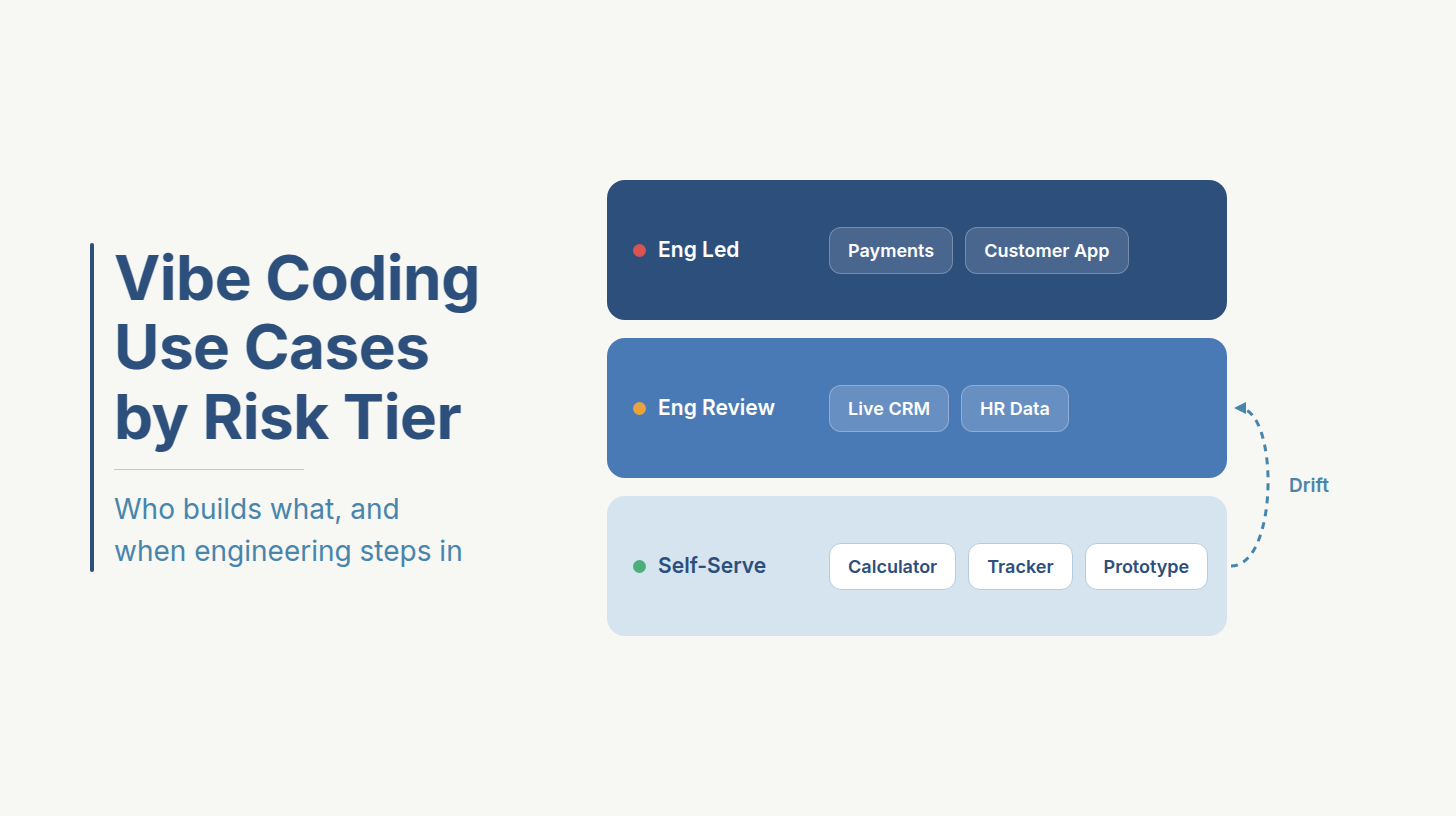
The projects that benefit most share one property: the cost of an AI agent guessing wrong is higher than the cost of writing the specification.
If your organization is already in the middle of moving work off an outsourced SDLC vendor and onto an AI-native team, this project-risk lens applies directly to that transition. Ideas2IT covers what that decision actually involves in how to replace an outsourced SDLC vendor with an AI-native team, and the two pieces are meant to be read together if that is the situation you are in.
Smaller feature work is where spec-driven development should be applied selectively rather than uniformly. A single-team, low-blast-radius change to an internal tool does not need the same specification investment as a payments API. The categories above are where you should start, not because a framework says so, but because that is where an agent's wrong guess costs you the most.
Knowing which projects need specification is the first decision. The second is knowing exactly what belongs in that specification, because "write more documentation" is not an actionable instruction, and treating it as one is why some teams that try spec-driven development give up on it within a month.
A specification is a bounded, checkable list of what has to be true before an agent is handed a task, and it is shorter than most engineering leaders expect once they see it written out in full.
That is the full list. It does not grow with project size, only with project risk. Most of this material already exists somewhere in a ticket, an architecture document, or a senior engineer's working knowledge. The real work is consolidating it into a form an agent can actually consume, which is the subject of the next section.
Once a team accepts that specification matters, the natural instinct is to over-correct, and over-specification kills the same velocity gain that AI coding agents were adopted to produce in the first place. The right amount of specification is calibrated to project risk, not applied through a fixed template across the entire backlog.
A low-risk internal tool with one consuming team needs business rules, a data contract, and acceptance criteria, and nothing more. A payments-adjacent service with multiple consumers and a compliance requirement needs the full component list from the previous section, written precisely enough that a reviewer with no context on the project could verify the implementation against it.
The test that separates enough from too much is simple. If a competent engineer, reading only the specification, would still have to guess how the system should behave in a given situation, the team has under-specified. If the specification restates implementation detail the architecture constraints already cover, the team has over-specified.
Talk to us about where your specification gaps actually sit.
If your AI-assisted development has been running for six months on individual velocity alone, the gap between what looks fast and what is actually reliable has likely started showing up in your rework numbers, even if nobody has connected the two yet.
A working session with Ideas2IT on this specific question, how much specification your highest-risk projects actually need versus how much they currently have, produces a scoped map of that gap rather than a generic maturity score.
Talk to Ideas2IT about a specification readiness assessment
A requirements document written for a human product manager and a specification written for an AI coding agent are not the same artifact, and treating them as interchangeable is why teams that already write thorough requirements still see inconsistent agent output.
A specification an agent can use consistently needs seven components in a predictable structure:
Requirements written as prose, with business context, technical detail, and edge cases interleaved in paragraph form, force an agent to infer structure that was never made explicit. Requirements broken into these seven components give the agent the same shape every time, regardless of which engineer wrote the original ticket.
Most engineering organizations already have the raw material for this in existing tickets and design documents. What is usually missing is the consistent structure that lets an agent, or a different engineer picking up the work six months later, parse the specification the same way every time. Once that structure exists, the next decision is where the agent's authority actually ends, which is the boundary question the next section addresses directly.
The boundary between what an AI coding agent should decide and what a human engineer must decide is not a trust question. It is a risk-and-reversibility question, and your own engineers have likely already drawn this line informally without writing it down anywhere.
The data backs up where practitioners already draw this line without being told to. The 2025 Stack Overflow Developer Survey found that 76 percent of developers do not plan to use AI for deployment and monitoring, and 69 percent say the same about project planning. That is not caution for its own sake. Deployment and planning decisions are the hardest to reverse once made, and the cost of an agent guessing wrong there is categorically higher than the cost of an agent guessing wrong on a unit test.
Writing this boundary down as policy, rather than leaving it as tacit agreement among senior engineers, is what makes it enforceable when a new team picks up an unfamiliar codebase or a new agent enters the workflow. Without a written boundary, the line moves every time the person enforcing it changes. And a boundary that only exists as policy is not verifiable, which is exactly the problem the next section covers.
Passing tests are not the same claim as correct behavior. The gap between those two things is exactly what surfaces when a compliance review or a board question asks whether the system does what it was supposed to do, not whether it passed the tests someone wrote after the fact.
Traceability closes that gap by creating an explicit chain: a requirement maps to a specific section of the specification, the specification maps to the implementation generated against it, and the implementation maps to a test written to verify the specification's acceptance criteria, not just to verify that the code runs.
When that chain exists, a reviewer can answer a specific question, does this implementation satisfy this requirement, by following the chain rather than by re-reading the code and guessing at original intent. When the chain does not exist, which is the current state for most AI-assisted codebases, a reviewer can only answer a weaker question: does this code pass its tests.
This distinction matters most at the exact moment your organization needs it most: an incident review, a security audit, or a board question about AI-generated code quality. Building the chain after the fact, once a codebase has already grown without it, is significantly harder than building it as a habit from the start of a project, which is why the guardrails in the next section need to exist before scale.
A specification-driven pilot that works on one team does not automatically scale to twenty teams, because the guardrails that made the pilot safe were often implicit, held by the specific engineers who ran it, rather than written down as a standard anyone else can follow.
The guardrails that need to exist before scaling include:
Without these in place before scale, every team scaling independently reinvents its own version of each guardrail, and the organization ends up with the same inconsistency spec-driven development was meant to fix, just at a larger and more expensive scale. The organizations that get this right treat guardrails as infrastructure to build once and reuse, not as documentation to write once and hope teams follow.
Guardrails answer what has to be true across the org. The next question most engineering leads ask is more practical: does adopting this discipline mean replacing the coding tools their teams already use. It does not, and treating it as a tool migration is the most common reason rollouts stall before they start.
Whatever your engineers currently run, whether that is GitHub Copilot, Claude Code, Cursor, or another agent, spec-driven development sits as a discipline layered on top. The specification is written first, and the existing tool is what consumes it and generates the implementation. The integration work is making sure your specification format is something your current tools can actually take as input, and that your review process checks the output against the specification rather than just against a diff.
Framing the rollout this way removes the single biggest objection engineering leads raise when spec-driven development is proposed: that it means asking every team to switch tools mid-project. It does not, which clears the way for the actual rollout sequencing covered next.
Rolling out spec-driven development to an entire engineering org at once is how well-intentioned initiatives turn into initiatives nobody follows six months later. A phased path, with named ownership at each stage, is what separates a rollout that sticks from a mandate that gets quietly ignored.
Ownership across product, architecture, engineering, and QA has to be explicit at each stage. A rollout with only engineering ownership tends to produce specifications engineers find useful and product managers find unreadable, and a rollout with only product ownership tends to produce the reverse. Once a rollout is underway, the natural next question is how to know it is actually working, which is what the org should start measuring immediately.
Velocity was the metric that justified adopting AI coding agents in the first place, and it is the wrong metric to justify spec-driven development, because velocity alone cannot tell you whether the thing being built faster is correct.
A board or a compliance function will ask about several of these metrics whether or not you have been tracking them. Having the answer ready is the difference between a five-minute conversation and a multi-week scramble. None of this means the discipline belongs on every project, which is the honest limit covered next.
Got a system nobody's ever fully written down? That's usually where this works best.
Start the Scoping Conversation
The strongest argument for spec-driven development is not that it should be applied everywhere, and a pitch that claims otherwise is a reason to be skeptical of the rest of the pitch.
Low-complexity changes with a single consuming team and low blast radius do not need a formal specification. The overhead exceeds the risk being managed. Exploratory work, where the entire point is discovering what the system should do rather than confirming what it already knows it should do, is actively harmed by specification discipline, because writing a spec for something not yet figured out produces a spec that is wrong on day one. Rapidly changing requirements, common in early-stage product work, make static specifications a liability, since the team ends up maintaining two sources of truth that drift apart within weeks. Highly ambiguous discovery-stage work belongs in the same category: specification reduces ambiguity that has already been resolved, it does not resolve ambiguity that is still open.
Naming these limits up front is what makes the rest of this piece credible. Spec-driven development is a governance mechanism for work where getting it wrong is expensive. Forcing it onto work where the value is in moving fast and learning is how organizations turn a legitimate discipline into a reason engineers stop trusting the initiative. Knowing where it does not belong also clarifies what the organization actually needs to build for itself versus what existing tools already handle, which is the next decision.
Once an organization commits to spec-driven development at scale, the next question is what has to be built in-house versus what existing tooling already handles. Getting this wrong in either direction wastes real engineering time.
What the organization should standardize itself: specification templates tailored to its actual architecture and risk categories, the workflows that route specifications through review before implementation starts, the guardrails from the earlier section stated in a form tools can enforce, validation criteria that define what "matches the specification" means for its systems specifically, and the reusable engineering patterns that emerge from running this across multiple teams. What existing AI tooling already handles: the actual code generation, test generation against defined criteria, and first-pass implementation work described earlier in this piece.
Organizations that try to build custom tooling for code generation itself are usually solving a problem commercial and open-source tools already solve well. Organizations that skip standardizing their own templates, guardrails, and validation criteria are the ones whose pilot works on one team and falls apart on the second. Bringing all of this together, standardization, guardrails, rollout sequencing, and measurement, is what turns a set of good individual decisions into an operating model, which is the final piece of this argument.
Every section in this piece has been building toward one operating decision: whether an organization treats spec-driven development as a technique a few teams experiment with, or as the standing discipline that governs how every team uses AI coding agents from this point forward.
The difference between those two states is not effort. It is ownership. A technique lives with whichever team happens to be trying it this quarter, and it disappears the moment that team's lead moves to a different project. A standing discipline has specifications, agents, engineering standards, automated validation, human review, and governance operating together as one system, with ownership that survives individual team changes.
Getting from the first state to the second is not a matter of writing more documentation. It is a matter of deciding who owns the specification standards, who enforces the guardrails, and who is accountable when a team scales past the pilot stage without either.
The organizations struggling with AI-assisted delivery right now are struggling because nothing between the requirement and the implementation was ever written down in a form an agent, or a new engineer, could consistently use. That gap is fixable at the project level before it becomes an organization-wide governance problem. The path through it is the one this piece has walked: know where specification belongs in your SDLC, know which projects need it most, define what has to be specified and how much, draw the line between AI and engineer authority, and build the traceability and guardrails that make all of it verifiable at scale.
Talk to us about operationalizing this across your engineering org
If your organization is already running AI coding agents in production without a consistent answer to the ownership questions above, that gap is the actual risk sitting underneath whatever velocity numbers are currently being reported upward. Closing it is a specific, scoped piece of work.
Talk to Ideas2IT about operationalizing spec-driven development across your engineering org
Ideas2IT works inside your engineering environment through the Forward Deployed Engineer model rather than handing over a framework and a set of recommendations. FDEs embed directly into your existing stack, your standups, and your OKRs from day one, which means the specification standards, guardrails, and validation criteria described in this piece get built with your actual codebase and your actual teams, not designed in the abstract and handed off for your engineers to interpret. You can read more about how the model works on the Forward Deployed Engineer page.
Anticlock is the platform that carries that work forward once the FDE engagement establishes it. Vibe coding tools like Cursor and Claude Code give individual developers real productivity gains, but at the team level, every developer ends up using them differently, which is precisely the inconsistency this piece has argued against since the first section. Anticlock standardizes AI-driven development across a team by enforcing consistent tooling, security guardrails, and deployment standards, so the specification discipline built during an FDE engagement does not depend on any one engineer remembering to follow it.
One line: Anticlock is what you use when you want to build exactly the software your business needs, own it completely, have it ready for AI agents from day one, and do it in a fraction of the time it used to take.
Here's the thing most spec-driven development advice misses: it tells you to write better specs and stops there. Fine advice, but it skips the actual hard part about who's supposed to write these specs, and what happens once they're done?
At Ideas2IT, we split it into two jobs that usually get treated as one.
First, turning what the business actually needs into something precise enough to build from. This is the part almost every tool quietly assumes away, they assume a developer is already there to translate the ask into a spec. Which is not the case here. A business owner who's never opened a code editor can approve this spec directly, because it's written for them.
Second, once that spec is signed off its turned into code. Every piece of what gets built traces back to a specific requirement. If someone asks why a feature exists six months from now, nobody has to go digging. You just look it up from the spec.
We learned how much this matters on a client project that had run entirely on Excel for close to two decades a pricing and estimation spreadsheet with somewhere around 3,000 rows, and almost no two rows following the same formula. That spreadsheet was, in effect, their spec. It just wasn't written down as one. Once we reverse-engineered it into an actual specification and built from that, the toolchain got us roughly 70% of the way to a working application on its own. The rest was a developer cleaning up edges and not rebuilding from scratch.
That's really the whole point. Spec-driven development as a coding trick makes one developer faster. Spec-driven development as a real capability means the person who actually knows the business can own the source of truth.
The entry point for this specific problem is scoped and specific: an assessment of where your current AI-assisted delivery already has specification gaps, mapped against the project categories in this piece, producing a prioritized list of where to apply spec-driven development first and what it would take to operationalize it. From there, the engagement scales into the FDE-led rollout described above.
Didn't find what you were looking for?