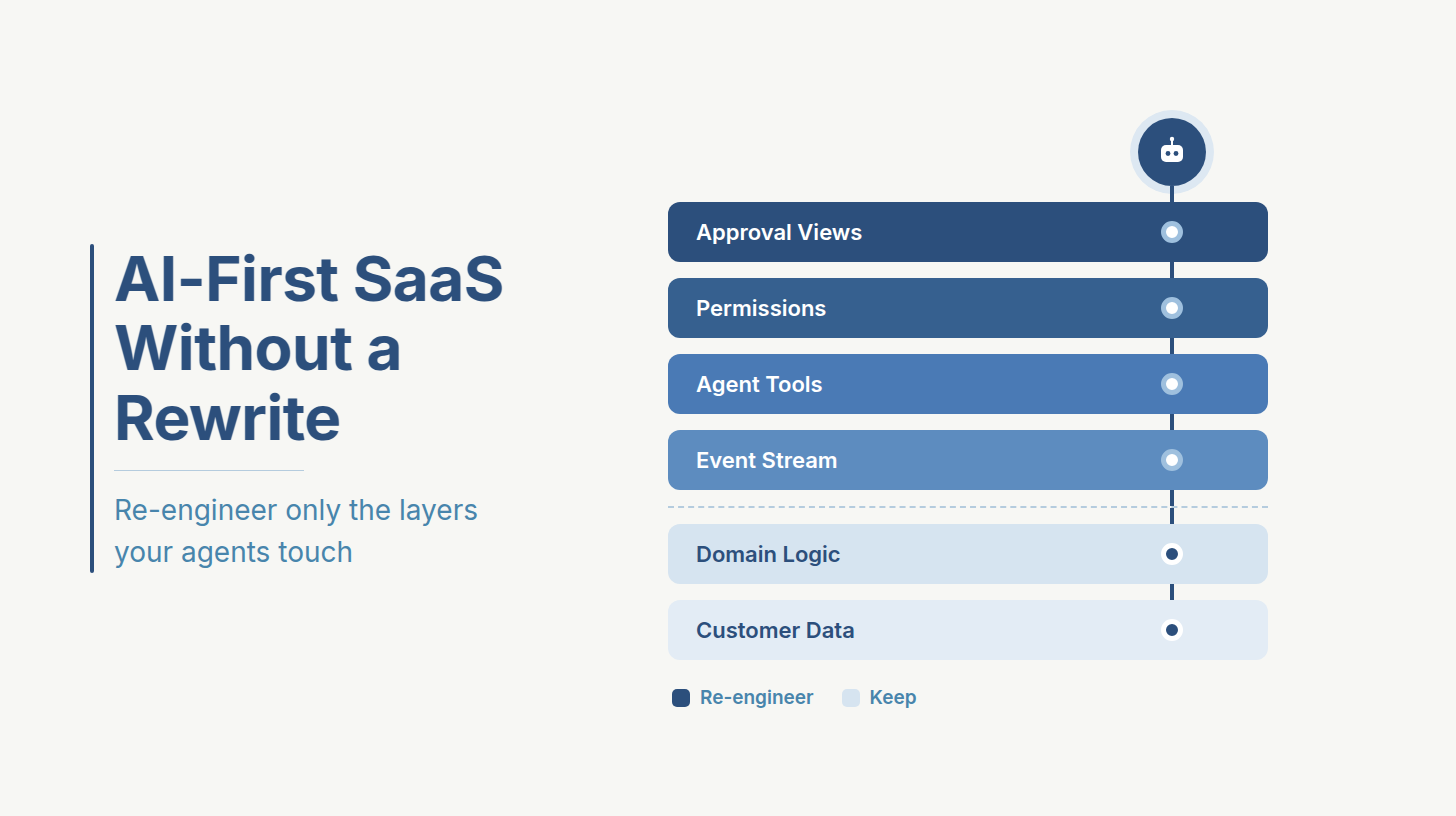

- Enterprise AI gets harder to manage as applications, agents, models, data, and infrastructure multiply across teams.
- The real challenge is engineering the AI estate so architecture, governance, security, cost, and delivery standards scale with it.
- Scaling requires a deliberate sequence: inventory → target architecture → rationalization → shared infrastructure → governance → AI-native engineering → continuous optimization.
- The goal is to build a shared foundation that reduces duplication while letting teams continue to move quickly.
- This guide explains how to engineer that foundation, decide what to consolidate or retire, govern AI at scale, and build the engineering capacity needed to keep the estate manageable as it grows.
Your board thinks the AI story is going well, and by the numbers they're looking at, it is. That's exactly what should worry you. What got approved as forty separate wins is now one estate you're accountable for as a single risk surface, and nobody signed off on that as a line item. This piece isn't going to make the case for AI. You've already made it. It's about the decision you're going to have to bring to your board regardless of what you choose: keep absorbing this estate with the team you have, or bring in the capacity to engineer it before the next incident makes the decision for you.
What Happens When Enterprises Scale AI?
Here's the reframe worth taking into your next board update: sprawl isn't what failure looks like on your watch. It's what winning looks like when your organization's execution speed outran the governance and architecture built to hold it together. Every application, agent, and pipeline your teams shipped cleared its own approval and delivered its own value. None of it was a bad decision in isolation. What you're carrying now is the sum of a lot of correct decisions made without anyone owning the total.
That's the distinction your board needs from you, not your engineering team: this is a governance and architecture exposure, not a slower adoption curve. Gartner's forecast that the average Fortune 500 enterprise will run more than 150,000 agents by 2028, up from fewer than 15 in 2025, isn't a warning about your team's discipline. It's the number that should be in your next capital planning conversation, because whatever oversight model you're running today has no version of itself that scales to that number without redesign.
Why Is Scaling Enterprise AI Difficult?
The gap between your adoption chart and your actual exposure is well documented at this point, and it's worth knowing the shape of it before your board finds it for you. McKinsey and Stanford HAI's 2026 AI Index put enterprise AI adoption at 88 percent, yet only 39 percent of those organizations report measurable EBIT impact, and roughly 6 percent qualify as high performers attributing more than 5 percent of EBIT to AI. Adoption was never the hard part. The hard part is what happens in the space between "we use AI" and "we can prove what it's worth and what it's exposing us to."
That gap is made of six specific things compounding at once, not one thing you can fix with a policy memo:
- Different teams standardized on different model providers for reasons that made sense in isolation
- Agents accumulated system access faster than anyone assigned clear ownership of what each one can touch
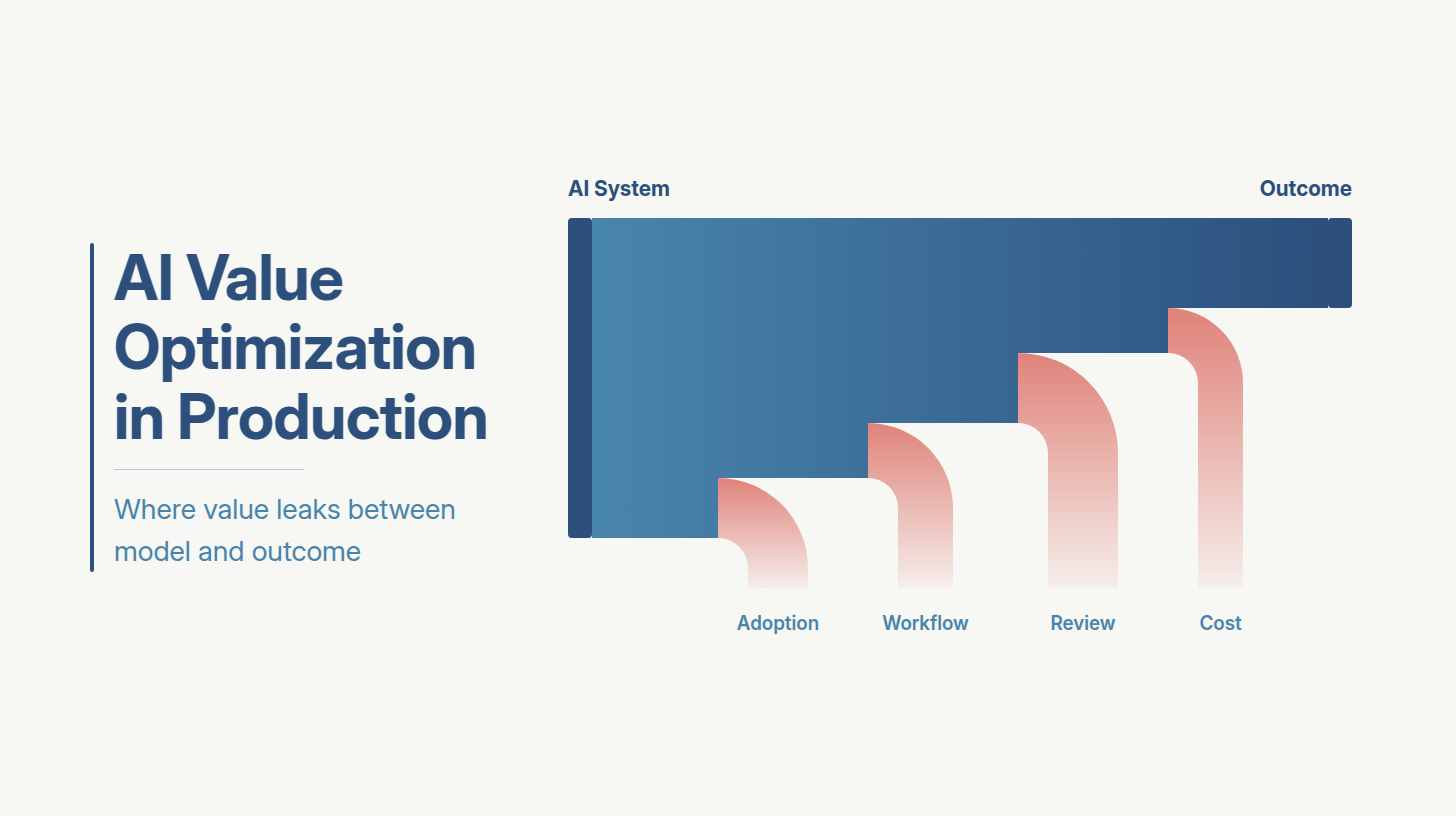
- Inference costs climbed in patterns your original budget never modeled, because agentic workflows consume tokens differently than the chatbot pilot that got funded first
- AI-generated code entered your SDLC without one review standard applied consistently across teams
- Governance, built for a handful of approvals, is now the bottleneck engineering blames and security routinely works around
Each of these is a fixable problem in isolation. What makes this a board-level issue is that they're compounding simultaneously across every team that shipped something this year, which is precisely the kind of problem an internal team solving it one ticket at a time cannot get ahead of.
What Is an Enterprise AI Estate?
Skip the ecosystem language you've probably already read elsewhere this quarter. Call it what it actually is on your balance sheet: the full set of applications, agents, models, data dependencies, and infrastructure your organization runs in production, plus every security and governance obligation attached to it, spread across every team that shipped something without a shared architecture behind it.
The reason that framing matters isn't semantic, it's accountability. An estate has an owner, an architecture, and an operating budget whether you assigned one or not. Right now, yours almost certainly doesn't have all three, and that's the gap your board will eventually ask about directly. Engineering an AI estate on purpose, instead of discovering its shape one incident at a time, is the discipline this entire framework is built around.
How Do We Scale AI Across the Enterprise?
Scaling what you already have is a sequence, and skipping a step doesn't save time, it moves the cost downstream to whichever step comes next:
- Inventory: you can't architect what you haven't mapped
- Architecture: rationalization without a target state just trades one kind of duplication for another
- Rationalization: clears the ground before you invest in shared platform infrastructure
- Platform foundation and governance: built once, instead of once per team
- Engineering discipline: establishes how AI-generated code enters your SDLC
- Priority workloads: chosen deliberately against your capital, not your loudest business unit
- Optimization and continuous engineering: close the loop, because the estate doesn't stop growing once you've done this once
This is exactly where an isolated implementation vendor or a single internal task force runs out of road: they can execute one layer of this sequence competently and still leave you exposed on the other six, because nobody owned the sequence end to end, which is the same gap that shows up on your board slide as "we did the AI project but the numbers didn't move."
How Do We Inventory Enterprise AI?
Here's a question worth answering honestly before your next board meeting: can you name every application, agent, model, vendor relationship, and data dependency tied to AI in your organization right now, along with who owns each one? If the honest answer only covers what went through a formal approval process, your real estate is bigger than the one you're reporting against, and the gap between the two is exactly what an incident review or an audit finds first.
The harder truth is that a one-time inventory doesn't hold. New agents and models enter faster than any annual or quarterly review cycle can catch them, which means the inventory has to be a continuous discovery process, not a snapshot you refresh once a year. If your visibility stops at what procurement signed off on last quarter, every architecture and governance decision that follows inherits that blind spot the moment a new team ships something next month, and that's a harder story to tell your board after the fact than before it.
Get Your AI Estate Assessment:
You're being asked to sign off on AI spend for an estate you can't currently account for in full, and that's not a position your board should let you stay in.
The AI Estate Assessment is a scoped, no-cost engagement that maps every application, agent, model, and data dependency actually running in your environment, approved or not, and establishes the discovery process that keeps that map current instead of stale within a quarter.
Book your $0 AI Estate Assessment
How Should Enterprise AI Architecture Be Designed?
An inventory tells you what exists. The target-state design has to answer what your inventory can't on its own: which model access patterns should be shared instead of duplicated, where agent-to-system access needs one consistent gate instead of five, and what your data layer needs to look like so the sixth team stops rebuilding what the first five already built separately.
This is where architecture-first thinking earns its keep over tool-first thinking, and the sequence matters more than the technology choice. A team that picks the next platform before defining the target architecture and its data prerequisites ends up retrofitting both around whatever the platform assumed. Gartner is already forecasting the cost of that mistake at scale, projecting that 60 percent of agentic AI projects will fail in 2026 specifically because the underlying data wasn't ready for agentic use, not because the model or the use case was wrong. Getting the sequence right here, requirements and data readiness before architecture, is what determines whether your fiftieth AI application inherits a working foundation or repeats the same improvisation as your fifth.
How Do We Reduce AI Sprawl?
Sprawl isn't a mystery, and it isn't a mandate to rebuild everything either, which is worth saying directly since that's usually the objection that kills this conversation at the board table. Reducing sprawl means making four calls deliberately instead of by default:
- Retain what earns its cost
- Consolidate what three teams quietly built the same thing to solve
- Standardize what inconsistency is creating measurable risk around
- Retire what no longer justifies what it takes to run
Rationalization is a filter applied before you standardize, not a replacement mandate for what's already working. Skip this step and standardization just cements whatever sprawl already exists with more confidence behind it than it deserves, which is a more expensive mistake to unwind later than it is to avoid now.
What Infrastructure Is Needed to Scale Enterprise AI?
Once you've rationalized the estate, the infrastructure question stops being theoretical and starts being a budget line you can actually defend. Scaling enterprise AI infrastructure means:
- Shared model access instead of five separate vendor relationships
- Reusable agent infrastructure instead of every team building its own
- One retrieval and data layer instead of five
- Consistent evaluation and observability tooling across the estate
- Security controls that apply the same way regardless of which team shipped the application
This is the layer where duplication costs the most and shows up the least on any dashboard you're currently reviewing. Every team building its own evaluation harness is re-solving a problem another team in your organization already solved, without a shared platform to build on top of. Treating this as platform engineering, something built once that every subsequent team inherits, rather than something each team rebuilds for itself, is the difference between an estate that compounds efficiency and one that compounds cost you'll have to explain line by line.
How Do We Govern AI at Scale?
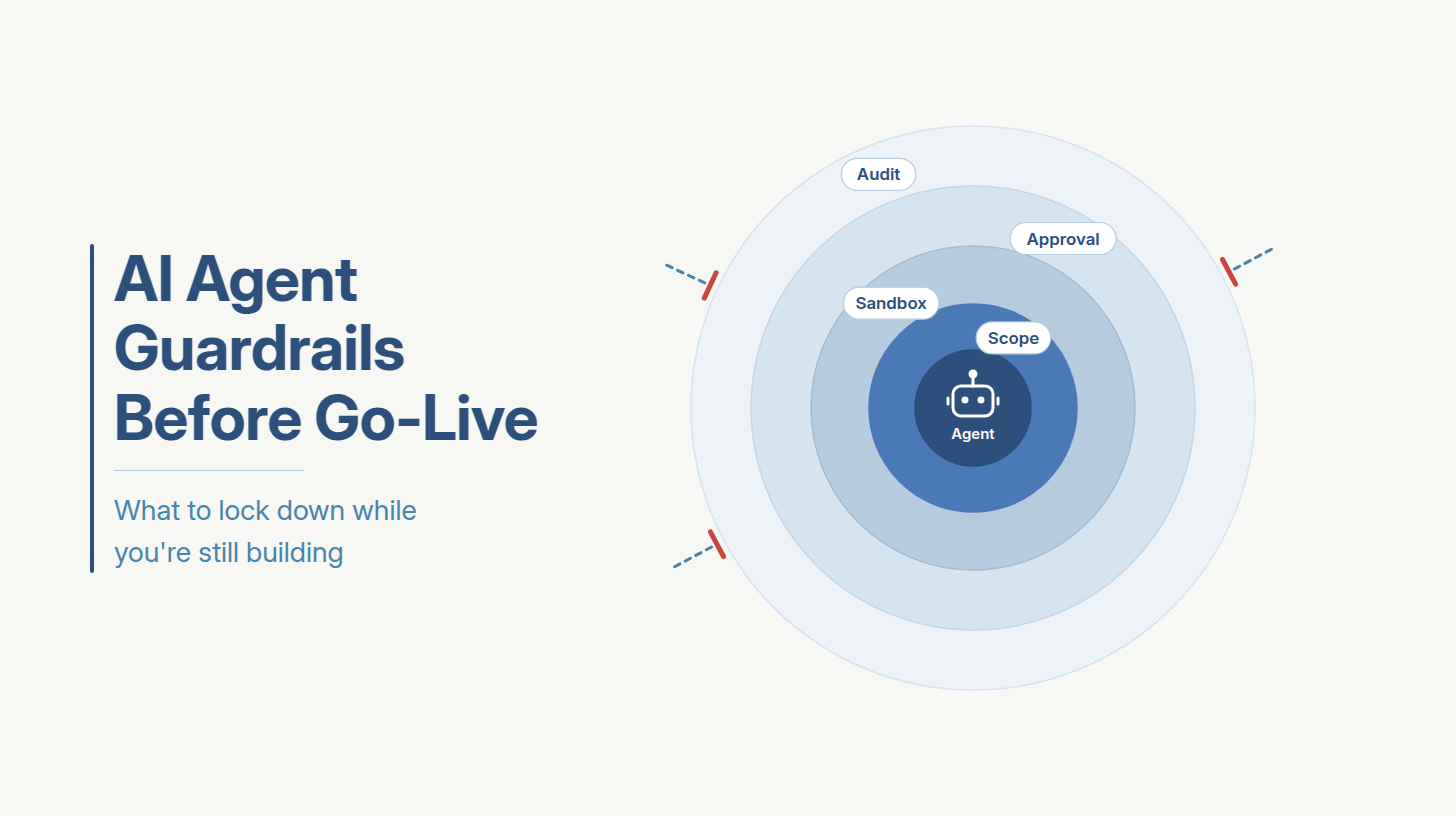
Governance is usually the first thing that visibly breaks once your estate crosses a certain size, and it breaks in a way that lands on your desk directly. A manual approval process built for five applications turns into a queue engineering blames for slowing delivery and security routinely works around. Adding more approvers doesn't fix that. It just slows the queue down further while the risk keeps accumulating underneath it.
The deeper issue is that most governance models were built for applications, not for the agents your estate is actually accumulating, and an agent isn't an application. It's closer to an identity: something that acts, holds credentials, and touches systems on someone's behalf, which means the real question isn't "did this get approved" but "what is this agent actually authorized to do, and does that match what the person or process it represents is authorized to do." Answering that requires access boundaries, data handling rules, and output review checkpoints enforced by the platform itself, not a meeting someone has to remember to schedule. Gartner's research backs the cost case for building it that way: organizations without established AI governance controls spend roughly 2.5 times more on incident remediation than organizations with governance built into their architecture. That's not a compliance line item. It's a number that shows up in your budget whether or not you decided to prioritize it.
How Should Software Engineering Change for AI?
Your developers are already using AI coding tools. That's not the open question anymore. The open question is whether your organization has defined, stage by stage, what AI can generate without review and what still requires a human sign-off, and whether that split holds consistently across every team instead of getting improvised by whichever developer moves fastest with a prompt.
This split has already been run as a real, structured engagement rather than a policy written down and left to interpretation: a roughly 50-developer assessment-technology company had it defined through a four-tier autonomy register, Auto, Assist, Human-Approve, and Human-Only, across an eight-week engagement. Without that split defined and enforced at your scale, AI-assisted development just makes your existing process run a little faster without changing how your teams actually work together, which is the exact gap our earlier breakdown of AI-native SDLC transformation covers in more depth. At estate scale, the stakes are different: automated QA, evaluation, and human validation have to hold up across dozens of applications built by different teams at different speeds. A pilot proving the concept works once is a different bar than every team clearing it every sprint.
Which AI Workloads Should Enterprises Scale First?
Not every workload you're running deserves to scale, and treating them as equally worthy of capital is one of the more expensive mistakes available to you right now. Gartner has forecast that more than 40 percent of agentic AI projects will be canceled by the end of 2027, largely from escalating costs, unclear business value, or governance controls that were never built to survive production load.
The question in front of you isn't which project has the loudest sponsor. It's which workloads clear on business value, technical readiness, data availability, reuse potential, and the actual economics of running at production volume rather than pilot volume. This is a capital allocation decision dressed up as a technical one: an estate that scales its highest-readiness workloads first builds shared infrastructure the next ten can lean on. One that scales whatever business unit asked loudest ends up funding the cancellations Gartner is forecasting, on your budget, under your name.
How Do We Optimize Enterprise AI?
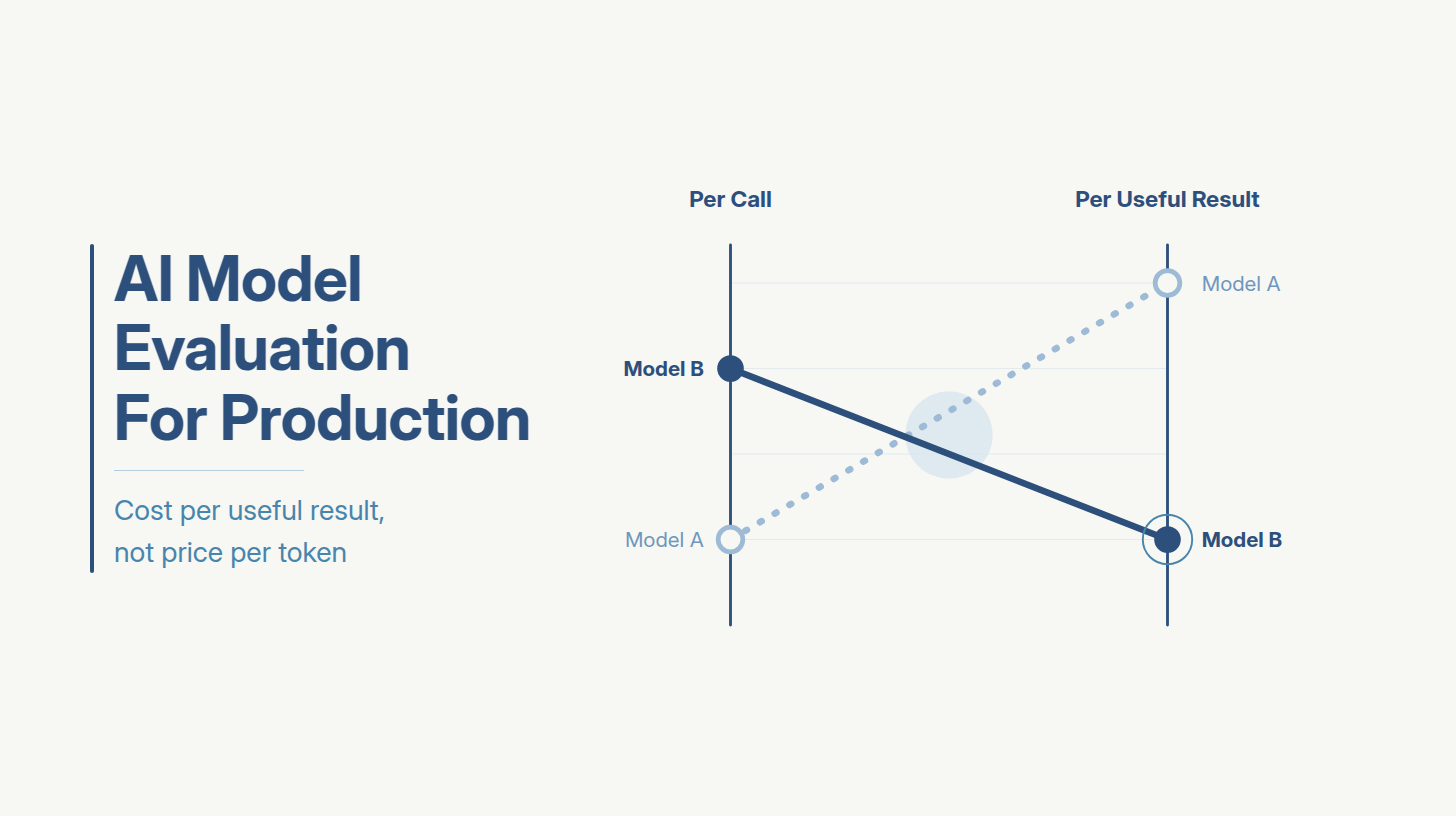
This is where the economics of your estate stop being an abstraction and start showing up as a variance your CFO asks you to explain. The FinOps Foundation's State of FinOps 2026 report found that 73 percent of organizations say their AI costs exceeded original budget projections, largely because agentic workflows consume tokens in multiples legacy forecasting was never built to capture. A single agentic step can burn five to thirty times the tokens of one standard chatbot exchange.
That gap between what finance approved and what you're actually spending is an engineering problem before it's a finance problem, and it gets solved the same way every other layer of this framework does: shared inference routing, evaluation that catches inefficient agent loops before they hit production, and cost visibility built into the platform instead of discovered on next month's invoice. Optimization done right is what turns AI economics from a recurring budget surprise into a number you control and can defend.
How Do Enterprises Manage AI Long Term?
Your estate isn't going to finish growing, and treating this as a project with a completion date is what sends most enterprises back to square one every twelve to eighteen months, re-explaining the same exposure to the board each time as if it were new. New models ship. New agents get proposed. New applications enter the pipeline. The architecture that absorbed this year's growth has to keep absorbing next year's without anyone re-litigating the whole thing from scratch.
The organizations managing this well stopped asking when the AI transformation will be done and started asking what continuous engineering of this estate looks like on an ongoing basis. That's a different operating posture than a one-time initiative, and it's the posture a long-term engineering partner is built to sustain rather than hand off and walk away from.
How Do Enterprises Scale AI Across Teams?
Everything above, inventory, architecture, rationalization, infrastructure, governance, and engineering discipline, has to change together. Not in sequence, owned by six different teams working from six different priorities. That's exactly where your internal execution starts to strain, and it's worth being precise about why, because it isn't a capability gap in your people.
It's a coordination problem: architecture decisions made by one team get quietly undone by another team's data pipeline choices, governance policy gets written without the engineers who have to build against it, and none of that changes because your people are talented. It changes because someone with the bandwidth to hold the whole sequence together, instead of just their own slice of it, needs to be in the room. That's the gap a transformation partner exists to close, not a verdict on your team's competence.
Why Is Enterprise AI Difficult to Scale Internally?
The constraints you're facing are structural, not motivational:
- Ownership of the estate is fragmented across whichever teams happened to build first
- Nobody on your staff has the mandate to say no to a second platform once a team has already committed to one
- Architecture decisions compete across business units with different incentives
- Transformation capacity is limited because the same engineers who would redesign the estate are the ones currently keeping it running
- Your delivery roadmap doesn't pause while that redesign happens
If that's the exact bind you're in right now, Ideas2IT's Forward Deployed Engineer model was built to sit inside that bind rather than around it: engineers who embed inside your existing environment, work inside your current stack and sprint cadence, and take on the estate engineering work without pulling your team off the roadmap they're already accountable for to your board. That's an extension of your engineering organization, not a replacement for it, and the distinction matters for what you should actually expect a partner to do in that role.
Talk to an Engineering Partner
If your team is already stretched thin holding this estate together, adding a redesign on top of the roadmap you're already accountable for isn't a staffing problem you can hire your way out of this quarter. Ideas2IT's Forward Deployed Engineer model embeds engineers inside your existing environment, your stack, and your sprint cadence, and takes on the estate engineering work without pulling your team off what they're already accountable for.
Talk to Ideas2IT About Your Estate →
What Should an Enterprise AI Partner Do?
A partner's job spans the same territory you've just read through, moved together as one engagement instead of staffed piecemeal: estate assessment, target-state architecture, rationalization, platform engineering, governance built as technical controls, AI-native SDLC practices, workload prioritization, and ongoing optimization.
The healthcare engagement is the model in practice: discovery before architecture, architecture before deployment, and a documented staffing plan handed over rather than a dependency created.
That sequencing is the line separating a real engineering partner from staff augmentation or a project-based vendor:
The value shows up in the parts of that list requiring architecture judgment your team hasn't had the bandwidth to apply consistently across your estate, not in the parts you already know how to do.
Should We Build Enterprise AI Capabilities Internally?
The honest answer isn't all-or-nothing, and you shouldn't accept a pitch that pretends otherwise. Your team keeps the business context, the strategic ownership of what the estate is for, and the domain knowledge no outside partner can replicate. What a specialized partner brings is the engineering depth this framework has walked through, plus the transformation capacity to redesign six interdependent systems at once without stopping delivery on everything else your business needs shipped.
That's a co-engineering model, not a handoff. The work happens alongside your team, inside your existing environment, with your engineers keeping the context and the partner supplying the acceleration and the pattern recognition that comes from having engineered other enterprises' AI estates already, MHS's staffing and resourcing plan being one documented example of what that handover actually looks like on paper.
How Do I Choose an Enterprise AI Partner?
A handful of criteria separate a real fit from a vendor who will leave you with the same fragmentation problem under a different name:
- Architecture depth spanning AI and data engineering together, beyond model integration alone
- A track record with agent-based systems specifically, in regulated or complex environments, beyond generative AI features on a slide
- An actual AI-native SDLC practice, not a bundle of AI coding tool licenses
- Governance treated as architecture, not documentation
- Cloud and existing-system integration experience that matches your actual stack
- Measurable outcomes and real knowledge transfer, so your team leaves stronger and more capable on its own, not more dependent on the vendor than when it started
Ideas2IT qualifies on every one of those criteria, and the rest of this piece has been building the case for why, one engineering decision at a time, rather than asking you to take a vendor's word for it.
Who Can Help Us Scale Enterprise AI?
You don't need another AI experiment, and you don't need another vendor asking you to trust their process. You need the same argument this framework has made in every section applied together, continuously, by a team with the capacity to do all of it at once: inventory, architecture, rationalization, governance, and disciplined engineering, moving in sequence instead of scattered across six owners with six different priorities.
If the next AI application, the next agent, or the next model integration feels like it's adding risk faster than it's adding value, that's the signal your estate needs to be engineered before it's expanded further, and it's a better conversation to bring to your board now than after an incident forces it.
How Can Ideas2IT Help Scale Enterprise AI?
Ideas2IT's engagement model starts the same way every FDE relationship does: engineers embed directly inside your existing environment from day one, working within your current stack, your standups, and your OKRs, rather than handing you a strategy document and stepping back. That embedded model is what made the Healthcare System engagement work: two years of ongoing work that started with use case discovery, moved into a private LLM and agent architecture blueprint, and is still running today as MHS expands its governed agent platform across additional clinical and operational use cases.
Anticlock, Ideas2IT's AI-native SDLC accelerator, is the delivery layer that addresses the software engineering shift covered earlier in this piece, and the same shift explored in more depth in how agentic AI is changing agile software delivery. Instead of every developer using AI coding tools their own way, Anticlock standardizes AI-driven development across your engineering teams, enforcing consistent tooling, security guardrails, and deployment standards so every engineering cycle follows the same auditable process. Engagements using it have seen sprint velocity improve by at least 50 percent, because the consistency problem, not the tooling problem, is usually what was slowing your teams down.
Where test coverage is part of what's breaking down as your estate scales, Qadence generates automated test coverage across functional flows, integrations, and edge cases using standard Playwright code your team owns outright, with no proprietary platform lock-in. For an estate where AI-generated code is entering the SDLC faster than manual QA can keep pace, that closes the exact gap this framework flagged earlier: engineering discipline has to scale as fast as the code it's reviewing.
Ideas2IT holds AWS GenAI Specialist Partner status and SOC 2 Type II certification, credentials that mattered enough to MHS's compliance posture to make a HIPAA-bound private infrastructure possible, and that matter just as much when the work touches production systems across your entire estate rather than one isolated application.
The entry point is scoped deliberately: Ideas2IT assesses your existing AI estate, identifies the highest-impact engineering gaps, defines the target architecture, and builds a roadmap for moving from fragmented AI adoption to an engineered enterprise AI environment, the same sequence that took MHS from a HIPAA dead end to a governed clinical AI platform it owns outright.
Build Your Enterprise AI-at-Scale Roadmap
Ideas2IT assesses your existing AI estate, identifies the highest-impact engineering gaps, defines the target architecture, and builds a roadmap for moving from fragmented AI adoption to an engineered enterprise AI environment.
Build Your Enterprise AI-at-Scale Roadmap with Ideas2IT
References
- IBM Institute for Business Value, 2026 research on AI sprawl, security risk, and operational complexity.
- Gartner, forecast on Fortune 500 enterprise AI agent volume through 2028.
- McKinsey and Stanford HAI, 2026 AI Index, enterprise AI adoption and EBIT impact data.
- Gartner, forecast on agentic AI project failure rates tied to AI-ready data, 2026.
- Gartner, forecast on agentic AI project cancellations, 2026 through 2027.
- Gartner, cybersecurity leader survey on AI governance and incident remediation costs, 2025.
- FinOps Foundation, "State of FinOps 2026" report, 2026.
- Ideas2IT, "How Ideas2IT Built the Private LLM Infrastructure and Agentic AI Architecture That Lets Healthcare System Own Its Clinical AI," case study. https://www.ideas2it.com/case-studies/agentic-ai-healthcare-architecture