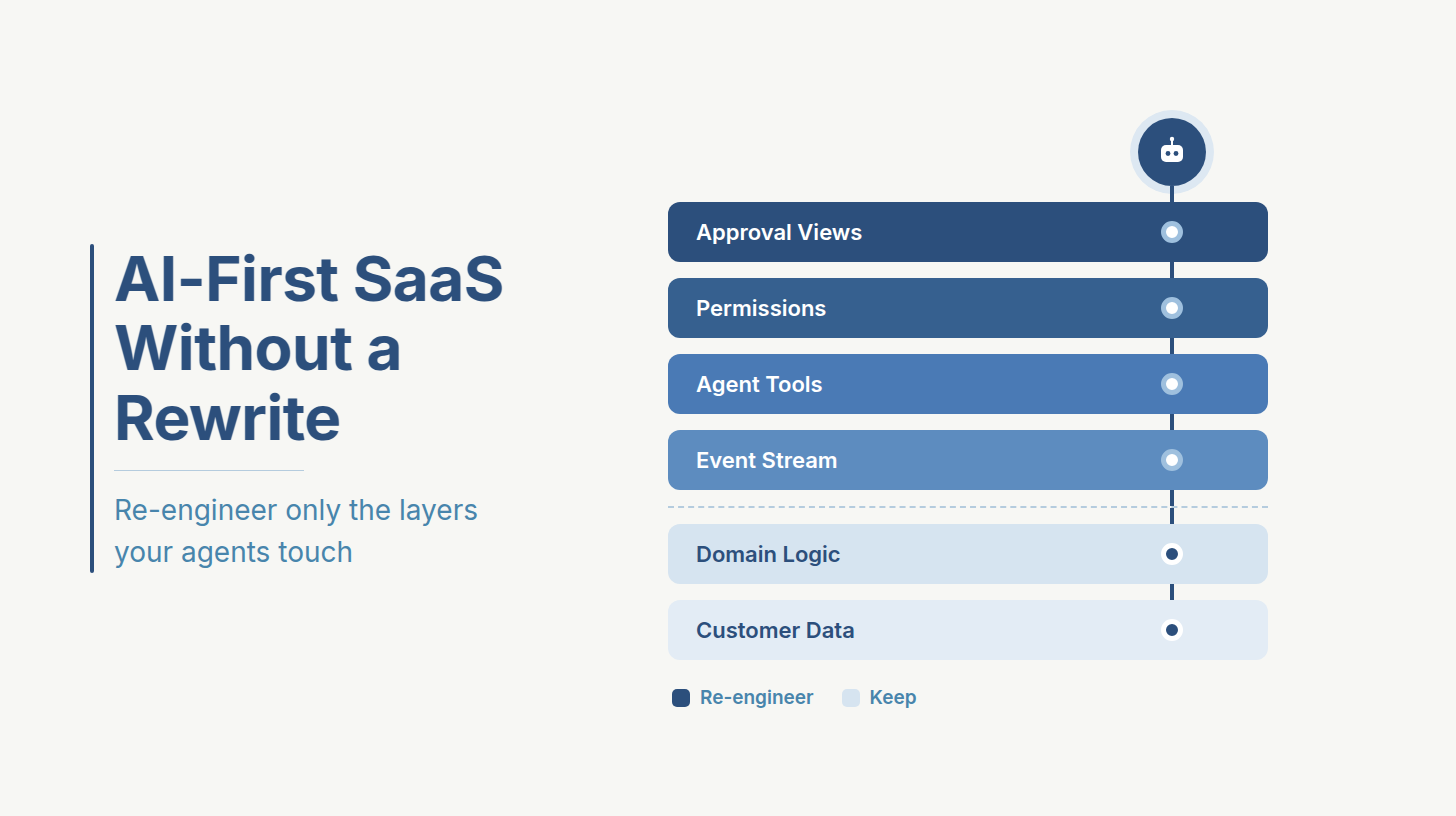

- The AI-native claim in your own org isn't proof of anything just because AI tools are in use everywhere. As commonly practiced, that's AI-augmented delivery, and most teams have it and call it native.
- The real gap is whether anyone has defined where AI has autonomy to act and where a human still decides, and whether the workflow was rebuilt around that answer.
- You can't close this gap with more licenses instead you need a defined autonomy model, a redesigned workflow, and a team trained through real pilots, in that order, built together.
- Every velocity number in your AI roadmap assumes the organization actually changed. If it didn't, the roadmap was built on adoption metrics.
If your engineers are already using Cursor, Copilot, Claude Code, and other AI tools, but if requirements, architecture, development, testing, review, and release still operate the same way, you haven't built an AI-native SDLC. You've built an AI-augmented one.
Adoption already happened, one developer at a time, in whatever way each of them found useful. What hasn't happened is any change to how the team works as a unit. Nobody has defined where AI drafts and where a human still owns the decision. A new engineer joining the team still has to invent their own pattern instead of learning one that already exists.
Quick answer: An AI-native SDLC is a software development lifecycle where AI's autonomy is explicitly defined at each stage and the workflow is rebuilt around that definition. Rolling out AI coding tools to individual developers produces AI-augmented delivery instead, where the same process runs faster but nothing about how the team operates has actually changed.
In this guide:
- What actually separates an AI-augmented team from an AI-native one
- The three things a real transformation requires, and why most organizations only build one of them
- How Ideas2IT rebuilt its own delivery model first, before bringing this to any client
- How an engineering org that came to us for exactly this got it built
- What a different kind of proof, modernizing the system underneath a transformation, looks like
- How Ideas2IT does this for you
What Is an AI-Native SDLC?
Most engineering organizations are fully AI-augmented and already calling it native. The difference is a specific, checkable distinction in how the SDLC itself is structured.
AI-Augmented Development: AI Makes the Existing SDLC Faster
Ness Digital Engineering describes AI-augmented delivery as keeping the traditional structure of requirements, design, development, testing, and deployment intact, using AI only to accelerate individual steps inside that structure. The process stays exactly what it was. Each step inside it just runs faster.
AI-Native Development: AI Changes How the SDLC Works
ELEKS frames AI-native delivery as reshaping the structure itself, changing how work gets planned, how decisions get made, and what a team's roles actually are once AI is a standing participant in the process rather than a tool one person reaches for. The workflow changed, and that is what distinguishes it from a single faster step.
The Difference Between AI-Augmented and AI-Native Engineering
Why AI Coding Tools Alone Don't Create an AI-Native SDLC
Buying more AI licenses expands the augmented layer without touching the native layer underneath it. Here is why that gap doesn't close on its own.
AI Tools Everywhere
Your team's AI usage probably looks healthy on paper. Adoption numbers are up and developers report using AI daily. Leadership sees license utilization climbing every quarter but none of that tells you whether the organization changed.
Why Developer-Level Adoption Doesn't Change Organizational Velocity
An individual developer can decide, on their own, to run an AI assistant against a pull request. No developer can unilaterally decide that the team's code review process now includes an AI-drafted first pass with defined human checkpoints, because that decision sits above any one person. Developer-level adoption is capped at whatever a single person can influence: their own pull requests, their own review comments, their own local workflow. Organizational velocity depends on the things no individual controls alone, review policy, test strategy, release gates, and cross-team consistency, which is exactly why adding more individual tool use stops moving the velocity number after a certain point.
The Governance Gap Between AI Adoption and AI Autonomy
GitLab's 2026 AI Accountability Report, based on a Harris Poll survey of 1,528 developers and technology buyers across six countries, found that 80 percent of organizations adopted AI coding tools faster than they built policy to govern them, and 92 percent reported active governance gaps in how AI-generated code gets tracked and reviewed. Adoption raced ahead of structure at almost every organization surveyed. Individual tool use is now standard practice. Structure to govern and direct that use remains rare.
For the phase-by-phase mechanics of where AI plugs into requirements, build, test, and release, see how AI moves through each stage of the SDLC. The progression is consistent across almost every organization: tools arrive first, adoption follows, a governance gap opens between the two, and that gap is the actual transformation problem.
What Does an AI-Native SDLC Actually Require?
Becoming AI-native is not one decision. It is three separate pieces of work, and most organizations build one of them and assume the other two will follow on their own. This is likely the part of this guide worth returning to, since everything else in it builds on these three pieces.
A Defined AI Autonomy Model
An autonomy model is an explicit, written answer for each stage of the SDLC: where AI drafts and a human reviews, where AI acts within a bounded task and only surfaces exceptions, and where a human retains sole authority regardless of what AI produces. Without it, every developer decides independently, and the organization ends up with as many informal versions of AI-native as it has teams.
Workflows Rebuilt Around AI Autonomy
Once autonomy is defined, code review, test strategy, and requirements work all have to change to match it, not simply have AI inserted into steps that already exist. Review has to account for where AI drafted the first pass. Test coverage targets have to shift toward the specific gap between shipping fast and shipping safely. Requirements work has to separate what AI can structure from what only a product owner can decide.
A Team Trained Through Real Engineering Pilots
A written autonomy model and a redesigned workflow do nothing if the team reverts to old habits the first time a release date tightens. That requires role-specific training, not a single all-hands session, and a small number of teams running the new model on real work before it's asked of everyone else.
These three pieces depend on each other. An autonomy model without a redesigned workflow is a document nobody follows. A redesigned workflow without a trained team reverts under the first deadline. Building all three at once, correctly, inside an organization that is also shipping product on its normal schedule, is where this typically breaks down.
How Do You Define AI Autonomy Across the SDLC?
An autonomy model sounds procedural until you try to write one. Done properly, it has to be specific enough that two different engineers reading it make the same call in the same situation, stage by stage.
Requirements and Planning: AI Assists, Humans Own Intent
At the requirements stage, AI's role is typically to decompose epics into structured stories and acceptance criteria, and to keep requirements documentation queryable rather than static. The product owner retains ownership of intent and prioritization. AI drafts structure, not judgment calls about what the business actually needs.
Architecture: AI Validates Before Development Begins
AI's role in architecture is validation, not decision-making: checking component alignment, scalability trade-offs, and integration risk against a proposed design before code gets written, while those decisions are still cheap to reverse. A human architect still owns the actual call.
Development: AI Generates, Engineers Direct and Review
In development, AI drafts code inside the team's real codebase and conventions. The autonomy question here is how much scrutiny that draft gets before it merges: extra review wherever AI produced the first pass, standard review where a human wrote it directly.
Testing: AI Expands Coverage, Engineers Own Test Strategy
AI's role in testing is generating test cases and surfacing coverage gaps, targeted specifically at the gap between what ships fast and what ships safely. Human QA engineers still own test strategy and edge-case judgment. AI expands what gets checked, not what counts as sufficient.
Release: AI Predicts Risk, Humans Own the Go/No-Go Decision
At release, AI can flag risk and support incident triage, but the go or no-go decision on a production release stays exclusively human, without exception. The cost of an autonomous release decision being wrong is categorically different from the cost of an autonomous code suggestion being wrong.
How Do You Rebuild the SDLC Around AI Autonomy?
Defining autonomy is a policy decision. Rebuilding the SDLC around it is an operating change, and it has to touch the same five stages.
Replace Static Requirements With Structured, Queryable Artifacts
Requirements stop living in documents nobody re-reads and start living as structured artifacts a developer can query directly for a current, context-aware answer, rather than toggling between a ticketing tool, a wiki, and someone's memory of a decision made two sprints ago.
Build AI Into Architecture Validation
Architecture review adds an AI validation pass before a design goes to a human architect for sign-off, checking for component misalignment and integration risk early enough that catching a problem doesn't mean redoing three sprints of work.
Redesign Development Around AI-Assisted Engineering
Code review changes shape once AI is drafting a meaningful share of pull requests. Reviewers calibrate extra scrutiny to where AI produced the first pass, and the team defines explicitly what a human always checks regardless of who or what wrote the code.
Shift Testing From Manual Creation to AI-Generated Coverage
Test creation shifts from engineers writing every test from a blank page to engineers reviewing and refining AI-suggested test cases and coverage gaps, with the freed-up time going toward the edge cases and test strategy decisions that still require human judgment.
Make Release Planning Predictive Rather Than Reactive
Release planning moves from reacting to problems after a deployment to modeling risk and recommending timing before one, with humans retaining the actual go or no-go authority.
Why Is an AI-Native SDLC Difficult to Build Internally?
Most organizations that try to build this internally do not fail from lack of effort. They fail because the three requirements above get assigned to three different people, or to nobody in particular, and nothing forces them back together.
No Single Owner for the AI Autonomy Model
The autonomy model usually has no single owner. A platform team might sketch guidelines for one workflow. A tech lead on another team makes their own call because nobody told them otherwise. Six months in, an organization can have five different informal versions of what AI is allowed to do, none of them written down, none of them consistent across teams that are supposed to be operating the same way.
Workflow Redesign Gets Fragmented Across Teams
Redesigning code review, testing, and requirements work around a new autonomy model touches process that several teams already own and have opinions about. Without someone accountable for making that redesign consistent across the org, each team adapts the old workflow slightly differently.
Training Fails Without Real Engineering Pilots
An all-hands session on AI-native practices lands well in the room and evaporates within a sprint, because nobody has actually run the new model on live work yet. Without a small number of pilot teams executing the redesigned workflow on real releases first, the training has nothing concrete to reinforce it, and the org reverts to old habits the moment a deadline gets tight.
Why Organizations End Up With Multiple Versions of "AI-Native"
Each of these failures compounds the others. An organization with no autonomy owner, a fragmented workflow redesign, and training that didn't stick ends up running several different, unstated versions of AI-native at once, none of them consistent, and none of them the version leadership described to the board.
If your team already has fragments of an autonomy model, a partial workflow redesign, and a training session everyone attended and nobody applies, you are not behind. You are in the exact spot where this normally stalls, and the missing piece is usually not effort but ownership: a team that has already built this end to end and can run the missing 20% instead of you rebuilding the first 80% from scratch. A short working session can map which of the three pieces your organization actually has, which are missing, and what an eight-week program to close the gap looks like for a team your size.
How Should an Engineering Organization Start Its AI-Native SDLC Transformation?
This is where the three requirements above turn into a sequence you can actually run.
Start With One or Two Pilot Squads
Full-team rollout on day one guarantees inconsistent adoption, because nobody has tested the autonomy model against real work yet. Selecting one or two squads first, chosen for real production work rather than a synthetic exercise, is what turns the transformation from a policy into practice anyone can point to.
Define the Autonomy Model Before Scaling AI Usage
The order matters. Autonomy gets defined before AI usage expands, not after. Scaling tool access ahead of a defined model just multiplies the inconsistency problem across more people, faster.
Run the Model Against Real Engineering Work
A pilot only proves anything if it runs against a real release under real deadline pressure, not a sandboxed exercise. That is the only environment that reveals whether the autonomy tiers hold up when a deadline gets tight, which is exactly the condition that breaks an untested model.
Measure What Changed Beyond Tool Adoption
Measuring success by AI usage numbers just restates the adoption metric that already exists. The metrics that matter are tied to the workflow itself: review time per pull request, defect rate on AI-assisted code versus human-only code, and time from story creation to acceptance.
Build the Scaling Roadmap From Pilot Results
The roadmap for the rest of the organization gets built from what the pilot squads actually proved, not from what the framework predicted on paper. Autonomy tiers that held up under pilot pressure expand. Tiers that didn't get revised before they reach a second team.
How Do You Scale an AI-Native SDLC Across the Engineering Organization?
A successful pilot proves the model works for one or two squads. Scaling it organization-wide is a distinct step with its own failure modes.
Build a Trained Anchor Cohort
Scaling starts with the cohort that ran the pilot, not a new training initiative from scratch. The engineers who operated the autonomy model on real releases become the people who train the next squad, because they've already made the judgment calls a written playbook can't fully capture.
Standardize Prompts, Patterns, and AI Engineering Practices
The prompt and pattern library built during the pilot, tied to the organization's actual stack and coding standards, becomes the shared reference every subsequent team starts from, rather than each new squad inventing its own conventions.
Extend Autonomy Gradually From Assist to Higher Tiers
Autonomy tiers expand the same way they were built: gradually, and only where the pilot proved the tier held up under real release pressure. A stage that started in Assist moves to Human-Approve once a track record justifies it, not on a fixed calendar.
Operationalize AI Usage Across Engineering Teams
Operationalizing autonomy at scale requires a governance layer that enforces the model consistently across every team, not each team interpreting a shared document differently. Without that layer, the inconsistency the transformation was built to eliminate reappears at a larger scale, just distributed across more teams instead of more individual developers.
Measure Transformation, Not Tool Adoption
The same principle from the pilot phase holds at scale: track review time per pull request, defect rate, and time from story to acceptance across every team running the model, not licenses issued or prompts logged. Adoption metrics measure activity. These metrics measure whether the organization actually changed.
What Does an Eight-Week AI-Native SDLC Transformation Look Like?
A first structured pass through this sequence typically runs eight weeks, broken into four phases.
Week 1: Assess the Existing SDLC and Select Pilot Squads
The first week is spent on fit, not rollout: reviewing the organization's actual SDLC, current AI usage patterns, and toolchain, then selecting one or two squads to pilot the new model before it goes near the rest of the organization.
Weeks 2-5: Define Autonomy and Train the Engineering Team
Weeks two through five build full-team orientation so every engineer, product owner, QA lead, and DevOps engineer shares the same baseline understanding, role-based training beyond that baseline, and a specific autonomy model built collaboratively rather than handed down.
A typical four-tier autonomy model maps like this:
Weeks 6-7: Run the AI-Native Workflow on Real Releases
Weeks six and seven put that model into practice with the selected pilot squads, running real work through the redesigned workflow rather than a simulated scenario.
Week 8: Turn Pilot Results Into a Scaling Roadmap
Week eight turns pilot results into a scaling plan:
- A trained anchor cohort of eight to fifteen engineers who can operate the model without daily support
- A prompt and pattern library built from the organization's actual stack
- A roadmap for extending the model to the rest of the engineering organization
Most tiers in a first pass start in Assist or Human-Approve, expanding only as the pilot squads prove the model holds under real release pressure. That staged posture is the deliberate, sequenced path to defined, expanded autonomy, not a lesser goal an organization settles for on the way to something bigger.
How Ideas2IT Built Its Own AI-Native Delivery Model
Before Ideas2IT brought this model to any client, the company ran the same three-piece transformation internally, across roughly 700 engineers.
Rebuilding Our Own Delivery Model Across 700 Engineers
The autonomy model came first, defined stage by stage, before any workflow or training work began.
Embedding AI Into Requirements, Architecture, Development, Testing, and Release
- Requirements moved from static documents into structured, queryable artifacts that a developer can check directly instead of hunting across Jira, Confluence, and old specs
- Architecture gets validated by AI before a line of code is written, checking component alignment and integration risk while those decisions are still cheap to change
- Development runs on internal copilots trained on Ideas2IT's own repositories and coding patterns, not a generic model guessing at conventions it has never seen
- Testing runs mostly on its own, with engineers reviewing and refining AI-suggested test cases and coverage gaps rather than writing every test from a blank page
- Release planning stays predictive, with risk modeled ahead of a deployment rather than discovered after one
Training Engineers Through Lighthouse
The training piece runs through Lighthouse, Ideas2IT's internal learning platform, which teaches engineers to work with LLMs, agentic development patterns, and GenAI application frameworks directly, rather than through a single onboarding session. Ideas2IT also restructured company ownership itself, with 33 percent equity distributed to employees, so the engineers running this model day to day have a direct stake in whether it keeps improving.
Standardizing AI-Native Delivery Through Reusable Accelerators
None of the above held together without a redesigned workflow underneath it. Ideas2IT restructured delivery around cross-functional squads that combine AI and ML engineers directly with full-stack developers and DevOps specialists, and standardized the resulting patterns into reusable infrastructure accelerators that now cut client time-to-value by 50 to 70 percent on new engagements. Read the fuller account of that internal transformation.
What Does an AI-Native Transformation Look Like Inside a Real Engineering Organization?
The eight-week sequence above is the template. Here is what it looked like applied to a real, anonymized client.
The Starting Point: AI Tools Were Already Everywhere
A technology company with an engineering team of roughly fifty people had already reached the plateau described earlier in this guide. AI tools were in use across the team. Nothing about how the organization delivered software had actually changed.
The Eight-Week Transformation
Ideas2IT ran the same eight-week sequence described above: a first week assessing the client's actual SDLC and selecting pilot squads, four weeks building full-team orientation and role-based training, two weeks running the model against real releases, and a final week turning results into a scaling plan.
The Autonomy Model Built With the Client
The autonomy model built collaboratively with this client mapped the same four tiers to the client's real codebase and stack: Assist for requirements decomposition and product owner sign-off, Assist with added review scrutiny for AI-drafted code, Assist for AI-generated test coverage with QA owning strategy, and Human-Only for every production release decision.
The Pilot Cohort and Scaling Roadmap
The engagement closed with a trained anchor cohort of eight to fifteen engineers, a prompt and pattern library built specifically from this client's stack and coding standards, and a roadmap for extending the model across the rest of their engineering organization.
What Happens When the Legacy System Is the Constraint?
Here’s a scenario from one of our recent client engagement where the AI nativery hold was on hold because legacy systems was holding them back./
When the Existing System Limits AI-Native Delivery
Sometimes the constraint isn't the workflow at all. It's the system the team is building on top of. An organization can define a precise autonomy model and still stall, because the AI-assisted development, testing, and release practices they just designed have nowhere functional to run: the underlying application is years of undocumented logic held together by a spreadsheet or an unsupported framework. Here’s a scenario from one of our recent client engagement.
Digitizing the Legacy Estimation Workflow
A façade systems manufacturer came to Ideas2IT with exactly that problem. Estimators were running every project bid through a large Excel-based workbook that encoded years of pricing logic nobody had ever moved into a real application. Ideas2IT digitized that workbook into a web-based estimation platform, preserving the underlying calculation logic while adding centralized estimate management, role-based access control, and automated proposal generation, delivered by a hybrid onshore and offshore team.
Modernizing the System and Delivery Model Together
The platform work above solved the legacy constraint on its own: a manual, spreadsheet-based process moved into a real application with the underlying pricing logic preserved. Ideas2IT also ran a separate AI-native SDLC transformation with this same client's engineering team, applying the same three-piece structure described throughout this guide. If your organization's transformation involves both, an outdated system that needs rebuilding and a delivery model that needs to become AI-native, that is one engagement with one partner, not two vendors who have to coordinate with each other.
How Ideas2IT Helps Engineering Organizations Become AI-Native
Here's a walkthrough of how Ideas2IT actually assists organization in becoming AI Native.
Forward Deployed Engineers Embedded in Your Delivery Model
Ideas2IT's forward deployed engineers embed inside your existing environment, working your stack, your standups, and your OKRs from week one, which is the only way an autonomy model, a redesigned workflow, and a trained team actually get built with your organization rather than prescribed to it from the outside. You can see how forward deployed engineers operate inside an existing delivery team in more detail, including how that model compounds across engagements rather than resetting with every new client.
Anticlock for Standardizing AI-Driven Development
Ideas2IT's own forward deployed engineers run on Anticlock AI, an internal platform that standardizes how Ideas2IT's delivery teams use tools like Cursor and Claude Code across every engagement, staying inside Ideas2IT. It explains why the FDEs embedded in your organization operate with the same discipline on day one that Ideas2IT expects of its own engineers, rather than each individual FDE working however they personally prefer. The autonomy model, workflow redesign, and pilot structure your team ends up running gets built by people already operating under that same standard internally.
AI-Native Engineering With Governance Built In
Ideas2IT holds AWS GenAI Specialist Partner status, which matters here specifically because it is third-party validation of AI delivery competency rather than a vendor's own claim about itself, the exact kind of evidence this guide has been arguing you should look for. SOC 2 Type II and ISO 27001 certification sit underneath every engagement as a baseline, relevant if governance and access control are part of what your organization needs to redesign alongside the autonomy model itself.
From First Pilot to Organization-Wide Scale
The entry point for this work is scoped deliberately narrow: a short discovery phase that maps which of the three pieces, autonomy model, workflow redesign, trained team, your organization already has, which are missing, and what a first pilot would look like for a team your size, before any broader commitment gets made. From there, the engagement extends into the same eight-week structure described above, followed by the same scaling approach: a trained anchor cohort, standardized patterns, and gradual autonomy expansion. You can see the fuller custom software development approach Ideas2IT brings to engagements like this if you want the broader picture before that first conversation.
If you have gotten this far because your organization already has AI tools everywhere and still has no shared autonomy model or workflow that survives a tight release deadline, that is exactly the starting point Ideas2IT works from.
The underlying problem is rarely a lack of AI usage. It is the absence of one owned model for where AI acts and where a human decides, translated into workflows and a trained team that hold up under real pressure. A working session with Ideas2IT maps where your organization actually stands across the three pieces and scopes what a first pilot looks like for a team your size.
Talk to Ideas2IT about transforming your engineering org into an AI-native SDLC.
References
[1] Ness Digital Engineering. "AI-Native SDLC Explained: Building the Future of Software Delivery." Ness Blog. 2026. https://www.ness.com/blog/ai-native-sdlc-explained/
[2] ELEKS. "AI-Native Delivery: When AI Reshapes the Entire Lifecycle." ELEKS Blog. February 2026. https://eleks.com/blog/ai-native-delivery-reshapes-lifecycle/
[3] GitLab. "GitLab Research Reveals Organizations Are Generating AI Code Faster Than They Can Control It." 2026 AI Accountability Report, conducted by The Harris Poll. June 23, 2026. https://about.gitlab.com/press/releases/2026-06-23-gitlab-research-reveals-organizations-are-generating-ai-code-faster-than-they-can-control-it/