Just In
Ideas2IT is now an OpenAI Select Partner - recognized to help enterprises build, deploy, and scale AI with GPT-5, responsibly and at speed.
Read the announcement


As Head of AI/ML Engineering, you are not short on AI initiatives. You are short on a shared foundation underneath them. Every business unit that wants to ship an AI feature is rebuilding infrastructure your organization has already built somewhere else: retrieval pipelines, evaluation frameworks, agent orchestration, model access, and governance controls. This piece lays out what an Enterprise AI Factory actually centralizes, when it makes sense to build one, and how to sequence the build so you are not adding another initiative to the pile.
Your business units are not failing to collaborate out of neglect. They are shipping under their own deadlines, with their own budgets, and AI infrastructure is not something most of them were ever asked to share.
The pattern shows up the same way in every enterprise that reaches a certain scale. A product team stands up a RAG pipeline to answer customer questions from internal documentation. Six months later, a different division builds a nearly identical pipeline for its own document set, unaware the first one exists. Neither team is wrong to have built what they built. The problem is that nobody owned the decision of whether it should be built twice.
The same pattern repeats across evaluation and agent orchestration. One team writes a custom harness to test whether their agent's outputs are accurate before shipping. Another team, solving a different problem, does the same work independently, often with a lower bar for what counts as passing. Governance follows the same path: one business unit gets legal sign-off on a specific data handling pattern, and the next business unit re-litigates the same question because the precedent never left the first team's Slack channel.
This is not a fringe problem confined to a handful of overeager teams. According to McKinsey's State of AI in 2025 survey of nearly 2,000 organizations, 88 percent of respondents now report regular AI use in at least one business function, yet only about a third say their organizations have begun scaling those AI programs across the enterprise.
The gap between those two numbers is exactly where duplication lives: adoption is broad, ownership of the foundation underneath it is not. Gartner's research points to the same dynamic from a different angle, projecting that the average global Fortune 500 enterprise will run more than 150,000 AI agents by 2028, up from fewer than 15 in 2025, and that only 13 percent of organizations currently believe they have the right governance in place to manage that growth.
This is an ownership problem. Every business unit is incentivized to ship its own use case, and none of them is incentivized to build the shared layer underneath it, because that layer does not belong to any one of them. Closing that gap is what an AI Factory exists to do, and the next question is what, specifically, it should centralize.
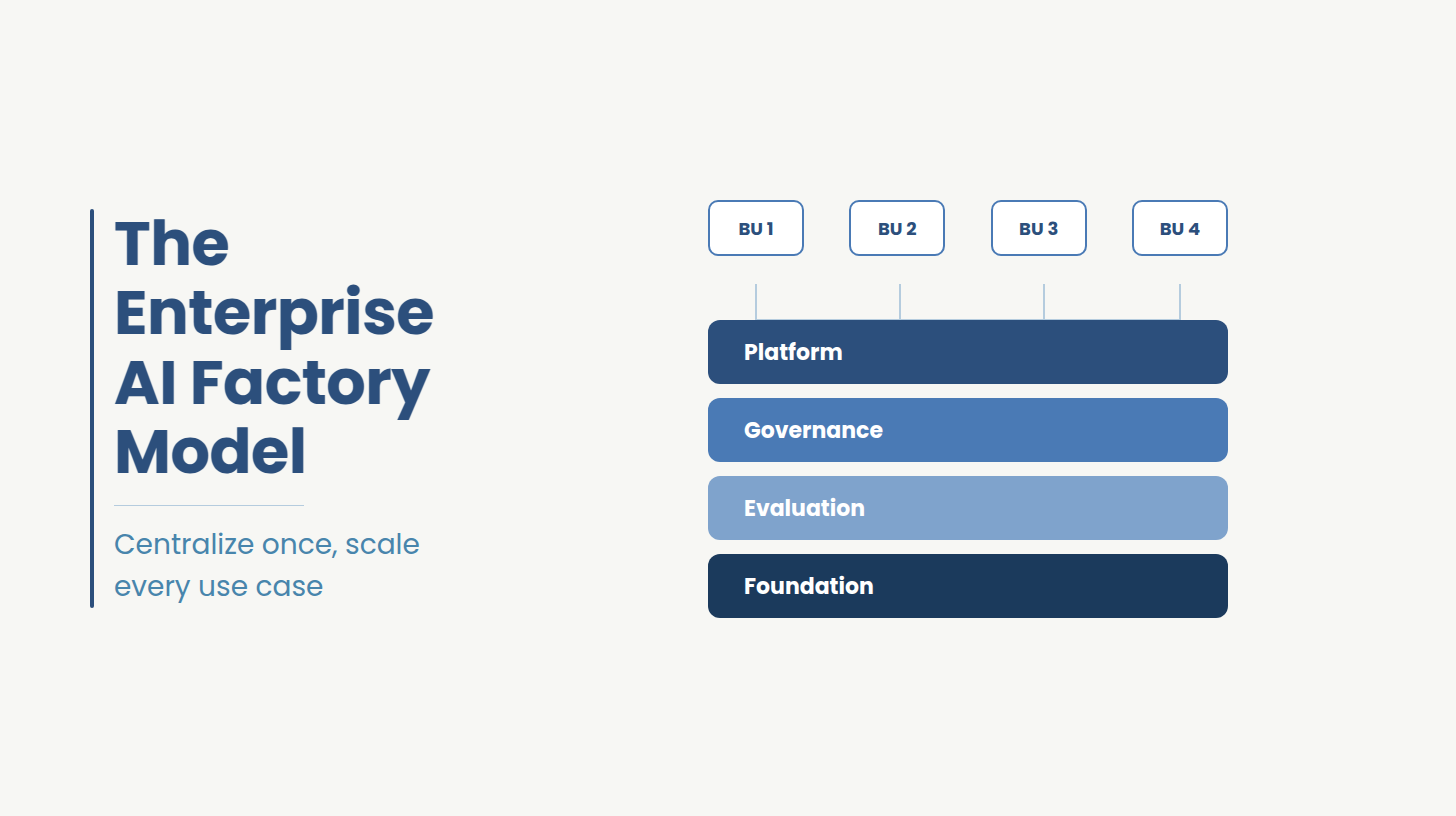
An AI Factory is the shared layer that every business unit's AI initiative should be built on top of instead of rebuilding. It is not a single platform and it is not a mandate that all AI work run through one team. It is a defined set of capabilities that get built once, governed once, and reused everywhere.
Six things belong in that shared layer, and each one maps to a specific piece of the duplication described above.
Ideas2IT's position on this operating model is specific: the AI Factory is not a research function or an innovation lab. It is production engineering infrastructure, and it should be measured the way you measure any shared infrastructure investment, by how much duplicate work it removes from the teams building on top of it. That framing raises an immediate follow-up question: how much of your AI engineering should actually live in that shared layer, and how much should stay with the business units.
Once you accept that a shared layer should exist, the next question is how much should sit inside it. Three models are available, and each carries a real trade-off.
A fully centralized model produces consistency and tight governance, but it creates a bottleneck. Business units with domain-specific problems end up waiting behind a central team that cannot possibly understand every use case as well as the people closest to it.
A fully distributed model is the state most enterprises are in today, and it produces exactly the duplication described earlier: parallel infrastructure, inconsistent governance, and no compounding advantage as the number of use cases grows.
A federated model splits the difference by design. The foundation, platform, architecture, reusable components, governance, and evaluation live in one shared layer that a central team owns and maintains. Execution, the actual building of a specific AI feature for a specific business problem, stays with the business unit that understands that problem best. This is the same trade-off the broader engineering organization has already been working through outside of AI specifically: Gartner projects that 80 percent of large software engineering organizations will have established a dedicated platform engineering team by 2026, up from 45 percent in 2022, precisely because centralizing the foundation while federating execution has proven out beyond AI use cases. An AI Factory is that same model applied to AI engineering specifically, and it is worth pressure-testing team structure the way delivery pods already have in adjacent parts of the organization.
Centralize the foundation because that is where duplication does the most damage and where a shared standard has the most leverage. Federate execution because business context is not something a central team can substitute for, and trying to own it centrally recreates the bottleneck problem in a different form. Once the split is right, the next question is what it actually saves you.
The economics of an AI Factory come from a single mechanism: build the foundation once, and every subsequent use case reuses it instead of rebuilding it.
Every row on the left side of that table has already been paid for once, somewhere in your organization. Without a shared layer, it gets paid for again every time a new business unit stands up a use case.
An AI Factory converts that repeated cost into a fixed cost. The platform, the reference architecture, the reusable components, the governance framework, and the evaluation harness get built and maintained once, by one team, and every business unit that builds a new use case draws on them instead of rebuilding them. The marginal cost of the fifth AI use case should be a fraction of the cost of the first, because four of the six shared-layer components already exist.
This is also why an AI Factory changes how you should be measuring AI engineering spend. The right metric is not spend per use case. It is the ratio of shared infrastructure spend to duplicated infrastructure spend across your AI portfolio. A high ratio of duplication is the clearest signal that centralizing the foundation will pay for itself, and it is usually the number that gets a CFO's attention faster than any efficiency argument framed in the abstract. Once that number makes the economic case, the harder question is how you actually run the thing day to day.
A shared layer without an operating model around it does not stay shared for long. Structure determines whether the AI Factory actually gets used or quietly gets bypassed the first time a business unit is in a hurry.
The team structure needs a central platform group that owns the shared layer and a set of embedded engineers or liaisons inside each business unit who understand both the shared infrastructure and the local use case. This is close to the pod-based structure Ideas2IT has documented in its own AI-native delivery model, where platformized delivery and embedded ownership are designed to work together rather than in competition with each other.
Governance needs a defined body, not a committee that meets quarterly, with the authority to set data handling and model access policy and the visibility to update it as new use cases surface new questions.
Intake and prioritization need a real process. Every business unit that wants to build on the AI Factory should submit its use case through a defined channel, and the central team should be evaluating requests against a consistent set of criteria: does this reuse existing components, does it require a genuinely new capability, and where does it rank against other requests competing for the same platform team's time.
Reusable assets need an owner and a lifecycle. A retrieval pipeline or prompt library that nobody maintains becomes a liability within two quarters. Architecture decisions need to be documented in a place every business unit can find them, not buried in a single team's internal wiki.
Deployment needs a consistent path so a change from one business unit does not carry different risk assumptions than a change from another. Measurement needs to track the reuse ratio directly: how much of each new use case draws on existing shared components versus how much gets built new.
Designing this operating model is a different exercise from writing a platform strategy document. It requires deciding who has authority over what, how disputes between a business unit and the central team get resolved, and how the model evolves as your AI portfolio grows. That is the part of this work Ideas2IT is built to do alongside your team, not hand to you as a framework and walk away. Before any of that design work starts, though, it is worth checking whether your organization actually needs it yet.
Not every organization running multiple AI initiatives needs an AI Factory yet. The signal is not the number of AI projects. It is the shape of the duplication underneath them.
One or two teams experimenting is not a centralization problem. But if two or more of these signals are present, the case for an AI Factory is not theoretical. It is already showing up in your numbers, even if nobody has assembled the numbers into one view yet, which is often the first useful output of an AI Factory assessment.
See where the duplication is already costing you.
If two or more of the signals above match your organization, an AI Factory assessment will show you exactly where centralizing the foundation would remove the most duplicated spend first.
Talk to Ideas2IT about an AI Factory assessment
Recognizing that the case exists is one thing. Knowing where to start building is a separate, harder question, and it is where most centralization efforts either gain momentum or stall.
The instinct once you have decided to build an AI Factory is to try to build the whole shared layer at once. That instinct is the fastest way to turn a centralization effort into a stalled platform project with no adoption.
Ideas2IT went through a comparable sequencing problem inside its own engineering organization, not as a client engagement but as an internal transformation. Rather than mandating AI-native practices top-down, the company ran a 60-day org-wide rollout that equipped more than 500 developers, QA, and data professionals with shared tools and workflows, using peer-led "anchors" instead of a central instructor group, and building governance in from day one rather than retrofitting it later. The detail worth taking from that pattern is not the specific tooling. It is the sequencing: shared foundation first, peer-driven adoption second, governance built in from the start rather than bolted on afterward.
Priority use cases matter more than a full roadmap at this stage. A live example of a business unit shipping faster on shared infrastructure is worth more to internal adoption than any architecture document, and it is exactly the kind of evidence that turns the next four business units into voluntary adopters instead of mandated ones.
Every AI use case your business units ship from here forward will either draw on a shared foundation or rebuild one. There is no third option. The only question is whether that foundation exists yet, or whether the fifth use case is quietly repeating the same build as the first one did.
The organizations that get ahead of this are not the ones with the most AI initiatives. They are the ones that centralized the six things worth centralizing, platform, architecture, reusable components, governance, evaluation, and engineering standards, while leaving execution with the business units that understand their own problems best. That is the specific, buildable answer to a question that otherwise stays stuck at the level of strategy slides.
Talk to Ideas2IT about assessing your duplicated AI engineering effort and designing your AI Factory operating model.
The starting point is a scoped assessment of your current AI initiatives, the infrastructure each one has built independently, and where centralizing the foundation would remove the most duplicated spend first.
Book a working session with Ideas2IT
Ideas2IT delivers this work through Forward Deployed Engineers who embed directly inside your existing environment from day one. Your FDEs join your stack, your standups, and your OKRs rather than operating from outside them. For an AI Factory build specifically, that means the engineers designing your shared platform layer are working inside the same governance constraints, the same business unit relationships, and the same delivery cadence your internal teams already operate under. A shared layer designed from outside your environment becomes a document. A shared layer built inside it becomes infrastructure your teams actually adopt.
Where the problem is enforcing engineering consistency across the business units building on your AI Factory, Ideas2IT uses Anticlock, an AI-driven software development platform built for enterprise-grade consistency rather than individual productivity. Anticlock standardizes how AI-assisted development happens across every team building on your shared layer: the same tooling, the same security guardrails, and the same deployment standards on every engineering cycle, regardless of which business unit is shipping. In organizations where AI-assisted development had been left to individual developer preference, standardizing it this way has produced sprint velocity gains of 50 percent or more, which is the same consistency problem an AI Factory operating model is trying to solve at the engineering layer.
Ideas2IT holds AWS GenAI Specialist Partner status and SOC 2 Type II certification, both relevant to enterprises evaluating a partner to help design governance and platform infrastructure that will sit underneath multiple business units' AI initiatives.
The engagement starts with a scoped entry point, typically an agentic operating model workshop or AI Factory assessment, built around a review of your current AI initiatives, the infrastructure duplicated across them, and a prioritized design for what belongs in your shared layer first. From there, the engagement transitions into building the foundation alongside your team, starting with the piece that removes the most duplication fastest, and expanding into the full operating model as adoption grows across business units.
Ready to see where your AI Factory should start?
Every Ideas2IT engagement opens with a free, scoped entry point built around your current initiatives, not a generic proposal.
Book a working session with Ideas2IT