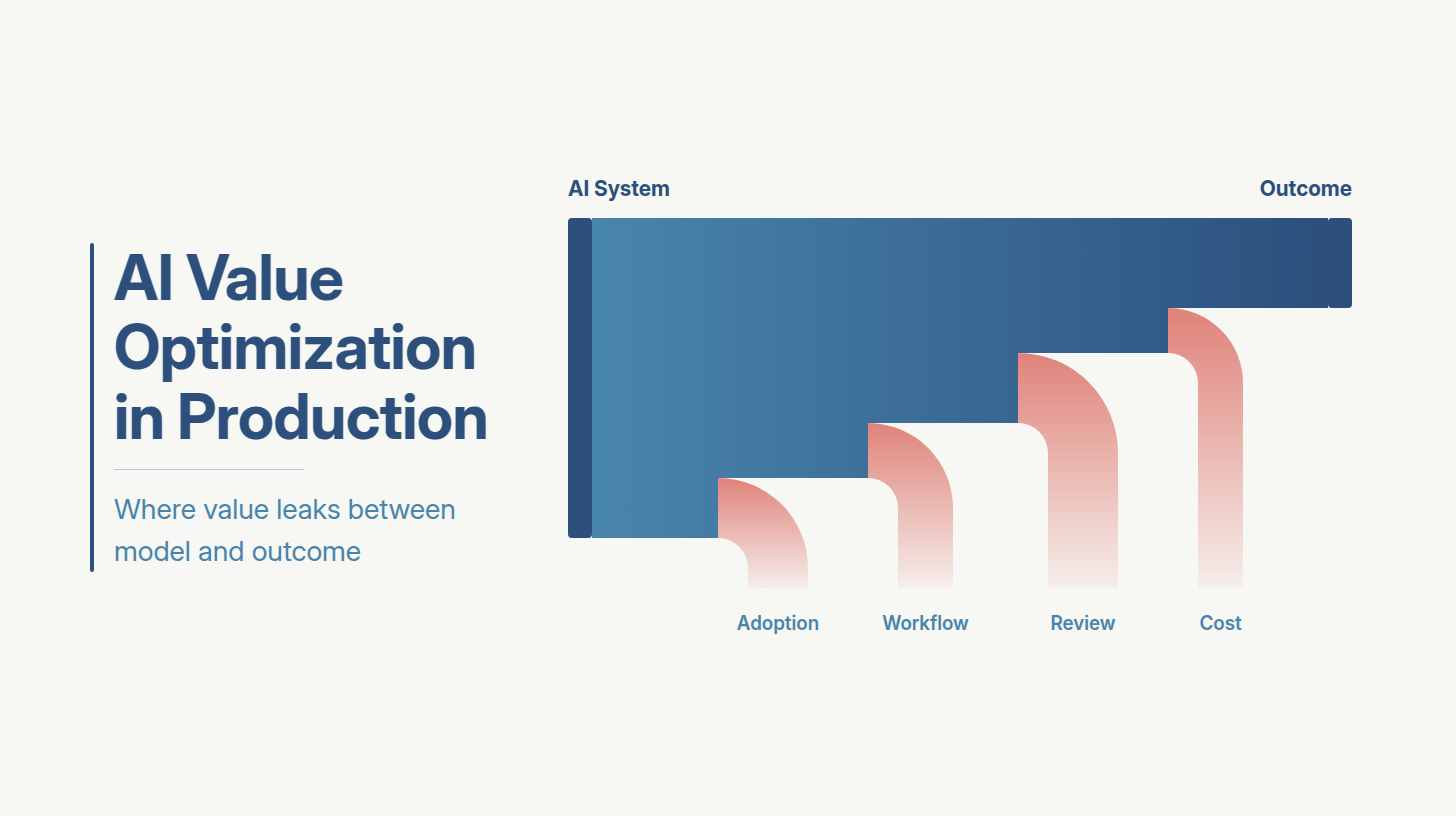

- Rising costs, too many delivery handoffs, and limited AI adoption are making traditional outsourced teams harder to justify.
- Replacing a vendor is not just a headcount change. Roles, QA, architecture, governance, and team composition all need to be redesigned around the work that actually needs to be done.
- Before choosing a replacement partner, ask for evidence: characterization tests, measured baselines, planning layers, exit gates, and a clear approach to knowledge transfer.
- A successful transition follows a defined path: assessment → target team design → pilot → knowledge transfer → phased transition → scale.
- The goal is a delivery model that is faster, more accountable, and built to use AI where it actually improves engineering output.
If you are reading this, you have probably already sat through a renewal conversation that left you with more questions than answers. This article does not spend time convincing you that outsourced delivery models are under pressure. It walks through why that pressure is showing up now, what actually changes on the other side of a switch, what to check before committing to it, and how to run the transition itself without disrupting the system your business depends on.
Your outsourced software team is getting more expensive while delivery is not getting faster. And now the vendor is telling you that adding AI tools will fix the gap. But in reality that won't.
If the same role-heavy structure, handoffs, approval layers, and labor-hour model remain in place, replacing one vendor with another simply moves the same delivery problem to a different invoice.
The real question is not which vendor should replace your current one. It is what should replace the delivery model itself?
An AI-native SDLC changes more than the number of developers on the team. It changes how work is planned, how engineers and AI agents divide execution, how QA is handled, where human review sits, and how the team is measured. In some backlogs, that can materially reduce the engineering effort required. In others, the gains are much smaller.
So before you sign another outsourcing contract, you need to know three things: what can actually be compressed by AI, what still requires senior engineering judgment, and how to transition without putting production at risk.
This guide walks through all three and shows how to evaluate whether an AI-native replacement makes sense for your own SDLC.
Why Companies Are Rethinking the Outsourced SDLC Model
The pattern shows up the same way in most organizations that eventually replace an outsourced vendor, and it rarely announces itself as a single event.
That last row is worth sitting with, because it is easy to misread. Adoption of AI coding tools has become close to universal at the individual level. Stack Overflow's 2025 Developer Survey found 84 percent of developers now use or plan to use AI tools, up from 76 percent the year before.
Most outsourced vendors are somewhere on that curve individually. Very few have turned it into an organizational practice with governance, measurement, and a planning layer behind it. That gap, individual tool use without an operating model around it, is the actual trigger, more than any single missed deadline.
There is also a slower-moving cost underneath all of this that rarely makes it into a renewal conversation. Gartner's research on infrastructure technical debt puts the average share of systems carrying technical debt concerns at around 40 percent, and that debt does not resolve itself while a vendor's structure stays role-heavy and change keeps passing through more handoffs than necessary. Every quarter that a role-heavy team spends managing its own coordination overhead is a quarter that backlog does not shrink.
It is tempting to read a slow, expensive vendor relationship as a vendor problem and go looking for a better vendor at the same rate. The more useful reframe, and the one the rest of this article is built around, is that the delivery model itself, priced on labor-hours and structured around handoffs between specialized roles, was built for a different era of software engineering.
Replacing one vendor with another that runs the same model just moves the same problem to a new invoice. The real question is not which vendor should replace this one. It is what the delivery model itself should look like now, which is exactly what changes under an AI-native team.
What Changes When You Replace the Traditional Team With an AI-Native Team?
The shift from a traditional outsourced team to an AI-native one is not a staffing change layered on top of the same operating model. It changes how the work itself gets planned, executed, and verified, across seven dimensions.
Ideas2IT's own AI-native SDLC model, described in more detail in a breakdown of what actually changes when a team adopts AI-native software delivery, is built around exactly this list. Forward Deployed Engineers embed inside the client's existing environment and act as the human layer in the workflow row above, while Anticlock, the platform underneath it, is what turns the AI-tooling and governance rows from individual habits into a standardized, auditable process across the whole team.
That table answers what changes at the system level. The next question most buyers ask is more personal: what happens to the people actually doing the work.
How AI Changes Software Development Team Composition
Team composition does not shrink evenly. It shifts based on which roles the AI-native model actually changes, and which ones it leaves alone.
Roles that change: Developers move from writing most code line by line to orchestrating agents that draft it, then reviewing and correcting. QA moves from authoring test cases from scratch to validating AI-generated coverage against real behavior. Business analysts and product owners take on more precision in how requirements are written, since agents work best from clear, specific specifications rather than loosely scoped tickets.
Roles that stay largely unchanged: Architecture decisions, security review, and domain-specific business logic still require direct human judgment, because these are exactly the areas where getting it wrong costs the most and where AI's failure mode is hardest to catch early.
That failure mode is well documented, not just anecdotal. In the same Stack Overflow 2025 survey, 66 percent of developers cited dealing with AI output that is "almost right, but not quite" as their top frustration, and 45 percent said debugging AI-generated code takes more time than writing it would have.
That is precisely the risk a senior reviewer with real domain knowledge exists to catch, which is why specialist expertise becomes more important in an AI-native model, not less, even as overall headcount changes.
The practical implication for a buyer evaluating a replacement vendor: the pitch should never be "we'll give you a fixed number of developers." It should be an outcome-based team design, built around which parts of your backlog compress well under AI-driven execution and which parts still need direct senior attention. That distinction is also what determines the answer to the question almost every buyer asks next.
How Much Smaller Can an AI-Native SDLC Team Be?
This is the question every buyer eventually asks, and the honest answer resists a single number. Team-size economics under an AI-native model depend on the mix of work in the backlog, not a fixed productivity multiplier that applies everywhere.
Backend-heavy work, business logic, data processing, integrations, API development, compresses the most, because it is the category where AI agents can execute against clear patterns with the least ambiguity. Frontend-heavy work, novel UX, and work with few comparable patterns to draw on compresses less, because the ambiguity that makes frontend work hard for a human developer makes it just as hard for an agent.
Ideas2IT's own internal measurement reflects this split directly. On backend-heavy engagements, completion rates from AI-assisted execution have reached 70 to 80 percent before human review. Frontend-heavy work typically lands closer to 30 percent, with the remainder still requiring direct engineering effort. Neither number is a general productivity claim; both are specific to where the work sits on that spectrum.
The right way to size a replacement team is to run your own backlog through that split rather than accept a vendor's blanket claim. A team that is genuinely half the size of your current one is a realistic outcome on a backend-heavy platform. On a frontend-heavy one, the honest number is smaller, and a vendor claiming otherwise without having looked at your actual backlog composition is making an arbitrary claim, not a measured one. Team size, though, is only one input into whether a switch pays off. The next section covers what to actually measure.
How AI-Native Teams Change Development Speed and Cost
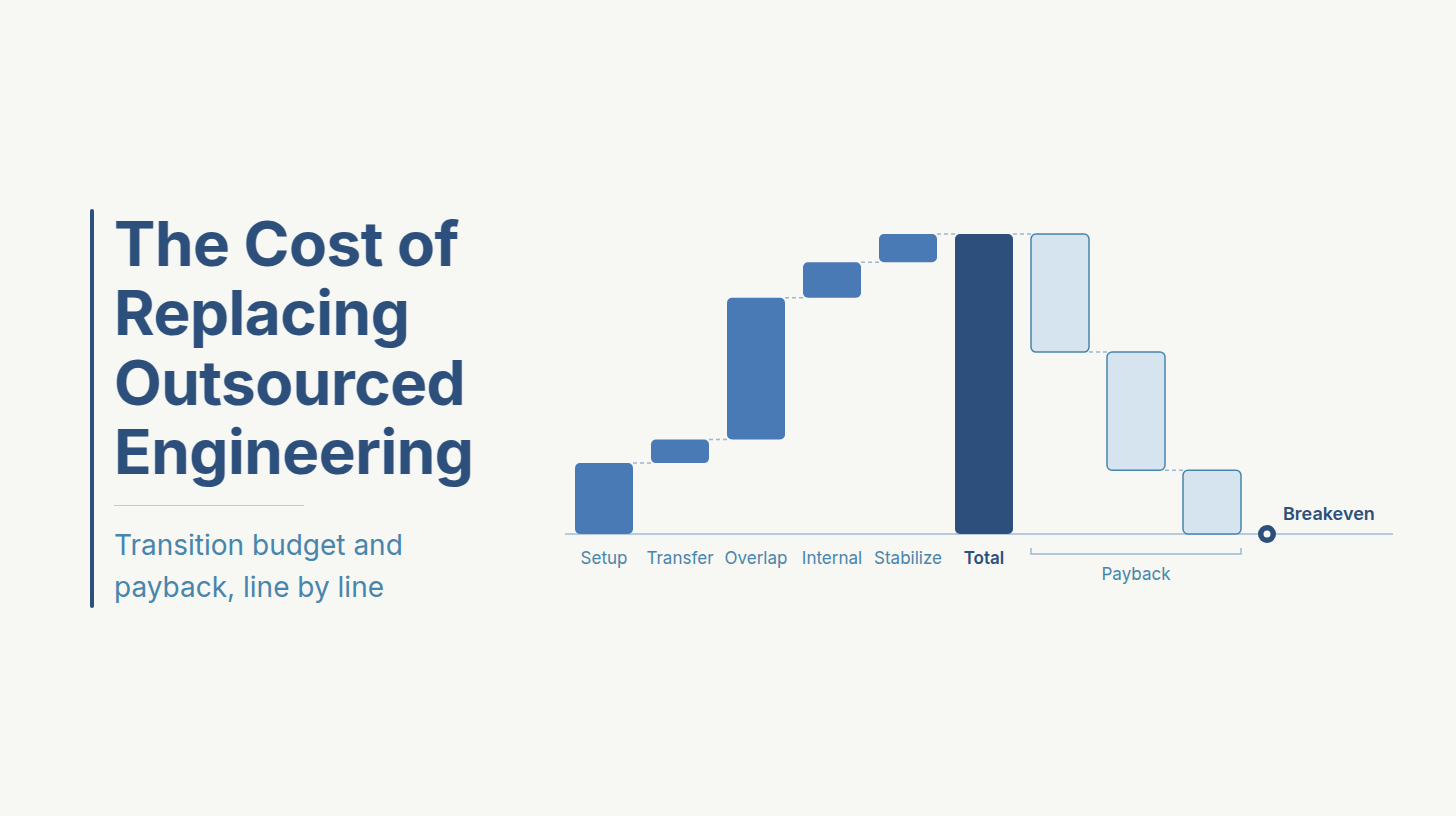
Team size is one input. The metrics that actually determine whether a switch was worth it are cycle time, throughput, QA effort, rework, release frequency, and total delivery cost, measured against your own baseline rather than a vendor's industry-wide claim.
Rework and release frequency are the pair worth watching most closely, because they reveal whether speed came from genuine capability or from cutting corners. The 2025 State of AI-Assisted Software Development report, published by Google Cloud and DORA in collaboration with GitHub based on survey data from nearly 5,000 developers, found that AI adoption now correlates with improved delivery throughput, but continues to correlate with reduced delivery stability wherever teams lack strong automated testing, mature version control, and fast feedback loops. In other words, faster releases that also destabilize production are not the outcome you are buying, no matter how the throughput chart looks.
Total delivery cost is where this connects to ROI, and it is worth being specific about the comparison that actually matters. A deeper framework for structuring that ROI comparison, including how to weigh vendor claims against your own numbers, is covered in Ideas2IT's guide to evaluating an AI implementation partner.
The short version: the comparison that matters is not hourly rate against hourly rate. It is cost per shipped feature, function points delivered per dollar spent, measured before and after the switch on your own numbers.
Once those metrics are defined, the next step is applying them to your current vendor directly, before signing anyone's replacement pitch.
Want a second opinion before your next renewal conversation? Ideas2IT can walk your last four sprint reports against your rate history and tell you, in plain terms, whether the numbers above point toward a delivery-model problem or a one-off rough quarter.
Talk to Ideas2IT about your SDLC numbers
What to Ask Your Existing SDLC Vendor Before You Replace Them
The same five questions apply to your current vendor and to any vendor pitching an AI-native takeover. The answers separate an operating model from a pitch deck.
A vendor, including your current one, that answers all five with specifics has an operating model. A vendor that answers with confidence and no specifics has a pitch. If your current vendor cannot clear this bar, the practical next step is a structured SDLC assessment, which is the first stage of the transition process below, rather than another renewal conversation that ends the same way this one did.
How to Transition From an Outsourced Vendor to an AI-Native Team
Once the decision is made, the switch itself runs through six stages, each with a clear exit point before the next one starts. This is the sequence that turns the evaluation above into an actual delivery model.
Assessment
Before designing a replacement, the incoming team needs an accurate picture of what exists today, not what the vendor's documentation claims exists. That means a codebase and dependency map, a classification of the current backlog into feature work, defect work, and technical debt, and a review of integration points, scheduled jobs, and release practices that are not written down anywhere. This should produce a specific artifact: an application and workflow map the incoming team is accountable to before any code changes hands.
Target Team
Once the assessment is done, the next decision is what the replacement team should actually look like for this specific system, following the backend-versus-frontend split described earlier rather than a generic template. Team size and shape are a consequence of the assessment, not an assumption made before it.
Pilot
This is the stage most vendors try to skip, because a real pilot is where claims get tested against your own codebase instead of a demo environment. A pilot should prove three things: that AI agents can execute against a slice of the actual repository, that a velocity baseline can be measured before and after using your own function points, and that a characterization-test process protects existing behavior in the piloted area before anything ships.
Knowledge Transfer
A pilot that proves out moves into full knowledge transfer. This is where most switches actually fail, not because the new team lacks capability, but because the transfer happens without a defined structure and institutional knowledge gets lost in the handoff. The goal is not to have the new team ready to take over immediately. It is to have them ready to execute representative work under review, while current delivery continues uninterrupted.
Transition
Transition should never be a single cutover date. It moves through named phases, each with an exit gate that has to be met before responsibility moves forward.
Scale
Once full ownership is established, the same governed AI process that ran the transition becomes the standing operating model, with a velocity baseline tracked continuously rather than measured once and forgotten. This is also where structural modernization work, the kind that was likely stalled under the previous vendor's flat backlog and rising technical debt, starts moving again, because the delivery capacity to take it on now exists.
With the framework, the questions, and the transition sequence all covered, the remaining step is applying it to your own system rather than a hypothetical one.
See What Your SDLC Could Look Like With an AI-Native Team
Everything above is a framework for evaluating the decision. The next concrete step is running it against your own system. Ideas2IT can assess your current SDLC, walk your actual backlog through the backend-versus-frontend split described earlier, and design the AI-native team structure, delivery model, and transition plan specific to what you have.
See what your SDLC could look like with an AI-native team
How Ideas2IT Transformed Its Own Software Development Lifecycle
Before offering this model to other organizations, Ideas2IT ran it on itself, and it did not start with a finished platform.
It started around 2021, encountering GitHub Copilot before it was widely adopted, while already running application modernization projects for clients. The early result matched what most teams still see today: a direct copilot-style assistant could get a team to roughly 30 to 35 percent effective productivity gains, with hallucinations and rework eating into the rest. A generated screen might look complete and still hide, for example, six nearly identical tabs implementing the same logic six different ways, which is exactly the "almost right" failure mode developers report in the Stack Overflow data cited earlier in this article.
That gap, between what a raw AI assistant produces and what is actually safe to ship in production, is what led Ideas2IT to build a layer on top of foundation models rather than hand developers a tool and call the job done. That work produced an enterprise context model for representing large, existing codebases accurately, so AI tooling could reason about hundreds of thousands of lines of code instead of hallucinating against them.
It also produced an automated documentation capability for codebases that were never properly documented in the first place, and Anticlock, the platform that runs a deterministic planning layer underneath AI agents rather than letting each agent improvise its own approach to a ticket. A separate test-automation capability, built after commercial alternatives underperformed, has measurably doubled function-point test coverage across the engagements it has been rolled out to.
By Ideas2IT's own internal measurement, this combination produces roughly twice the effective delivery velocity compared to a team using AI as an unmanaged, individual-developer tool, with the exact ratio depending on how backend-heavy or frontend-heavy the work is, consistent with the split described earlier in this article.
That measurement work, along with two acquisitions specifically to bring in senior AI engineering talent, is also why Ideas2IT holds AWS GenAI Specialist Partner status and is recognized as one of a small number of Generative AI competency partners, credentials that matter specifically because they require demonstrating production-grade AI practices, not just AI-adjacent marketing.
Ideas2IT now runs this same AI-SDLC practice as an engagement model for other organizations facing the exact vendor problem described at the start of this article. If the six-stage transition above looks like the right next step, the natural continuation is a working session against your own repository and backlog, structured the same way Ideas2IT's own transformation was: assess honestly, prove it on a real slice of the work, then scale what holds up.
Want the case study? Read the full account of Ideas2IT's own AI-native transformation, or talk to Ideas2IT directly about what a transition engagement would look like for your organization.
Talk to Ideas2IT about a transition engagement
References
- Stack Overflow. "2025 Stack Overflow Developer Survey: AI." https://survey.stackoverflow.co/2025/ai
- Google Cloud and DORA, in collaboration with GitHub. "2025 State of AI-Assisted Software Development Report." https://dora.dev/dora-report-2025/
- Gartner. "Reduce and Manage Technical Debt." https://www.gartner.com/en/infrastructure-and-it-operations-leaders/topics/technical-debt