.avif)
OverviewThe World Health Organization (WHO) reports suggest that the two main routes of transmission of the COVID-19 virus are respiratory droplets and physical contact.Respiratory droplets are generated when an infected person coughs or sneezes. Any person in close contact (within 1 m) with someone who has respiratory symptoms (coughing, sneezing) is at risk of being exposed to potentially infective respiratory droplets.Droplets may also land on surfaces where the virus could remain viable; thus, the immediate environment of an infected individual can serve as a source of transmission (contact transmission). Wearing a medical mask is one of the prevention measures that can limit the spread of certain respiratory viral diseases, including COVID-19.In this study, medical masks are defined as surgical or procedure masks that are flat or pleated (some are shaped like cups); they are affixed to the head with straps. They are tested for balanced high filtration, adequate breathability and optionally, fluid penetration resistance. The study analyses a set of video streams/images to identify people who are compliant with the government rule of wearing medical masks. This could help the government to take appropriate action against people who are non-compliant.ObjectiveTo identify the person on image/video stream wearing face mask with the help of computer vision and deep learning algorithm by using the PyTorch library.Approach1.Train Deep learning model (MobileNetV2)2.Apply mask detector over images / live video streamFlowchart

Data At SourceThe raw images used for the current study were downloaded from PyImageSearch article and the majority of the images were augmented by OpenCV. The set of images were already labeled “mask” and “no mask”. The images that were present were of different sizes and resolutions, probably extracted from different sources or from machines (cameras) of different resolutions.Data PreprocessingPreprocessing steps as mentioned below was applied to all the raw input images to convert them into clean versions, which could be fed to a neural network machine learning model.
- 1.Resizing the input image (256 x 256)
- 2.Applying the color filtering (RGB) over the channels (Our model MobileNetV2 supports 2D 3 channel image)
- 3.Scaling / Normalizing images using the standard mean of PyTorch build in weights
- 4.Center cropping the image with the pixel value of 224x224x3
- 5.Finally Converting them into tensors (Similar to NumPy array)
Deep Learning FrameworksTo implement this deep learning network we have the following options.
- 1.TensorFlow
- 2.Keras
- 3.PyTorch
- 4.Caffee
- 5.MxNet
- 6.Microsoft Cognitive ToolKit
We are using the PyTorch because it runs on Python, which means that anyone with a basic understanding of Python can get started on building their deep learning models.and also it has the following advantage compared with TensorFlow 1. Data Parallelism 2. It looks like a Framework.In PyTorch, I have used the following module to develop the algorithm,
- PyTorch DataLoader - which is used to load the data from the Image Folder
- PyTorch DataSets ImageFolder - which is used to locate the image sources and also have a predefined module to label the target variable.
- Pytorch Transforms - helped to apply the preprocessing steps over the source image while reading from the source folder.
- PyTorch Device - identifies the running system capabilities like CPU or GPU power to train the model. It will help us to switch the system usage.
- Pytorch TorchVision - it will help us to load the libraries which are created before. Like pre-trained models, image sources and so on. It is one of core in PyTorch
- PyTorch nn - it is one of the core modules. This module helps us to build our own Deep Neural Network (DNN) models. It has all the libraries needed to build the model. Like Linear layer, Convolution layer with 1D, conv2d, conv3d, sequence, CrossEntropy Loss (loss function), Softmax, ReLu and so on.
- PyTorch Optim - help us to define the model optimizer. it will help the model to learn the data well. For example Adam, SDG and so on.
- Pytorch PIL - helps to load the image from the source.
- PyTorch AutoGrad - another important module, it provides automatic differentiation for all operations on Tensors. For example, a single line of code .backward() to calculate the gradients automatically. This is very useful while implementing the backpropagation in DNN.
Image Classification Algorithm from PyTorchCNN (Convolutional Neural Network) has many versions of pre-trained and well-architected networks for example AlexNet, ResNet, Inception, LeNet, MobileNet and so on. In our case I have chosen the MobileNetV2 due to its lightweight and very efficient mobile-oriented model.MobileNetV2MobileNetV2 builds upon the ideas from MobileNetV1 [1], using depthwise separable convolution as efficient building blocks. However, V2 introduces two new features to the architecture: 1) linear bottlenecks between the layers, and 2) shortcut connections between the bottlenecks1. The basic structure is shown below.

MobileNetV2 ArchitectureThe typical MobilenetV2 architecture has as many layers listed below, In Pytorch we can use the models library in TorchVision to create the MobileNetV2 model instead of defining/building our own model.The weights of each layer in the model are predefined based on the ImageNet dataset. The weights indicate the padding, strides, kernel size, input channels and output channels.

Why choose MobileNetV2?Based on ImageNet dataset MobileNetV2 outperforms MobileNetV1 and ShuffleNet (1.5) with comparable model size and computational cost. And also it will perform well for the smaller dataset.

Face Mask Detector
Training with Face Mask
As described above I have used the augmented data which is a smaller dataset. I have also applied all the necessary preprocessing requisites applied on the top of source images using the PyTorch transforms, PIL and DataSets.The sample face mask training files look like as below.
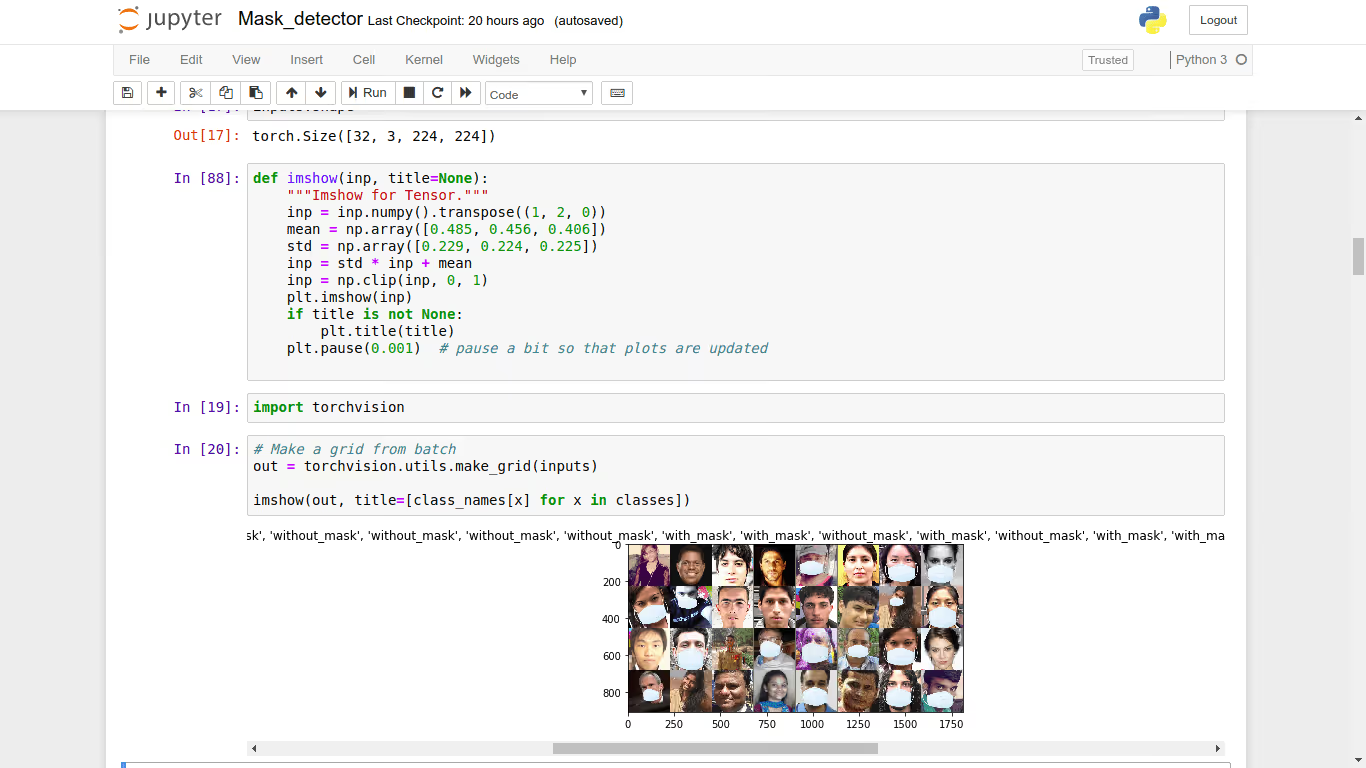
Image 1: Training set example
Model Overwritten
MobileNetV2 was chosen as an algorithm to build a model that could be deployed on a mobile device. A customized fully connected layer which contains four sequential layers on top of the MobileNetV2 model was developed. The layers are
- 1.Average Pooling layer with 7x7 weights
- 2.Linear layer with ReLu activation function
- 3.Dropout Layer
- 4.Linear layer with Softmax activation function with the result of 2 values.
The final layer softmax function gives the result of two probabilities each one represents the classification of “mask” or “not mask”.

Accuracy Overview
The data set has been divided into two sets, likely a training and validation set. The accuracy of image classifier over the training set vs validation.

Image 2: Training vs Validation Accuracy
Test Sample
For the reference I have attached a single image prediction result.

Image 3: Test sample
Face Mask Detection in webcam stream
The flow to identify the person in the webcam wearing the face mask or not. The process is two-fold.1.To identify the faces in the webcam2.Classify the faces based on the mask
Identify the Face in the Webcam
To identify the faces a pre-trained model provided by the OpenCV framework was used. The pre-trained model is based on Single-Shot-Multibox Detector (SSD) and employs a ResNet-10 Architecture as the backbone. The model was trained using web images. OpenCV provides 2 models for this face detector:1.Floating-point 16 version of the original Caffe implementation.2.8 bit quantized version using TensorflowIn this example I have used the Caffe model in this face mask detector.
SSD Basic Architecture
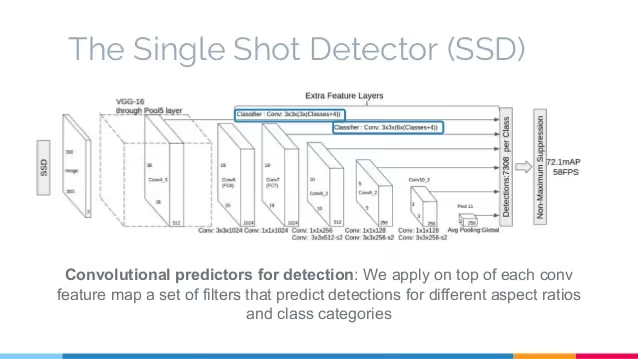
Single-shot MultiBox Detector is a one-stage object detection algorithm. This means that, in contrast to two-stage models, SSDs do not need initial object proposals generation step. This makes it, usually, faster and more efficient. This model will return the array of faces detected on the video frame.
Face Mask Classifier
Subsequent to face detection, the mask detector model was used to identify the frame face covered by mask or not. The flow of this process described in the image below.

Face Mask identification on Stream
The testing video has been attached here.
Use Cases
Here are a few use cases where this mask detection technology could be leveraged.AirportsThe Face Mask Detection System could be used at airports to detect travelers without masks. Face data of travelers can be captured in the system at the entrance. If a traveler is found to be without a face mask, their picture is sent to the airport authorities so that they could take quick action.

HospitalsUsing Face Mask Detector System, Hospitals can monitor if quarantined people required to wear a mask are doing so or not. The same holds good for monitoring staff on duty too.

Offices & Working SpacesThe Face Mask Detection System can be used at office premises to ascertain if employees are maintaining safety standards at work. It monitors employees without masks and sends them a reminder to wear a mask.

GovernmentTo limit the spread of coronavirus, the police could deploy the face mask detector on its fleet of surveillance cameras to enforce the compulsory wearing of face masks in public places.

Conclusion
The current study used OpenCV, Pytorch and CNN to detect whether people were wearing face masks or not. The models were tested with images and real-time video streams. Even though the accuracy of the model is around 60%, the optimization of the model is a continuous process and we are building a highly accurate solution by tuning the hyperparameters. MobileNetV2 was used to build the mobile version of the same. This specific model could be used as a use case for edge analytics.